Fire-Resistant Rock Wool Sandwich Panels for a Logistics Warehouse in Peru: A Case Study
When a logistics warehouse owner in Peru needed an envelope system that could meet strict fire safety codes, resist a demanding industrial environment, and conform to a curved architectural design, standard products simply weren't an option. This case study explains how Henan Tseason Panel Co., Ltd. delivered a custom rock wool sandwich panel solution that exceeded every target—and what other logistics facility owners and EPC contractors can learn from it.
Project Overview
| Detail | Specification |
|---|---|
| Location | Peru, South America |
| Client Type | Logistics warehouse project owner |
| Annual Panel Volume | ~10,000 m² |
| First Cooperation | August 2024 |
| Core Product | Fire-resistant rock wool sandwich panels |
The client operates an active logistics facility where fire risk, chemical exposure from goods handling, and architectural aesthetics all demanded a highly engineered panel choice—not a commodity product.
The Technical Challenge: Four Requirements That Had to Work Together
Most suppliers can meet one or two performance targets. This project required all four simultaneously:
- ≥120-minute fire resistance rating — a code and insurance requirement for logistics facilities storing mixed goods
- Corrosion and oxidation resistance — to withstand the humidity and chemical exposure typical of active warehousing environments
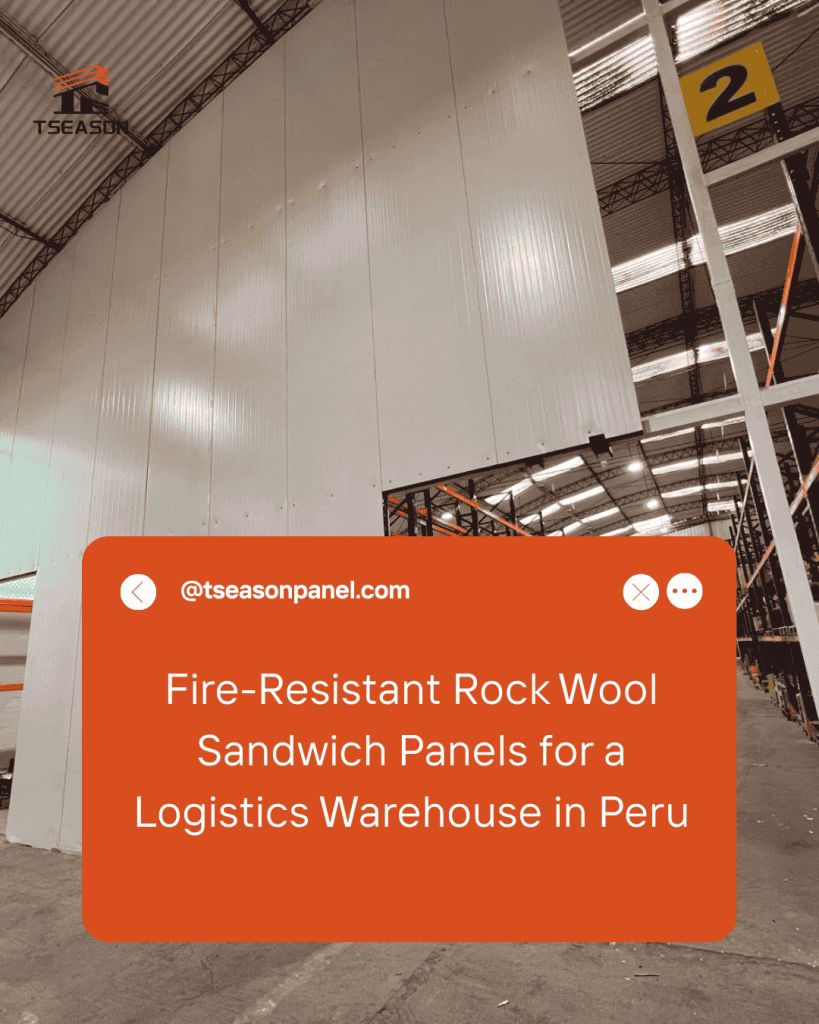
- Custom curved panel cutting — the building's façade featured curved sections requiring precise, radius-matched panels
- Clear, site-ready installation guidance — the local construction team needed drawings and manuals accurate enough to minimize on-site errors
The Solution: High-Density Rock Wool Core + Aluzinc Steel Facing
Core Material: 100 kg/m³ Rock Wool at 100 mm Thickness
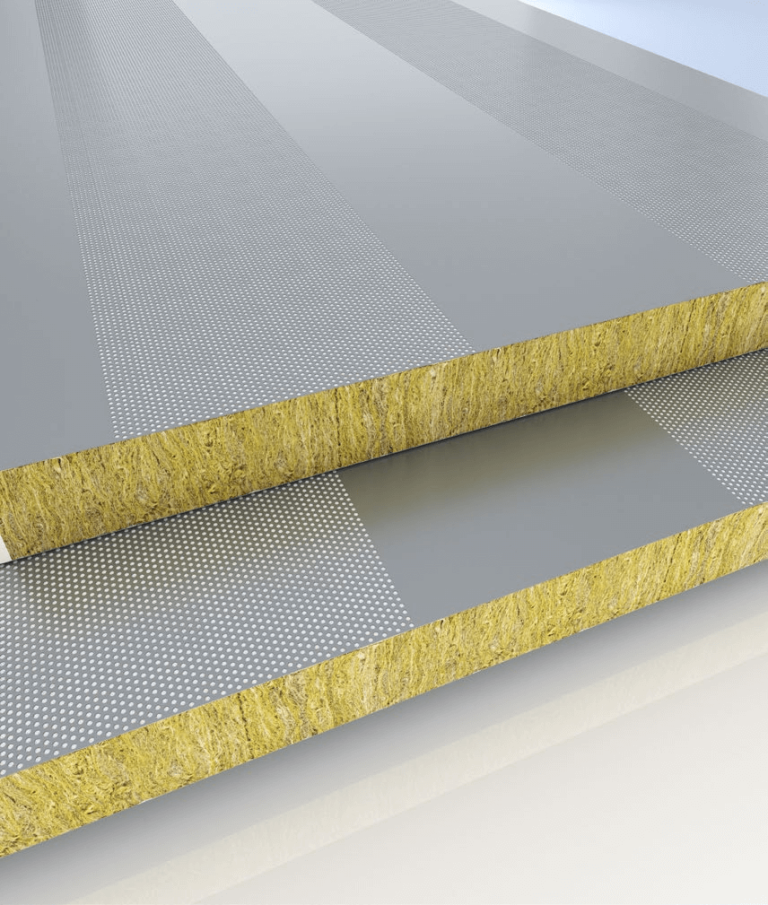
Rock wool is a non-combustible mineral fiber derived from basalt. At a thickness of 100 mm and a density of 100 kg/m³, rock wool sandwich panels are independently verified to achieve a fire resistance of 120 minutes (REI 120 / EI120). Rock wool itself can withstand temperatures exceeding 1,000°C without melting or releasing flammable gases, making it the correct specification choice when the fire target is 120 minutes or more.
For this project, panels were tested and independently verified by local Peruvian testing to achieve 125 minutes of fire resistance—exceeding the original project requirement by 5 minutes [from project Q&A].
Facing Material: Aluminum-Zinc (Aluzinc) Coated Color Steel
The steel facings were specified as aluminum-zinc coated (Aluzinc/Galvalume) with an additional protective topcoat. Aluzinc steel outperforms standard galvanized steel at a rate of 2 to 4 times the service life in corrosive environments because it combines the sacrificial galvanic protection of zinc with the long-term barrier resistance of aluminum. In acidic, alkaline, or high-humidity warehouse conditions, this facing selection is critical for preserving structural integrity and appearance over decades of use.
Rock wool's chemical stability as an inorganic, non-hygroscopic material further supports long-term performance: it does not absorb moisture or corrode, and it does not support biological growth.
Custom Fabrication: Curved Panel Cutting
Logistics facilities increasingly integrate curved or arched façade elements for both structural efficiency and architectural identity. Standard sandwich panels are flat; curved sections require precise off-factory cutting to client-specified curvature parameters.
Tseason manufactured panels with custom arc-cut profiles matched to the building's curvature design, with different cutting geometries for different panel lengths and installation positions. The result:
- Smooth, continuous curvature across the façade
- Accurate panel-to-panel dimensions at every joint
- Clean, weathertight joints after installation
This capability is not universally offered and often determines whether a façade project is realistically achievable without costly site rework.
Installation Support: Drawings, Manuals, and Critical Joint Details
Getting panels to site correctly manufactured is only half the job. Incorrect installation—poor vapor sealing, improper fastener torque, unsealed penetrations—can undermine performance even with premium materials.
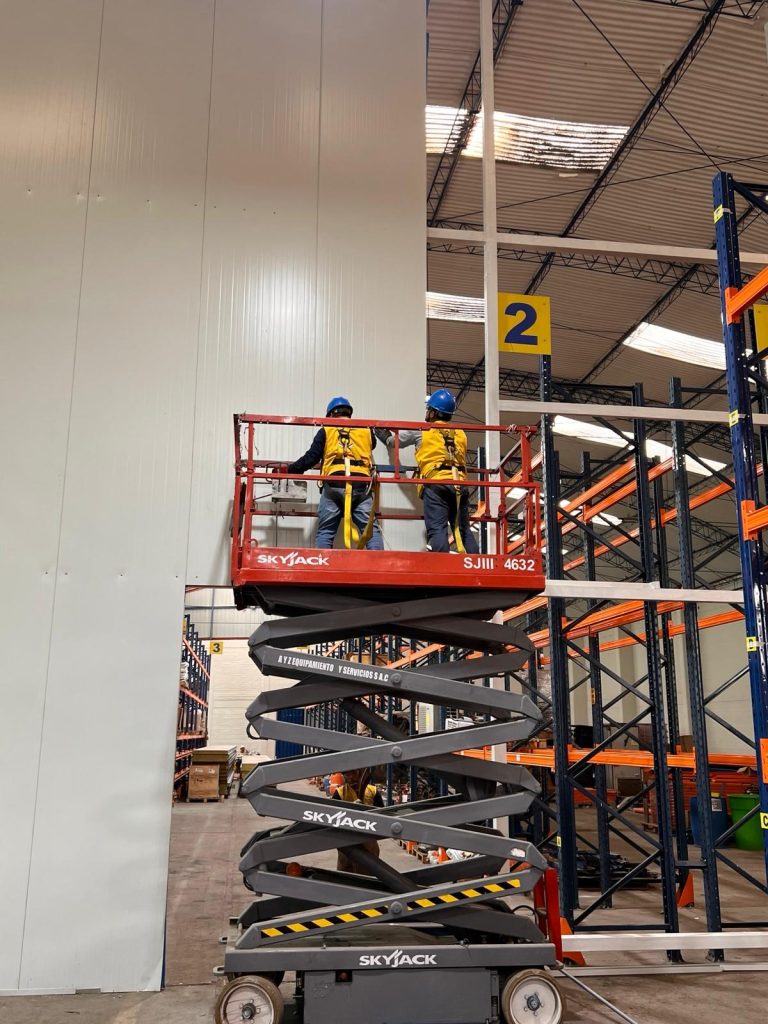
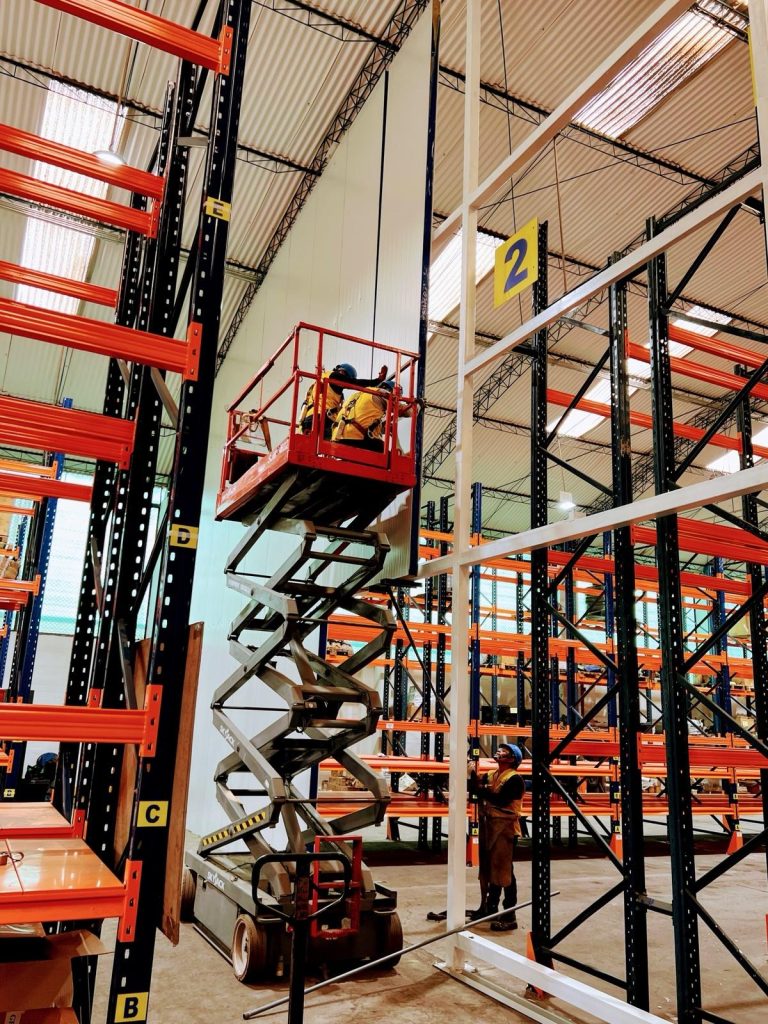
Tseason supported the Peruvian project team with:
- Detailed installation manuals: step-by-step instructions covering panel layout, fastener sequence, and joint sealing
- Custom installation detail drawings: specifically for complex or critical joints where standard instructions were insufficient
- Standardized site process: reducing improvisation and on-site decision-making that typically causes installation errors
The outcome: installation time was reduced by approximately 15% compared to the client's original schedule estimate.
Results: Independent Testing Confirms Performance
After installation, the client commissioned independent local testing to verify fire performance. Results:
| Performance Criterion | Target | Achieved |
|---|---|---|
| Fire resistance | ≥120 minutes | 125 minutes |
| Corrosion | None | No corrosion observed |
| Oxidation/deformation | None | No oxidation or deformation |
| Curved façade appearance | Match design | Intended effect achieved |
| Installation schedule | Baseline | ~15% time reduction |
The client confirmed satisfaction with both product performance and technical service throughout the project.
Why Rock Wool Panels Are the Right Choice for Logistics Warehouses
Logistics facilities present a demanding set of panel requirements that polyurethane (PU/PIR) panels often cannot fully satisfy:
For logistics and industrial buildings where fire code requires REI 60, REI 90, or REI 120, rock wool is the technically correct specification. PU/PIR remains the right choice for cold storage where low lambda and vapor resistance are the primary drivers.
What This Means for Your Project: Key Specification Decisions
If you are specifying or procuring sandwich panels for a logistics warehouse or industrial building:
1. Define your fire resistance target first.
120-minute ratings require a minimum of 100 mm thickness at adequate density. Confirm this with your local building code and insurer before specifying thickness.
2. Specify density alongside thickness.
A 100 mm panel at 80 kg/m³ performs differently from one at 100 kg/m³. Specify both parameters in your BOM or procurement inquiry.
3. Match the steel facing to your environment.
Standard galvanized facings are adequate for dry, mild climates. For coastal, humid, or industrial chemical environments, specify Aluzinc or PVDF-coated facings for a corrosion life of 30–50 years.
4. Plan for non-standard geometry early.
Curved or shaped panels require curvature parameters before production begins. Late design changes to panel geometry are expensive and cause schedule delays.
5. Request installation drawings, not just panels.
A complete supply package includes panel layout drawings, fastener schedules, joint details, and penetration sealing instructions. These prevent the majority of on-site assembly errors.
About Tseason Panel: Technical Capabilities Behind This Project
Henan Tseason Panel Co., Ltd. is a Chinese manufacturer with nearly 30 years of experience supplying sandwich panels, steel structures, and modular building systems to global markets. For this Peru project, the relevant capabilities included:
- Rock wool panel manufacturing with controlled density production (verified 100 kg/m³ core) meeting Class A non-combustible fire classification
- Aluzinc steel facing processing with anti-corrosion topcoat options for harsh environments
- Custom cutting and fabrication: radius/arc cuts, tapered panels, and non-standard profiles matched to client drawings
- Technical documentation: engineered installation manuals and detail drawings provided as part of the supply package
- International export experience: panels packed and shipped to Latin America with zone-coded labeling to simplify site handling
Tseason holds ISO 9001, ISO 14001, OHSAS 18001, CE, GOST, and SGS certifications, providing third-party verification of quality systems and product compliance for international project procurement.
Frequently Asked Questions (FAQ Schema-Ready)
What fire resistance rating do rock wool sandwich panels achieve?
At 100 mm thickness, a rock wool panel with density of 100 kg/m³ achieves approximately 120 minutes of fire resistance (REI 120/EI120), as verified by independent testing. Thinner panels (50 mm, 75 mm) achieve 30 and 60 minutes respectively.
Why use rock wool instead of polyurethane in a logistics warehouse?
Rock wool is a Class A1 non-combustible material with fire resistance ratings of 120 minutes or more, making it the appropriate specification for logistics, industrial, and regulated-use buildings. Polyurethane panels offer superior thermal insulation but are combustible and are not suitable where 90+ minute fire ratings are required.
What panel thickness is needed for a 120-minute fire rating?
A 100 mm thick rock wool panel at approximately 100 kg/m³ density consistently achieves 120-minute fire resistance. Density and thickness together determine the rating—confirm with your supplier's test documentation.
Can rock wool sandwich panels be cut to curved profiles?
Yes—panel manufacturers with precision CNC cutting capability can produce arc-cut panels to client-specified curvature parameters. This is critical for buildings with arched or curved facades and must be specified before production begins.
What does Aluzinc steel facing offer compared to standard galvanized steel?
Aluzinc (aluminum-zinc alloy coated) steel offers 2–4x the corrosion resistance of standard galvanized steel, with a projected service life of 30–50 years in harsh environments. It is the preferred facing material for industrial and coastal applications.
How do I verify panel performance when sourcing from China?
Request test certificates aligned to EN, GB, or ASTM standards for fire rating, foam density, and coating specification. For critical projects, arrange third-party pre-shipment inspection (e.g., SGS, Bureau Veritas) and retain independent local testing after installation as the final performance verification.
Ready to specify fire-resistant rock wool sandwich panels for your logistics or industrial project?
Contact Tseason Panel's engineering team to discuss fire resistance requirements, façade geometry, and technical documentation for your specific application.