EN 13501-1 vs. GB 8624: Technical Comparison for Sandwich Panel Procurement
A procurement engineer is reviewing fire specifications for a new industrial warehouse project. One supplier quotes their panels as "Class A2-s1,d0," while another supplier quotes "Grade A (GB 8624)." Both suppliers claim their materials are fire-safe and project-ready. The question for the procurement team is: are these two classifications structurally the same?
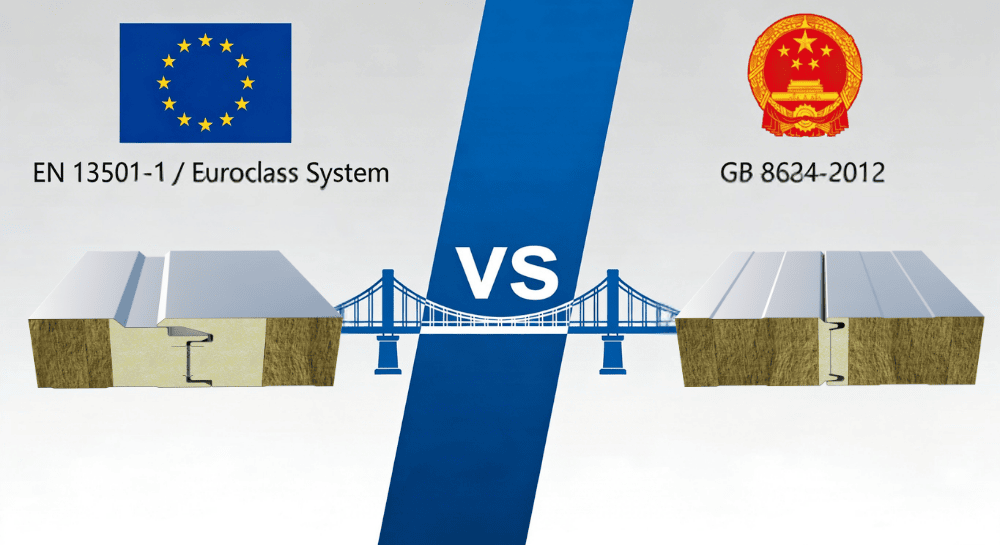
What is the difference between EN 13501-1 and GB 8624? EN 13501-1 and GB 8624 do not produce exactly equivalent results for sandwich panels, as they utilize different classification structures. The key structural difference is that EN 13501-1 evaluates and sub-classifies smoke production and flaming droplets separately, whereas GB 8624 utilizes a combined single-letter grade without sub-classification for smoke and droplets. [Source: casfiretec.com EN13501_1 comparison page].
What Is EN 13501-1 and Why It Matters for Sandwich Panels
EN 13501-1 is a fire safety standard published by the European Committee for Standardization (CEN) that classifies the reaction to fire of construction products. [Source: EN 13501-1:2018]. The current version governing these evaluations is EN 13501-1:2018+A1:2019. [Source: EN 13501-1:2018]. This standard is heavily utilized across the European Union and in international export markets to establish uniform safety benchmarks.
One of the most critical distinctions in building materials is understanding reaction to fire versus fire resistance. Reaction to fire evaluates how a material contributes to the development and spread of a fire, whereas fire resistance measures how long a structural element can withstand fire exposure before failing. EN 13501-1 specifically measures the reaction to fire. [Source: EN 13501-1:2018].
The Euroclass system is a standardized framework used within EN 13501-1 to categorize building materials from A1 (non-combustible) to F (undetermined performance). [Source: EN 13501-1:2018]. Under EN 13501-1, Class A1 designates non-combustible materials, while Class A2 indicates limited combustibility with controlled smoke and droplet behavior. [Source: EN 13501-1:2018].
| Euroclass | Combustibility | Example Materials |
| A1 | Non-combustible | Mineral wool, concrete |
| A2 | Limited combustibility | Gypsum boards (some grades) |
| B | Very limited fire contribution | |
| C | Limited fire contribution | |
| D | Acceptable fire contribution | |
| E | Acceptable reaction to fire | |
| F | No performance determined |
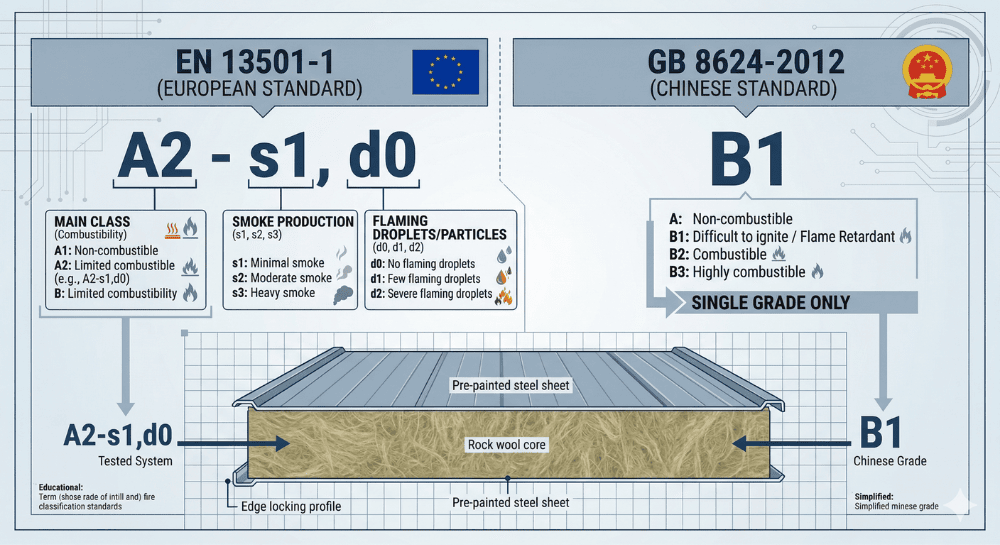
Beyond the primary letter grade, EN 13501-1 provides granular data on secondary fire hazards. The standard evaluates smoke production through sub-classes s1, s2, and s3, where s1 represents the lowest smoke emission. [Source: EN 13501-1:2018]. It evaluates flaming droplets through sub-classes d0, d1, and d2, where d0 indicates no flaming droplets occur. [Source: EN 13501-1:2018].
For a practical example, the classification A2-s1,d0 indicates that a sandwich panel has limited combustibility (A2), emits very little smoke (s1), and produces no flaming droplets (d0). [Source: EN 13501-1:2018].
Section Takeaway: Under EN 13501-1, sandwich panels are evaluated comprehensively, detailing not just baseline combustibility but also exact smoke emission and droplet formation behaviors.
What Is GB 8624 and How It Classifies Building Materials
GB 8624 is a Chinese national standard for the fire classification of building materials and products, issued by the General Administration of Quality Supervision, Inspection and Quarantine (AQSIQ) and the Standardization Administration of China (SAC). [Source: Code of China / chinesestandard.net]. The current version is GB 8624-2012, which superseded the previous GB 8624-2006 standard and became effective on October 1, 2013. [Source: Code of China / chinesestandard.net].
Historically, the GB 8624 standard was based on the German standard DIN 4102-1:1981. [Source: GB 8624-2012 standard preface]. The classification system categorizes materials into four primary grades: A (non-combustible), B1 (flame-retardant), B2 (combustible), and B3 (highly combustible). [Source: GB 8624-2012].
The primary structural divergence between the two standards lies in how secondary hazards are reported. GB 8624 uses a combined single-letter grade without sub-classification for smoke and droplets. [Source: casfiretec.com EN13501_1 comparison page]. To determine these grades, GB 8624-2012 references several specific test methods, including GB/T 5464 for non-combustibility, GB/T 20284 for the Single Burning Item (SBI) test, and GB/T 8626 for ignitability. [Source: GB 8624-2012].
| GB 8624 Grade | English Description | Approx. EN 13501-1 Equivalent |
| A | Non-combustible | A1 / A2 (approximately) |
| B1 | Flame-retardant | B or C (approximately) |
| B2 | Combustible | D or E (approximately) |
| B3 | Highly combustible | F |
Equivalences shown are approximate. Direct substitution of one standard for another in a project specification requires verification with the relevant certifying authority. [Source: fire-test.com, GB 8624-2012 standard preface]
Section Takeaway: GB 8624 provides a streamlined, single-tier grading system that broadly categorizes materials into four levels of combustibility without appending isolated smoke and droplet data.
Key Differences — EN 13501-1 vs. GB 8624 Side by Side
Part 1 — Scope and granularity:
The most visible difference during procurement is the depth of the classification code. EN 13501-1 evaluates heat release, smoke production, and flaming droplets/particles separately as distinct sub-classifications. [Source: casfiretec.com EN13501_1 comparison page]. In contrast, GB 8624 produces a single combined letter grade. This means two products with the same GB 8624 letter grade can have very different smoke generation behaviors in a real fire scenario.
Part 2 — Test method alignment:
Despite structural reporting differences, the testing methodologies share common ground. GB 8624-2012 references several test methods that align closely with European methods, such as the SBI test and ISO 5660 parameters. The 2012 revision increased compatibility with EN 13501-1 compared to earlier versions of the Chinese standard. [Source: GB 8624-2012 standard preface]. GB 8624 A is roughly equivalent to EN 13501-1 A1 or A2. [Source: fire-test.com / GB 8624-2012 standard text]. Furthermore, GB 8624 B1 is roughly equivalent to EN 13501-1 B or C. [Source: fire-test.com].
Part 3 — Market acceptance:
Geographic jurisdiction dictates which standard a procurement engineer must satisfy. EN 13501-1 is required for CE marking and is mandatory across EU construction projects. Conversely, GB 8624 is the mandatory standard for building projects executed within mainland China. For export projects heading to the EU, Middle East, or Southeast Asia, EN 13501-1 compliance is typically demanded by local building codes and rigorous project specifications.
| Dimension | EN 13501-1 | GB 8624-2012 |
| Issuing body | CEN (European) | AQSIQ/SAC (China) |
| Current version | EN 13501-1:2018+A1:2019 | GB 8624-2012 |
| Classification grades | A1, A2, B, C, D, E, F | A, B1, B2, B3 |
| Smoke sub-class | Yes (s1/s2/s3) | No |
| Droplets sub-class | Yes (d0/d1/d2) | No |
| Approx. A1 equivalent | EN A1 | GB A |
| Required for CE marking | Yes | No |
| Used in | EU + many export markets | Mainland China |
[IMAGE 3]
Alt text: EN 13501-1 vs GB 8624 structural comparison — sub-classification vs single-grade fire rating system
AI Image Prompt: A B2B technical comparison infographic. Two columns. Left column header: EN 13501-1 (EU flag icon). Shows three-level code: main class + smoke + droplets. Right column header: GB 8624-2012 (China). Shows single letter grade only. Below both columns: a rock wool sandwich panel cross-section. Arrows point to the panel from each standard label. Clean technical diagram, blue and gray tones, no people.
Filename: en13501-vs-gb8624-fire-rating-structure-comparison.jpg
Section Takeaway: While the test methods share technical similarities, EN 13501-1 provides a more granular classification system that remains mandatory for CE marking and most international specifications.
Fire Resistance vs. Reaction to Fire — The Distinction That Changes Everything in Sandwich Panel Specification
A common error in sandwich panel specification is confusing the reaction to fire standard (EN 13501-1) with the fire resistance standard (EN 13501-2). Reaction to fire dictates how a material contributes to a fire in its early stages. In contrast, fire resistance evaluates how long a fully assembled structural element resists a developed fire and prevents it from spreading to adjacent zones.
Under the European framework, fire resistance is expressed using the REI notation. REI notation defines a building element's performance across three parameters: structural load capacity (R), flame and gas integrity (E), and thermal insulation (I). [Source: EN 13501-2:2016]. These metrics are assigned time values in minutes, such as 30, 60, 90, or 120. [Source: EN 13501-2:2016].
For instance, an REI 30 rating means the panel maintains structural stability, stops flames, and insulates against heat transfer for a minimum of 30 minutes. Often, building codes require both certifications on the exact same project. A warehouse wall may require a Class A2 reaction to fire to prevent ignition, alongside an REI 60 fire resistance rating to ensure safe occupant evacuation if a fire occurs elsewhere in the building.
Section Takeaway: Reaction to fire evaluates how a sandwich panel burns, whereas fire resistance measures how long that panel functions as a barrier against a fully developed structural fire.
What These Standards Mean When You’re Buying Sandwich Panels
When evaluating sandwich panel proposals, procurement teams must carefully dissect the supplier's fire certification claims. The first step is identifying which standard and version year is cited on the document. Next, verify that the tested product configuration perfectly matches your specification, paying close attention to the core material type, core thickness, and steel grade.
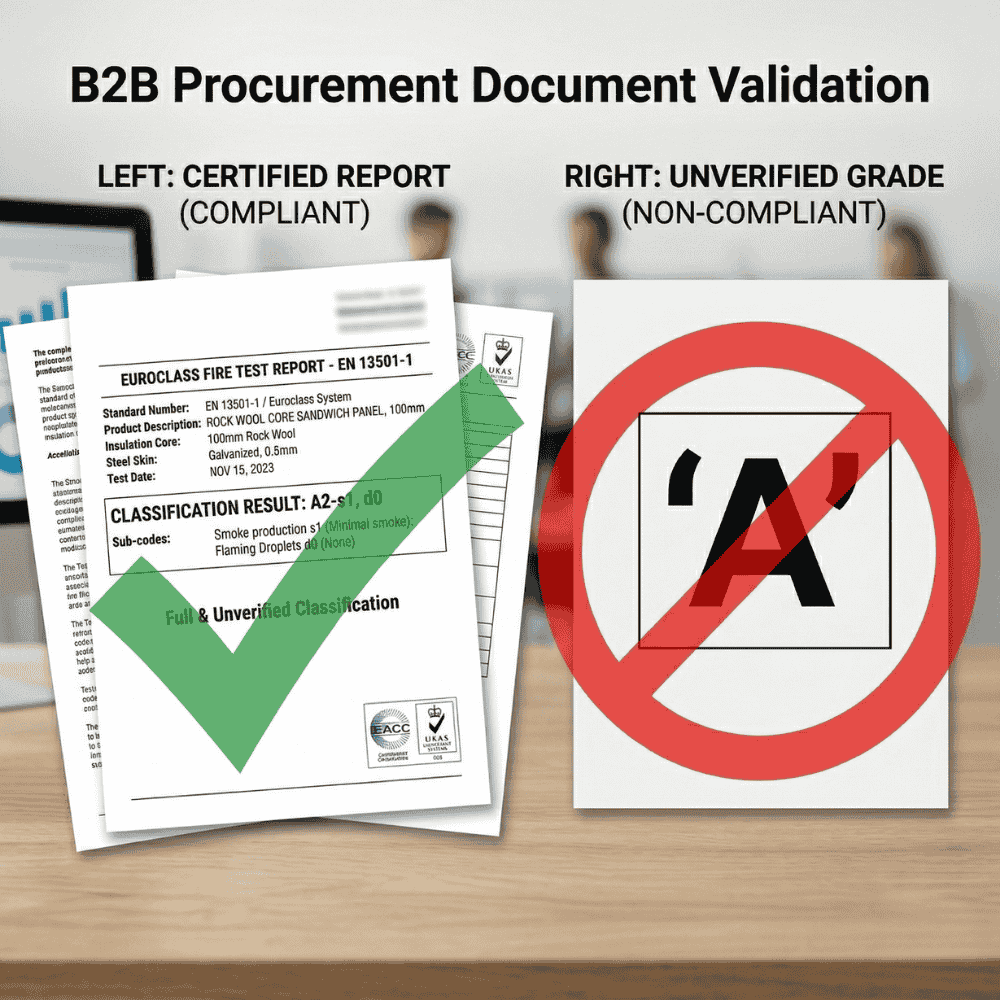
Buyers should watch for several common red flags during the documentation review. A certificate issued for a different panel thickness or core density than what is being quoted is invalid for your project. Similarly, claims of "Grade A" that lack a specific standard reference, or EN 13501-1 claims that omit the necessary "s" and "d" sub-classifications, indicate incomplete testing. Procurement engineers must also verify that the provided test reports have not passed their validity period.
To ensure compliance, buyers must request specific documents from the manufacturer. You should mandate the full laboratory test report rather than a single-page certificate summary. For products entering the European market, request the official Declaration of Performance (DoP) required for CE-marked materials. Finally, require a batch-level factory inspection report to confirm that the production run matches the tested prototype.
Section Takeaway: Accurate procurement requires verifying that the supplier's full test report matches the exact standard year, product configuration, and sub-classification demanded by the project specification.
How Tseason’s Rock Wool Sandwich Panels Are Certified
To demonstrate how these standard requirements apply to a manufactured product, we can examine the technical data of Tseason's PU edge-sealed rock wool sandwich panel. Tseason utilizes a 100 kg/m³ high-density hydrophobic rock wool core for these panels. Rock wool core panels typically achieve an A1 or A2 rating under the European framework. [Source: panelsandwich.org / Rockwool technical guide EN].
Specifically, this panel configuration achieves a reaction to fire rating of EN 13501-1: A2-s1,d0. [Source: Tseason technical data]. As decoded previously, the A2-s1,d0 classification indicates limited combustibility, minimal smoke emission, and zero flaming droplets. For fire resistance, the panels deliver performance of REI ≥ 30 min (EI30).
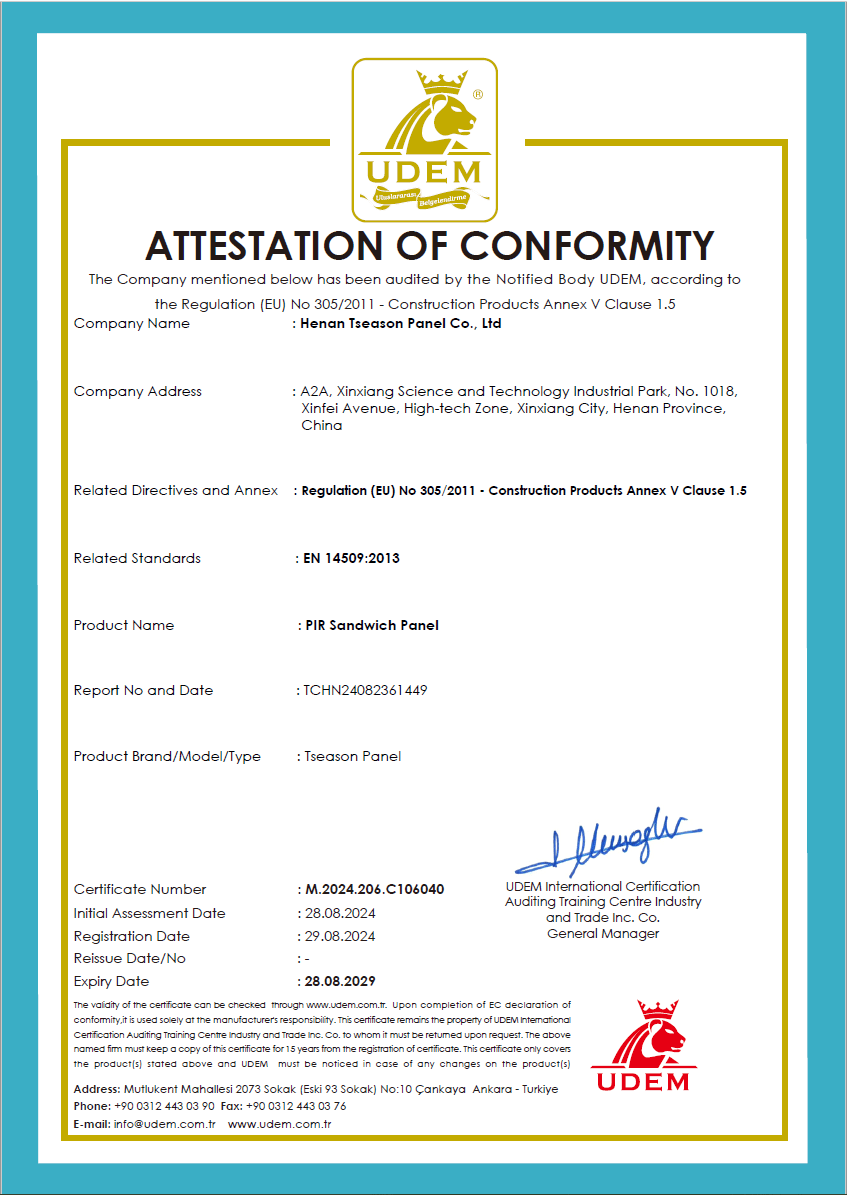
The panels are CE certified and compliant with EN 14509:2013, manufactured under an ISO 9001 certified quality management system. [Source: Tseason technical data]. Core material integrity is maintained through rigorous controls, achieving a fiber uniformity of ≥ 95% and water repellency of ≥ 98%. [Source: Tseason technical data]. Furthermore, a factory inspection report is provided with each production batch. [Source: Tseason technical data].
The above configuration directly addresses the verification points outlined in the previous section—standard reference, product-specific test configuration, sub-classification, and batch-level documentation.
Conclusion
Understanding the structural differences between EN 13501-1 and GB 8624 matters most when certifications from different markets are being compared or when a project specification references only one system. While both evaluate combustibility, the granular smoke and droplet data provided by EN 13501-1 makes it distinct from the single-tier GB 8624 approach.
If your project requires EN 13501-1 compliance for sandwich panels—whether for CE marking, export documentation, or project specification verification—Tseason's team can provide full test report packages, DoP documents, and product configuration confirmation matched to your specification. Share your required fire class, panel application, and project location to start the review.
Data Source Reference List
- [Source: EN 13501-1:2018] | EN 13501-1:2018+A1:2019 Fire classification of construction products and building elements | 2018/2019 | European Committee for Standardization (CEN)
- [Source: GB 8624-2012] | GB 8624 Classification for burning behavior of building materials and products | 2012 | AQSIQ / SAC
- [Source: panelsandwich.org / Rockwool technical guide EN] | Rockwool technical guide | N/A | panelsandwich.org