Imagine you are a procurement manager reviewing two construction quotes for a new 5,000 m² factory. A colleague suggests brick masonry — "it's the traditional choice." Before signing, you decide to run the numbers. What you find changes the conversation entirely.
Brick masonry is not actually cheaper. For a complete industrial factory — foundation, structure, walls, roof, and finishing — a steel structure with rock wool sandwich panels costs 15–25% less to build than a comparable brick masonry factory (HIG House, 50-project global study, 2024). And that is before accounting for energy bills and maintenance over the next 30 years.
This article presents a structured 30-year Total Cost of Ownership (TCO) model based on conservative industry estimates and published data. All assumptions are declared upfront. You are encouraged to substitute your own regional figures.
Data Disclaimer: All figures are conservative industry estimates or ranges from published sources. Exchange rate: 1 USD = 6.90 CNY (Wise / Fed H.10, March 2026). Cost ranges reflect a 5,000 m² light-industrial factory reference model. Contact Tseason Panel for project-specific pricing.
Calculation Assumptions
Parameter
Value
Basis
Building type
5,000 m² light-industrial factory, single story, 8m clear height
Representative baseline
Cost basis
Complete turnkey factory per m² of floor area (foundation + structure + envelope + basic MEP)
Apples-to-apples comparison
Climate zone
Northern China Zone II (Beijing-equivalent)
GB 50176
HDD18
~2,700
Beijing published climate data
CDD26
~450
Beijing published climate data
Electricity price
$0.10/kWh
China industrial average; global range $0.06–0.35 (see regional table)
Annual inflation
3% compound
Conservative long-run estimate
HVAC COP
3.0
Conservative mid-range
Rock wool panel U-value (100mm)
~0.40 W/m²·K
λ ≤ 0.043 W/m·K per GB/T 17393
Brick wall U-value (240mm + plaster)
~1.8–2.0 W/m²·K
Per GB 50176
Exchange rate
1 USD = 6.90 CNY
Wise / Fed H.10, March 2026
Section 1: Initial Construction Cost — Why Panels Cost Less to Build
The comparison must be made at the whole-building level, not the wall panel level in isolation. When you price a complete turnkey industrial factory — including foundation, structural frame, wall and roof systems, and basic finishing — the cost advantage shifts decisively toward the steel structure with rock wool sandwich panels.
Why Brick Masonry Factories Cost More
There are four structural reasons why a brick masonry factory carries a higher total construction cost than an equivalent steel-panel factory:
1. Foundation premium: Brick masonry walls weigh approximately 180–250 kg/m², compared to just 12–15 kg/m² for rock wool sandwich panels. For a 5,000 m² factory with ~2,300 m² of exterior walls, this weight difference requires substantially deeper, wider reinforced concrete footings and tie beams — adding ¥80–140/m² of floor area to foundation cost alone (conservative industry estimate).
2. Seismic reinforcement: Chinese seismic code (GB 50011) requires brick masonry factories in most regions to incorporate reinforced concrete tie columns, ring beams, and lintels at regular intervals. This reinforcement adds material and labor cost with no thermal or functional benefit. Steel portal frames inherently meet seismic requirements without additional reinforcement.
3. Mandatory insulation: Per GB 50189-2015 (Design Standard for Energy Efficiency of Public Buildings), industrial buildings in Northern China must meet minimum thermal envelope requirements. Brick walls alone fail this standard. Adding a compliant external insulation composite system (EICS) costs an additional ¥60–100/m² of wall area — approximately ¥33–55/m² of floor area for this building (conservative estimate). Rock wool sandwich panels meet GB 50189-2015 requirements directly, with no supplementary insulation needed.
4. Finishing labor: Brick walls require plastering on both faces plus exterior paint — a labor-intensive process requiring skilled tradespeople. In China's current labor market, plastering and painting for a 2,300 m² exterior wall adds approximately ¥25–45/m² of floor area (conservative estimate). Rock wool sandwich panels are factory pre-finished; no site plastering or painting is required.
Complete Factory Cost Comparison
(Per m² of floor area, 5,000 m² factory, China reference market 2024, conservative industry estimates)
Cost Component
Brick Masonry Factory (¥/m²)
Steel + Panel Factory (¥/m²)
Notes
Foundation
¥120–180
¥70–110
Brick walls 12–17× heavier
Primary structure
¥150–220 (RC frame + brick)
¥130–180 (steel portal frame)
Steel prefabricated, faster erection
Seismic tie columns / RC reinforcement
¥40–70
¥0
Not required for steel structure
Wall + roof system
¥80–120 (brick) + ¥60–100 (EICS insulation per GB 50189)
¥120–180 (rock wool sandwich panels)
Panels meet GB 50189-2015 directly
Finishing (plaster + paint)
¥50–80
¥0
Panels factory pre-finished
Doors, windows, drainage
¥30–50
¥30–50
Comparable
Total per m² floor area
¥480–720
¥350–520
Conservative industry estimate
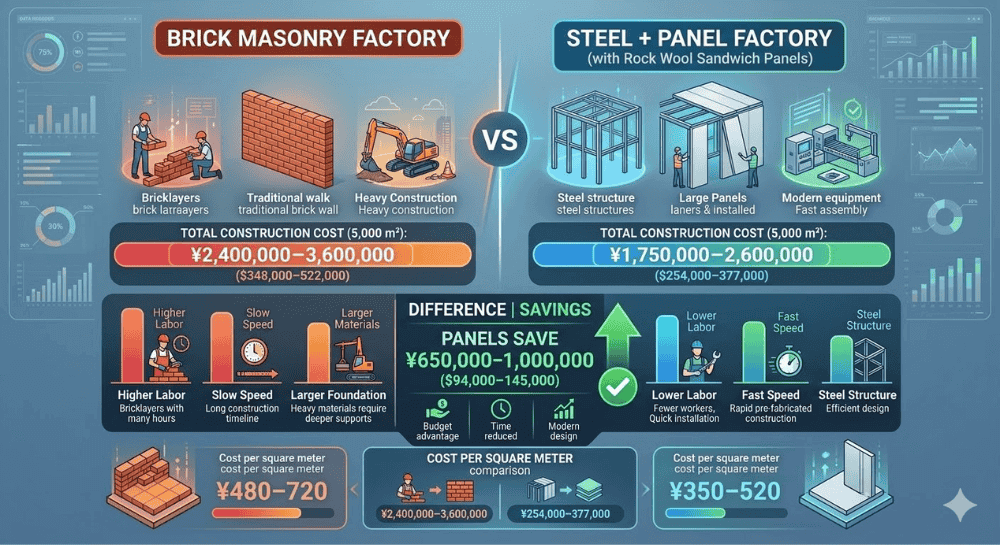
For the complete 5,000 m² factory:
Brick Masonry Factory
Steel + Panel Factory
Difference
Total construction cost
¥2,400,000–3,600,000 ($348,000–522,000)
¥1,750,000–2,600,000 ($254,000–377,000)
Panels save ¥650,000–1,000,000 ($94,000–145,000)
Source basis: Steel structure saves 15–25% overall vs. brick/concrete (HIG House, 50-project global study, 2024); steel factory 10–15% lower than concrete when labor, foundation, and timeline are included (XTDSTEEL, 2026); foundation and labor cost drivers confirmed by Allied Buildings and Metal Pro Buildings industry analyses. All figures are conservative industry estimates; exact costs depend on local market conditions.
The Schedule Dividend
Panel installation for a 5,000 m² scope takes 2–4 weeks, versus 8–12 weeks for brick masonry (conservative industry estimate). For a factory with weekly operating profit of $11,000–21,000, saving 6–8 weeks translates to a schedule dividend of $66,000–168,000 — on top of the construction cost saving already identified above.
Section 2: 30-Year Energy Cost — The Compounding Advantage
Having already saved $94,000–145,000 on construction, a rock wool sandwich panel factory continues to generate savings every year through a fundamental thermal physics advantage that never stops compounding.
The Thermal Performance Gap
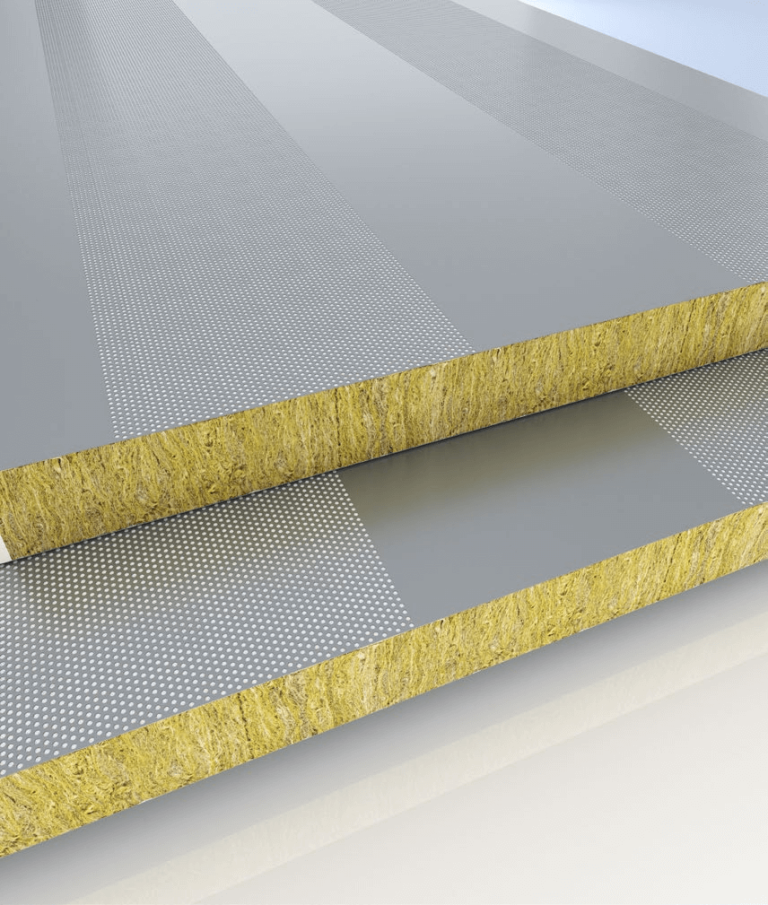
100mm rock wool sandwich panels achieve a U-value of approximately 0.40 W/m²·K, derived from rock wool's thermal conductivity (λ) of ≤ 0.043 W/m·K per GB/T 17393. A standard 240mm brick wall with EICS insulation added reaches approximately U ≈ 0.8–1.0 W/m²·K (per GB 50176 reference data) — and an uninsulated brick wall reaches only U ≈ 1.8–2.0 W/m²·K.
Even against an insulated brick wall, the 100mm rock wool panel is 2–2.5× better at stopping heat transfer. Against an uninsulated brick wall — still common in older or budget factories — the gap is 4–5×. Every square meter of brick wall loses or gains significantly more heat per hour than a panel, every day, for 30 years.
For the 2,300 m² exterior wall area in this model, the thermal performance gap translates to approximately 43,000–87,000 kWh of additional annual electricity consumption for the brick building (conservative industry estimate, exterior walls only, adjusted for HVAC COP of 3.0; lower bound compares against insulated brick, upper bound against uninsulated brick). At $0.10/kWh, choosing panels saves approximately $4,300–8,700/year from Year 1.
🌍 Regional Electricity Reference — How It Affects Your Savings
Region
Typical Industrial Rate (USD/kWh)
Estimated Year 1 Annual Saving
Savings Multiplier
China
$0.10
$4,300–8,700
1.0× (baseline)
India / SE Asia
$0.07–0.12
$3,000–10,400
0.7–1.2×
Middle East
$0.05–0.10
$2,150–8,700
0.5–1.0×
North America
$0.08–0.12
$3,440–10,440
0.8–1.2×
Latin America
$0.10–0.20
$4,300–17,400
1.0–2.0×
Europe
$0.15–0.35+
$6,450–30,450+
1.5–3.5×
Japan / Korea
$0.13–0.20
$5,590–17,400
1.3–2.0×
A buyer in Europe at $0.20/kWh sees double the annual savings shown in this model.
30-Year Cumulative Energy Savings
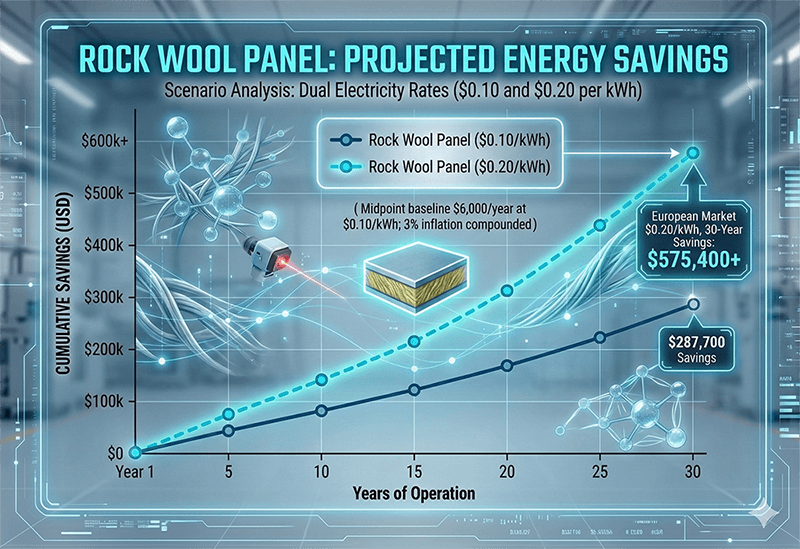
(Midpoint baseline $6,000/year at $0.10/kWh; 3% annual inflation compounded)
Year
Annual Saving
Cumulative @ $0.10/kWh
Cumulative @ $0.20/kWh (Europe)
Year 1
$6,000
$6,000
$12,000
Year 5
$6,951
$32,000
$64,000
Year 10
$8,064
$69,200
$138,400
Year 15
$9,353
$112,200
$224,400
Year 20
$10,850
$162,200
$324,400
Year 25
$12,585
$220,400
$440,800
Year 30
$14,599
$287,700
$575,400
The Year 1 saving range of $4,300–8,700 brackets the midpoint baseline above. In European markets at $0.20/kWh, 30-year energy savings from wall insulation alone exceed $575,000.
Section 3: Maintenance Cost Over 30 Years
Brick Masonry: Recurring Maintenance Obligations
Even with an external insulation system, brick masonry factories require regular maintenance interventions that steel-panel buildings do not. The porous nature of brick makes it inherently susceptible to moisture infiltration, and external insulation composite systems (EICS) require their own maintenance cycle.
Brick Maintenance Category
Per-Event Cost
30-Year Frequency
30-Year Total
Exterior repainting (wall + EICS surface)
$10,000–18,400/cycle
3–5 cycles
$30,000–92,000
EICS delamination / detachment repair
$3,600–8,700/incident
2–3 incidents
$7,200–26,100
Brick / mortar crack and spalling repair
$2,200–5,100/interval
6 intervals
$13,200–30,600
Water infiltration remediation
$2,900–8,700/incident
2–3 incidents
$5,800–26,100
30-Year Total
$56,200–174,800
Conservative industry estimates. Midpoint: ~$108,000.
Rock Wool Sandwich Panels: Minimal, Predictable Maintenance
Aluzinc-coated steel facing panels carry a corrosion resistance rating of 25–50 years under normal industrial conditions — no paint cycle, no insulation system to maintain, no mortar joints to deteriorate. Steel structure buildings have 40% lower annual maintenance costs than concrete or masonry buildings (HIG House, 2024) . Individual damaged panels can be replaced without disturbing adjacent elements or halting production.
Section 4: Tseason’s Quality Warranty — What It Covers and What It Saves You
⚠️ Specific warranty terms must be confirmed directly with Tseason for your project type and region. The following reflects available published documentation.
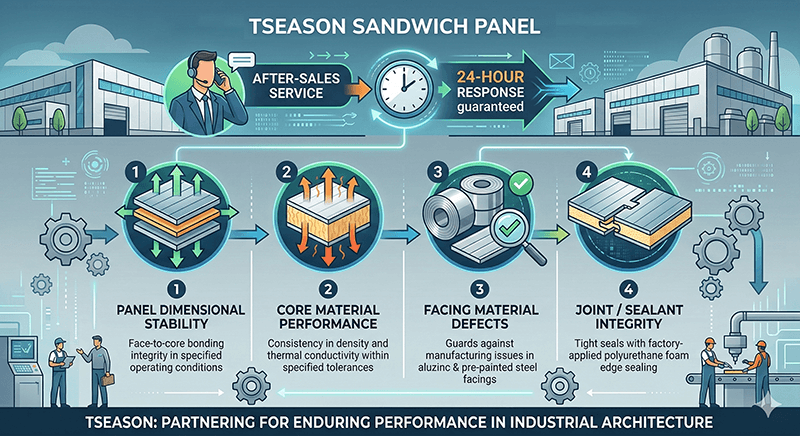
Tseason Panel's warranty coverageprovides structural performance protection for rock wool sandwich panel systems, covering:
Panel dimensional stability: Face-to-core bonding integrity under specified operating conditions
Core material performance: Density consistency and thermal conductivity within specified tolerances
Facing material: Manufacturing defect protection for aluzinc and pre-painted steel facings
Financial value of warranty coverage: If a structural defect affects 5% of installed wall area (~115 m²), remediation typically costs $22–40/m² — meaning warranty coverage can protect against a ~$3,700 repair exposure per incident (conservative estimate). This risk transfer from owner to manufacturer has direct financial value, particularly during the highest-risk early years of the building's life.
Section 5: Quality Consistency at Scale — Why It Matters for Your 30-Year Calculation
Tseason Panel's continuous automated PUMA and OMS production lines operate at the same equipment technology standard as leading European manufacturers. This directly protects the energy and maintenance assumptions built into this TCO model.
Foam density control: Continuous-line production maintains density uniformity within ±2–3 kg/m³ per batch (conservative estimate for quality continuous-line systems). Batch-foamed panels can vary by 10–20% between pours, creating inconsistent thermal values across the installed envelope and quietly reducing real-world energy savings below modeled projections.
Dimensional accuracy: Precisely manufactured panels create tight, consistent joints — eliminating thermal bridges and moisture entry pathways at every panel-to-panel interface.
Batch traceability: Every delivery should include test certificates covering fire resistance class (EN 13501 or GB/T standard), thermal conductivity (λ, per GB/T 10294 or EN ISO 10456), compressive strength (EN 826), and water absorption rate. These documents serve as procurement verification at receipt and as insurance or regulatory evidence throughout the building's lifespan.
Request a free sample to verify specification compliance before committing to large-volume procurement.
If inconsistent quality causes just 5% of the 2,300 m² wall area to require rework, remediation and contractor delay costs conservatively total $3,200–6,400 on a single project. Quality consistency is not a marketing claim — it is a quantifiable procurement risk with a direct dollar value.
Section 6: 30-Year TCO Summary — Panels Win on All Three Fronts
Model: 5,000 m² factory, Northern China reference climate, $0.10/kWh electricity, 30-year period, conservative industry estimates, complete building comparison.
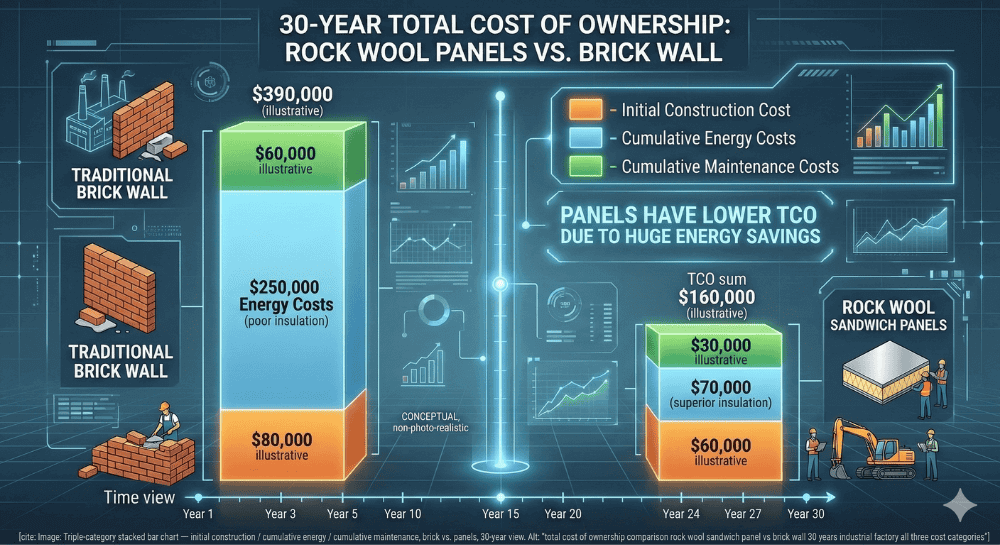
Unlike most building material decisions where you trade a higher upfront cost for long-term savings, rock wool sandwich panel factories deliver lower initial construction cost, lower annual energy cost, and lower maintenance cost — simultaneously.
At $0.20/kWh (European electricity rates), the cumulative energy saving doubles, bringing the total 30-year TCO advantage to approximately $350,000–700,000.
Source basis: Initial cost saving derived from 15–25% overall savings for steel+panel vs. brick (HIG House 2024) and 10–15% labor / foundation advantage (XTDSTEEL 2026); energy model based on GB/T 17393 and GB 50176; maintenance advantage based on 40% lower annual maintenance for steel structure buildings (HIG House 2024) and Allied Buildings analysis. All figures are conservative industry estimates.
The conclusion is unambiguous: choosing a brick masonry factory over a rock wool sandwich panel factory costs more upfront and keeps costing more every single year for 30 years. The total 30-year TCO penalty for choosing brick is conservatively $207,700–454,500 for a single 5,000 m² factory — rising to $350,000–700,000 in high-electricity-cost markets. See real project case studiesfor verified field performance data across multiple industries and geographies.
Get a Project-Specific TCO Estimate
The model above uses Northern China reference data. Your actual numbers depend on local construction labor costs, climate zone, electricity tariff, building design, and operational requirements. The framework — and the direction of every finding — applies globally.
Target temperature range: ambient / chilled / frozen
FAQ
1. Is it true that rock wool sandwich panel factories cost less to build than brick factories?
Yes — when comparing complete factory buildings at the same specification level. Steel structure with rock wool sandwich panels saves 15–25% on total initial construction cost versus brick masonry, primarily because of lower foundation requirements (panels weigh 12–17× less than brick), elimination of seismic tie columns, no plastering or painting, and no supplementary insulation system — panels meet GB 50189-2015 directly (HIG House, 2024) .
2. Why do brick walls require more foundation work than sandwich panels?
Brick masonry exterior walls weigh approximately 180–250 kg/m², compared to just 12–15 kg/m² for [[SLOT-02 | 100mm rock wool sandwich panels | YOUR-100MM-URL]]. For a 5,000 m² factory with ~2,300 m² of exterior walls, this 12–17× weight difference requires substantially deeper reinforced concrete footings and ring beams, adding ¥80–140 per m² of floor area to foundation cost alone (conservative estimate). Steel structures distribute loads far more efficiently, requiring significantly less foundation material .
3. Do brick walls need additional insulation on top of standard construction?
Yes. Per GB 50189-2015, industrial buildings in Northern China must meet minimum thermal envelope performance requirements. A standard 240mm brick wall fails this standard and requires an external insulation composite system (EICS), adding ¥60–100/m² of wall area to construction cost. [[SLOT-03 | Rock wool sandwich panels | YOUR-FIRERATED-URL]] meet GB 50189-2015 compliance directly without any supplementary insulation — eliminating this cost entirely.
4. How much energy does a rock wool sandwich panel factory save over 30 years?
For a 5,000 m² factory in Northern China, [[SLOT-02 | 100mm rock wool sandwich panels | YOUR-100MM-URL]] (U ≈ 0.40 W/m²·K) provide 2–2.5× better thermal performance than an insulated brick wall (U ≈ 0.8–1.0 W/m²·K). At $0.10/kWh, this translates to $4,300–8,700 in annual savings. Over 30 years with 3% inflation, cumulative savings reach approximately $150,000–290,000 at $0.10/kWh, and up to $575,000+ in European high-electricity-rate markets.
5. How do I verify the quality of rock wool sandwich panels before large-volume procurement?
Request [[SLOT-11 | per-batch test certificates | YOUR-CERT-URL]] covering fire resistance class (EN 13501 or GB/T standard), thermal conductivity (λ, per GB/T 10294), rock wool core density (kg/m³), compressive strength, and water absorption rate. Approve a physical sample first — [[SLOT-12 | request a free sample here | YOUR-SAMPLE-URL]]. Specify Aluzinc or PVDF-coated steel facings for corrosion-critical environments. For critical projects, arrange third-party pre-shipment inspection (SGS, Bureau Veritas, or equivalent).
Data Disclaimer
All cost figures, energy estimates, and financial projections in this article are conservative industry estimates for planning and comparative purposes only. The 15–25% construction cost saving of steel-panel vs. brick is based on published industry research (HIG House 2024 ; XTDSTEEL 2026 ; Allied Buildings ; Metal Pro Buildings ) and should be treated as a directional reference, not a guaranteed saving for any specific project. Actual costs vary significantly based on geographic location, local labor and material markets, building design, seismic zone classification, HVAC specifications, and utility tariff structures. Exchange rate used: 1 USD = 6.90 CNY (March 2026). No figure in this article constitutes a project quotation or contractual guarantee. Contact Tseason Panel directly for project-specific pricing, technical specifications, and TCO analysis tailored to your requirements.