4 Sandwich Panel Buying Mistakes That Show Up After Delivery
You requested three quotes. You compared the prices. The numbers looked acceptable, and the supplier confirmed the fire rating in writing. By any reasonable measure, the procurement process was done correctly.
Then the panels arrived on site. The steel was thinner than specified. The fire certificate referenced a product structure that didn't match what was delivered. And the thermal conductivity figure you used in your energy model was measured under test conditions that don't reflect your climate.
None of this shows up in a price comparison. All of it shows up later — in failed inspections, rework costs, and delayed handovers.
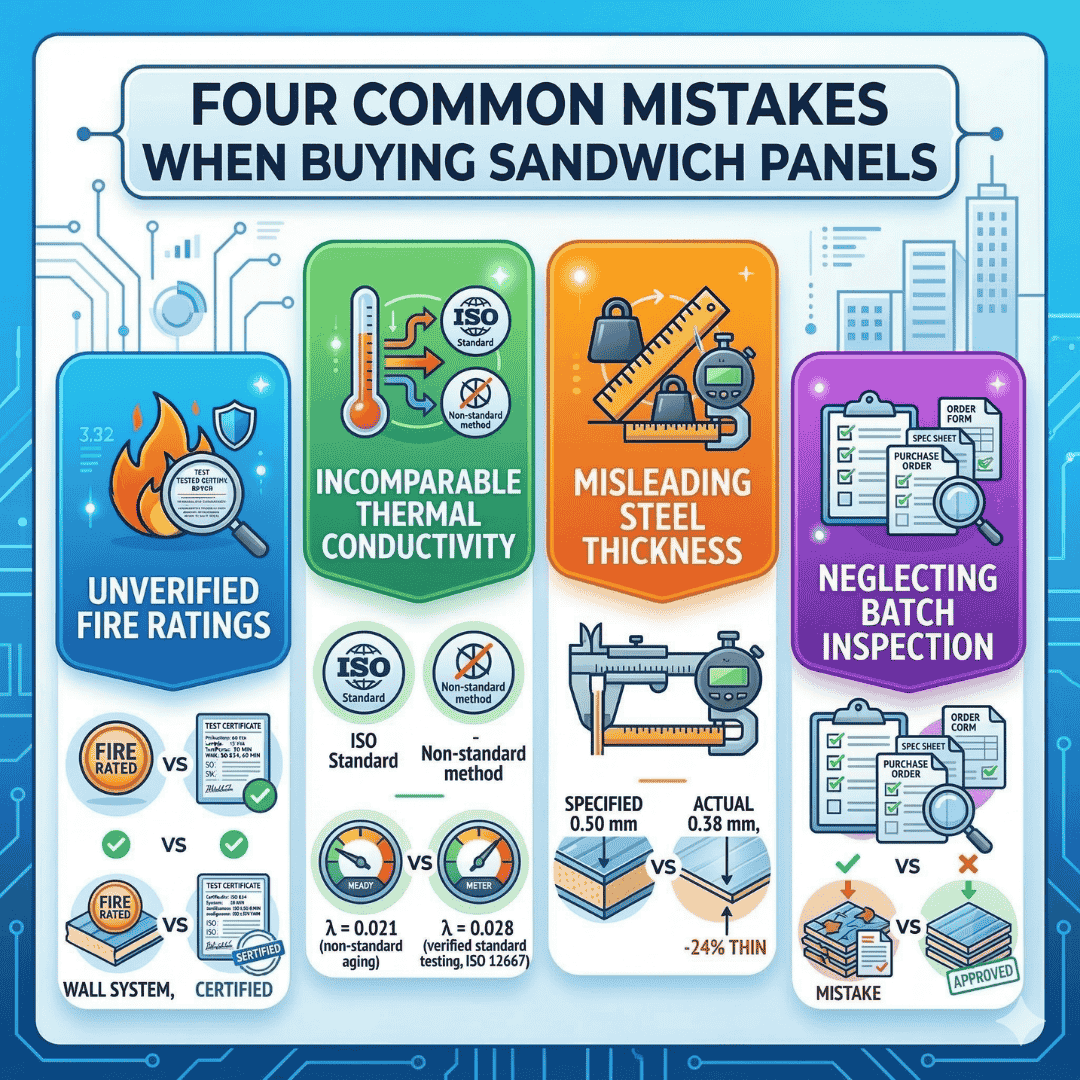
This guide covers four technical mistakes buyers run into before purchasing sandwich panels. Each one is preventable. None of them require specialist knowledge to catch — just the right questions asked at the right stage.
Quick answer: Yes — many buyers focus only on price and overlook hidden risks in fire certification, thermal data, steel thickness, and batch consistency. These four issues are behind most post-delivery disputes and inspection failures in sandwich panel procurement.
Mistake 1: Accepting a Fire Rating Without Checking What Was Actually Tested
What tends to go wrong
A supplier quotes a fire rating — B1, A2, or 120-minute resistance — and provides a certificate image. The buyer takes it at face value. At project handover, the inspector finds the certificate references a panel structure that doesn't match the product delivered.
Why this happens
Fire rating measures how long a building component resists fire spread or structural failure under controlled conditions. It's defined by specific standards (EN 13501-1 in Europe, GB 8624 in China) and is only valid for the exact product configuration that was tested — core type, density, thickness, facing material, and joint detail all matter.
The real risk in most markets isn't outright forgery. It's scope mismatch: the certificate is genuine, but it covers a 75mm rock wool panel with 0.3mm steel facings, and what you received is a 100mm EPS panel with 0.4mm facings. Two different products. One certificate.
Five steps to verify a fire certificate
- Check the standard number. Confirm whether EN 13501-1, GB 8624, or ASTM E84 applies to your project specification and whether the certificate references it.
- Check the issuing body. Testing should be done by an accredited third-party lab, not an internal quality department. Verify the lab's accreditation status if you have any doubt.
- Check the product structure on the certificate. Core type (rock wool, EPS, PIR), core density (kg/m³), core thickness (mm), and facing material and thickness must all match your order.
- Check the certificate date and validity. Some certificates carry expiry dates or are tied to specific production batches.
- Request the full test report, not just a summary page. The full report includes specimen dimensions, test conditions, and detailed results. A one-page certificate image without the attached report isn't enough for project verification.
Key point: A fire certificate is only valid for the exact product configuration it covers. Cross-check the tested specimen against your purchase order line by line — core type, thickness, density, and facing material all need to match.

Mistake 2: Comparing Thermal Conductivity Numbers Measured Under Different Conditions
What tends to go wrong
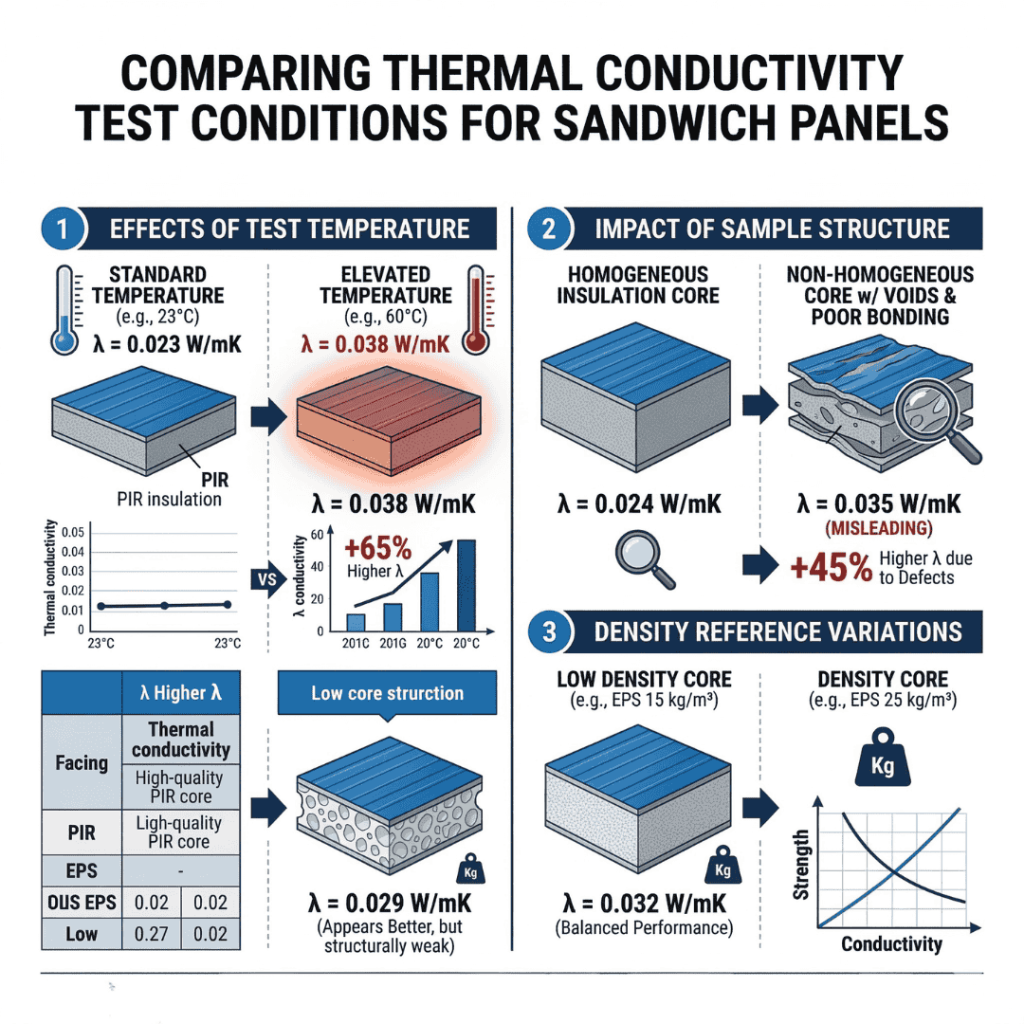
Buyer A compares three supplier quotes and picks the one with the lowest thermal conductivity (λ) value. The decision looks technically sound. In practice, the three values were measured at different test temperatures, using different sample densities, under different standard protocols.
Why the numbers can mislead you
Thermal conductivity (λ, in W/m·K) describes how readily a material transfers heat. Lower values mean better insulation. For rock wool sandwich panels, λ typically falls between 0.033 and 0.045 W/m·K — but the measured result shifts depending on how the test was run.
The most common source of bad comparisons is test temperature. A material tested at 10°C mean temperature produces a lower λ than the same material tested at 25°C. Suppliers don't always disclose the test temperature alongside the published figure, which makes direct comparison unreliable.
Other variables that affect the result
- Sample density (kg/m³) — higher-density rock wool performs differently from lower-density material
- Moisture content of the specimen at time of testing
- Sample thickness and its relationship to the tested panel structure
- Test standard used — EN ISO 10456, GB/T 10294, and ASTM C518 are not directly equivalent
Key point: Ask every supplier to provide the λ value alongside the test standard, test temperature, and core density. Only compare values measured under the same standard and conditions.
What to request from your supplier:
| Required Detail | Why It Matters |
|---|---|
| Test standard (e.g., EN ISO 10456) | Enables cross-supplier comparison |
| Mean test temperature (°C) | Lower temperature produces lower λ — conditions matter |
| Sample density (kg/m³) | Density affects thermal performance |
| Panel thickness tested | λ from a thin sample may not reflect full-panel performance |
| Product composition at time of test | Ensures the tested product matches your order |
Mistake 3: Steel Thickness Discrepancy — Labeled 0.50 mm, Measured 0.38 mm
What tends to go wrong
The specification sheet says 0.50mm steel facing. The order confirmation states 0.50mm. What arrives on site measures 0.38mm on a calibrated micrometer.
This is a documented issue in commodity panel manufacturing. Steel thickness tolerance — the allowable variance between nominal and actual measured steel — is applied inconsistently or not disclosed. Some suppliers quote nominal (labeled) thickness, while the base metal thickness after coating can be significantly less.
Why it matters beyond appearances
- Reduced structural strength — thinner steel panels deflect more under load and are more vulnerable to wind pressure at larger spans
- Lower impact resistance — panels are more susceptible to surface damage during installation and in service
- Shorter service life — thinner zinc or aluzinc coverage accelerates corrosion risk in industrial environments
- Compliance risk — if your project calls for 0.50mm steel and 0.38mm is delivered, the installation may not satisfy the design engineer's load calculations
How to catch this before delivery
- Specify base metal thickness, not total thickness. Total thickness includes zinc/aluzinc/paint coating. Base metal thickness (BMT) is the structural measurement. Confirm which one is being quoted.
- Request the factory inspection report showing measured steel thickness per coil. Reputable manufacturers record this as part of incoming material QC.
- Use a calibrated micrometer or ultrasonic thickness gauge on arrival samples — standard practice in professional building envelope procurement.
- Confirm coating specification separately. Aluzinc (AZ150, AZ185) and HDG (Z275) coatings add measurable thickness. Get it specified in writing.
Key point: Specify BMT explicitly in the purchase order, request coil inspection records showing actual measured thickness, and check a representative sample on receipt.
Mistake 4: Skipping Full Batch Inspection and Document Consistency Before Order Confirmation
What tends to go wrong
The sample passed. The fire certificate looks correct. Steel thickness was verified on the pre-production sample. Three months later, the production batch arrives and the specification sheet has changed, the core density has shifted, and the documents don't match the confirmed order.
Full batch inspection means verifying that the production lot you're actually receiving — not a pre-production sample — meets the agreed specification across all key parameters. Document consistency means confirming that inspection records, the product specification sheet, test certificates, and the order confirmation all reference the same product configuration.
This is the issue that catches even experienced procurement teams. Sample management tends to be tight. Production runs are where variation creeps in — through raw material substitution, density adjustments, steel coil changes, or coating batch differences. None of it is visible without systematic pre-shipment verification.
What to request before order confirmation
- Batch inspection record — factory QC data for the specific production run, not a generic product datasheet
- Product specification sheet matching the batch — confirming core type, density, thickness, and facing specs
- Fire and thermal test reports — confirming that the referenced product configuration matches the batch specification
- Steel coil inspection records — showing measured BMT for the coils used in the batch
- Coating specification confirmation — coating type, weight, and surface treatment for the batch
- Order confirmation cross-check — all parameters on the purchase order match the batch documentation before shipment release
Key point: Build a pre-shipment document review step into the procurement timeline. Have the supplier submit batch documentation for review before goods are released — not after they arrive.
Pre-Order Checklist: What to Confirm Before Placing a Sandwich Panel Order
Run through these before confirming any sandwich panel order:
- Fire test report — full report, not certificate image only; confirm the tested product structure matches your order specification
- Certificate verification — issuing body accreditation, test date, and standard number confirmed
- Thermal conductivity test conditions — λ value provided with test standard, mean test temperature, and core density
- Steel thickness — BMT specified in writing; factory coil inspection records requested
- Coating specification — type (aluzinc AZ150/AZ185, HDG Z275, PVDF), weight, and surface treatment confirmed
- Core type and density — rock wool, EPS, or PIR; density (kg/m³) confirmed against technical datasheet
- Panel dimensions and tolerance — width, length, thickness, and allowable manufacturing tolerance documented
- Batch inspection record — production-lot QC data, not only sample or type-test data
- Document consistency check — fire report, spec sheet, batch record, and order confirmation all reference the same product configuration
- Warranty and after-sales terms — coverage scope, duration, and defect claim process confirmed in writing before order
How Tseason Helps Buyers Reduce These Risks
The four issues in this guide share a common thread: buyers don't know what to ask for at the right stage. Not because the information isn't available — it is — but because most suppliers don't surface it proactively.
Tseason's inspection process is built around one straightforward principle: what you confirm before the order is what you receive on site. That applies whether you're buying online for the first time or placing a repeat order.
What the Pre-Shipment Inspection Covers
For every production order, Tseason's delivery inspection process works through each of the four risk areas in this guide:
- Mistake 1 — Fire certification: The factory test report is reviewed and cross-checked against the confirmed order specification before shipment. If the tested product configuration doesn't match the order, it gets flagged before the goods leave the facility.
- Mistake 2 — Thermal data: Product type and core specification — including core material, density, and thickness — are checked against the order confirmation as part of pre-shipment document review.
- Mistake 3 — Steel thickness: Steel thickness is physically measured using high-precision production line equipment. Coating specification — type, weight, and surface treatment — is confirmed separately against the purchase order. Verified tolerance on record is as low as 0.06% deviation.
- Mistake 4 — Batch inspection and document consistency: Before shipment release, Tseason's delivery inspection covers product quantity verification against the packing list, product type confirmation including butyl tape testing and edge trim check, factory test report review confirming it matches the batch being shipped, and color and surface consistency check across panels within the same shipment. Shipment only proceeds after all inspection items are cleared.
Third-Party Inspection for First-Time Buyers
For buyers sourcing online or working with Tseason for the first time, Tseason provides access to professional third-party inspection services — an independent verification layer that doesn't rely on the supplier's own QC reporting.
This directly addresses the concern most common among international buyers: the gap between what was approved during sampling and what actually ships in full production.
This isn't a claim of a perfect product. It's a documented process. If a discrepancy comes up during pre-shipment inspection, that's the right time to deal with it. Finding the same issue on site, after installation has started, is significantly more expensive for everyone involved.
Before You Place Your Next Order
The guidance above doesn't require specialist knowledge to apply. It requires structured questions, the right documents, and enough time in the procurement process to actually review them.
If you're comparing sandwich panel suppliers right now, send us your fire rating requirement, panel structure, and steel thickness specification. Tseason can review the key technical parameters and flag any gaps in the documentation before your order is confirmed.