Why the Real Difference in Sandwich Panels Lies Where You Can’t See
When selecting sandwich panels, most buyers first look at thickness, then price, and only later consider surface finish or color.
This approach is common in the market—and to be fair, not entirely wrong.
But those who have dealt with long-term operation, maintenance, or even rework usually come to a different conclusion:
The most critical part of a sandwich panel is never the surface.
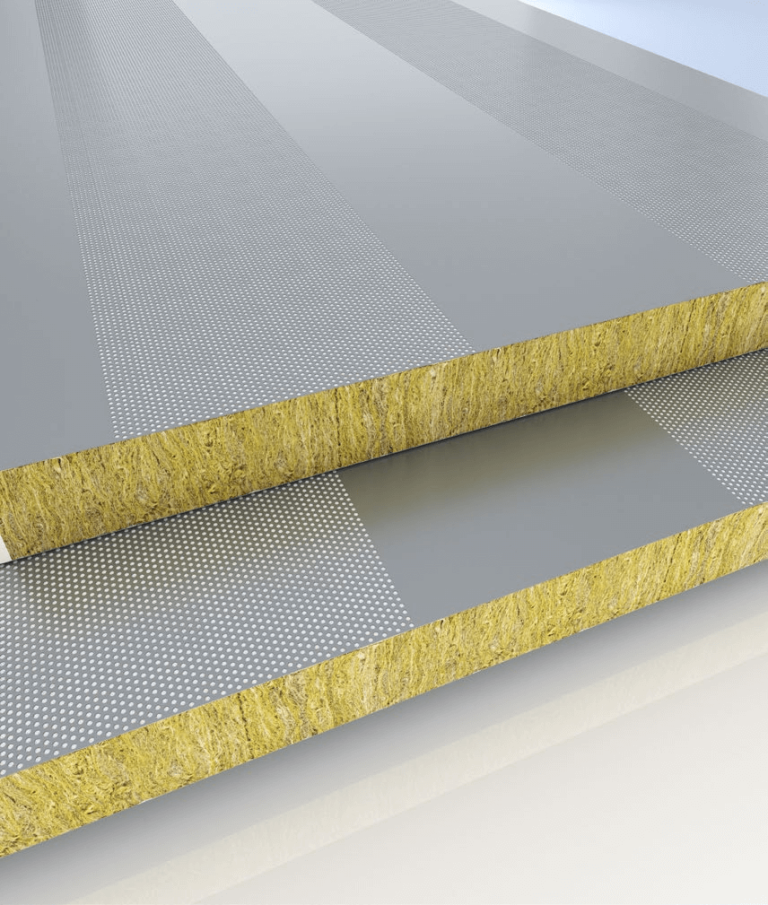
It lies inside the cross-section, deep within the core material—
and once installed, these internal details are almost impossible to correct.
Problems with Low-Quality PU Cores Start from the Inside
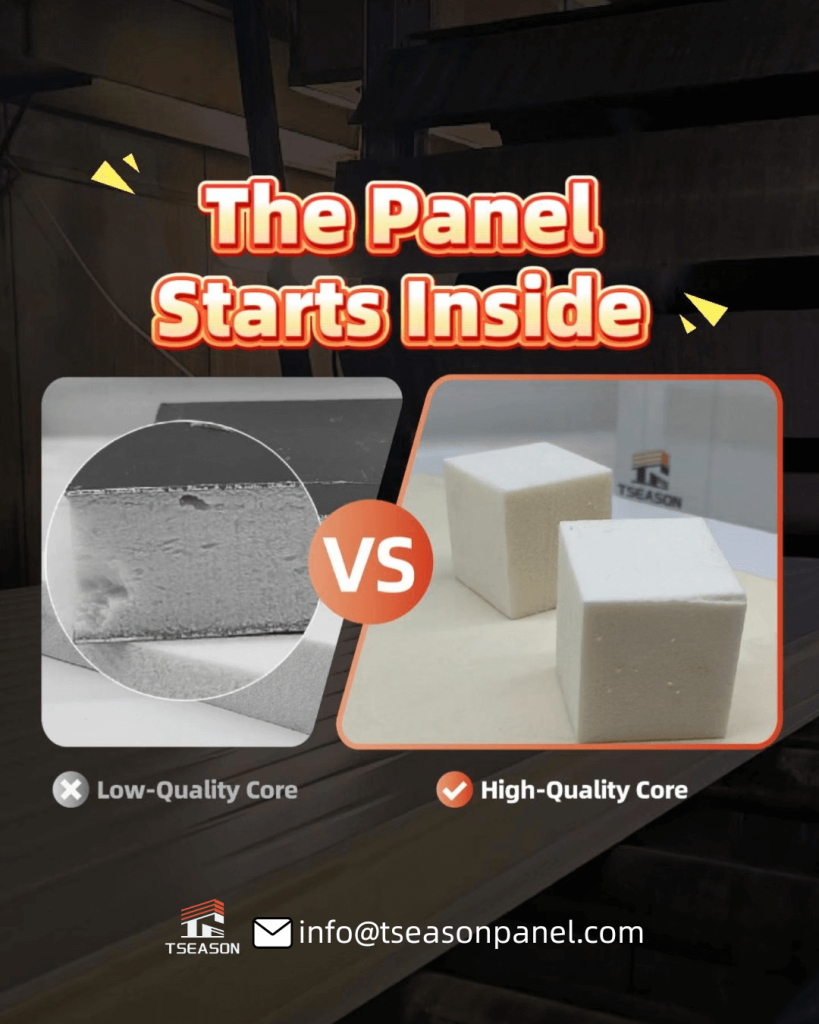
On-site, once the panels are cut open and compared, the differences are often readily apparent.
Lower-quality polyurethane cores frequently show internal issues:
uneven cell size, inconsistent distribution, or even voids;
powdering, blistering, cracks, and in severe cases, localized collapse.
These defects may not appear immediately at delivery,
but they tend to surface quickly during actual operation.
Insulation Failure Is About More Than Energy Loss
In many projects, issues are not immediately linked to the sandwich panels themselves.
Instead, operators notice rising energy consumption, unstable temperatures, or localized condensation.
In reality, the root cause often lies in the core material.
Once a polyurethane core absorbs moisture or loses structural integrity,
its insulation performance drops sharply—and rarely recovers.
Over time, this also affects structural stability and hygiene conditions.
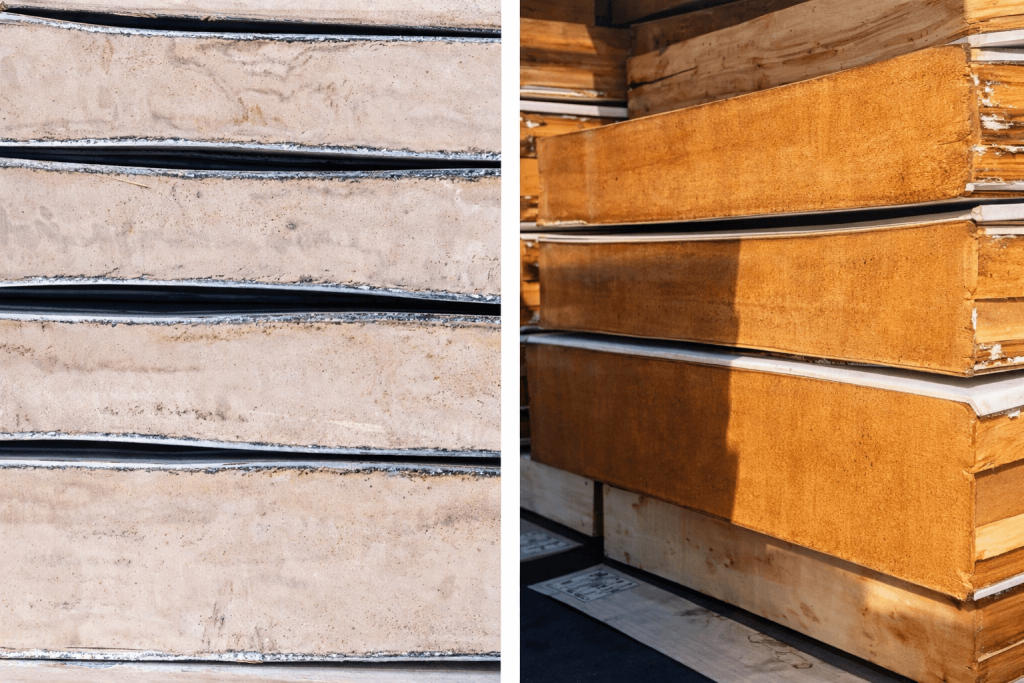
What Defines a Truly Reliable PU Core?
From a manufacturing perspective, the criteria are actually quite clear.
High-quality polyurethane cores are typically produced using high-pressure continuous foaming technology.
With stable pressure and precise formulation control, the foam cells become uniform and dense,
achieving a closed-cell rate consistently above 95%.
At Tseason, sandwich panel cores are produced on high-pressure foaming lines,
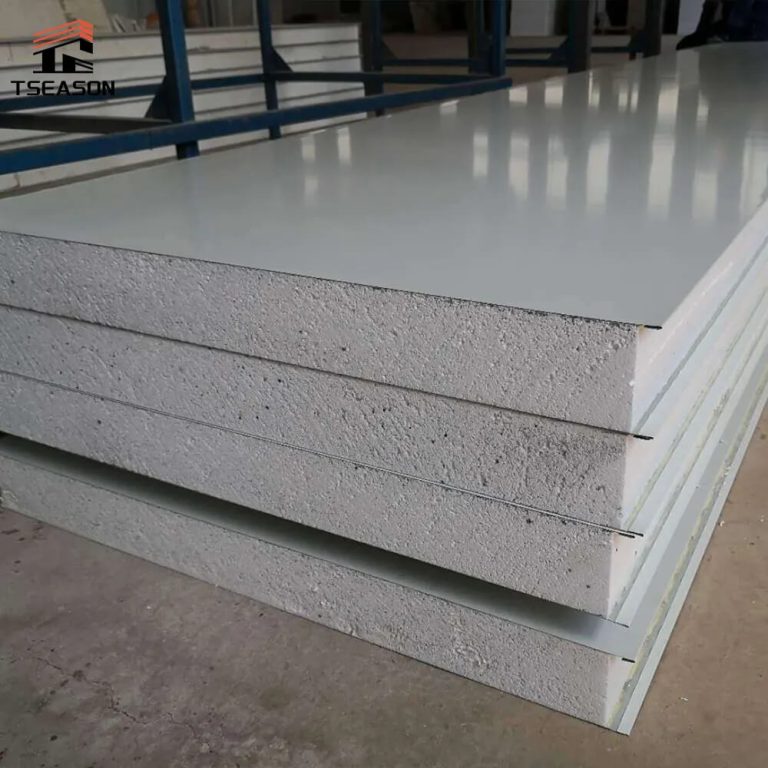
resulting in fine, compact cell structures with clean cross-sections—free from voids or powdering.
This structure isn’t about appearance; it directly determines long-term performance.
Tseason can ensure the consistency of PU sandwich panel products
Core Quality Depends on Process, Equipment, and Raw Materials
“Isn’t it all just polyurethane?”
This is a question many buyers ask.
The reality is that material names alone do not define performance.
Real differences come from three factors:
foaming process stability, equipment precision, and raw material consistency.
Tseason operates mature continuous production lines,
combining high-pressure foaming systems with verified raw material formulations,
ensuring consistent core performance across every batch—not just sample approval.
How a High-Quality Core Improves Three Key Performances
Uniform, closed-cell foam traps air effectively,
shortening heat transfer paths and delivering long-term insulation stability.
Dense structure also means more even load distribution,
improving compressive strength and overall panel rigidity.
At the same time, closed-cell foam limits moisture penetration,
enhancing water and vapor resistance from the inside out.
These benefits are structural—not add-ons.
Why does the manufacturing process matter? Here is the technical breakdown of the performance gap:
| Feature | Tseason High-Pressure Foaming | Low-strength risks surface buckling under thermal stress. | Impact on Project |
| Cell Structure | Uniform, >95% Closed-Cell | Irregular, Open Cells | Closed cells prevent moisture absorption; Open cells act like a sponge. |
| Density Consistency | ±2 kg/m³ deviation | ±5-8 kg/m³ deviation | Inconsistent density leads to weak spots and skin delamination |
| Compressive Strength | High (>150 kPa) | Variable (<100 kPa) | Low-strength risks surface buckling under thermal stress. |
| Thermal Conductivity | Stable at 0.022 W/m·k | Degrades over time | Poor cores lose insulation value by 10-15% within the first year. |
Pro Tip for Buyers: Ask your supplier for a cross-section sample. If you see visible air pockets larger than 1mm, it is likely a low-pressure product that will compromise your building's thermal envelope.
From Price Comparison to System Evaluation
More cold storage, industrial, and cleanroom projects are recognizing that
sandwich panels are not disposable materials—they are part of the building system.
That’s why Tseason focuses on long-term performance stability,
traceable manufacturing processes, and technical support aligned with real projects.
Final Thoughts: Real Value Is Hidden Inside the Panel
The surface creates the first impression.
The core structure defines performance for decades.
In most cases, panels produced with proven processes, stable equipment,
and reliable manufacturing systems deliver the lowest long-term cost—and the least risk.