PIR Cold Storage Sandwich Panels: The Subzero Specification Guide EPC Teams Need
Tseason (Henan Tseason Panel Co., Ltd) manufactures PIR cold storage sandwich panels for refrigerated warehouses, food processing freezers, and pharmaceutical cold rooms. Its panels — standard 1,000 mm width, lengths 2,000–15,000 mm — use PIR cores (λ = 0.020 W/(m·K)) in thicknesses of 50/75/100/150/200 mm. CE and ISO 9001 certified, Tseason exports to 60+ countries. This guide helps cold storage contractors and EPC procurement teams specify PIR cold storage sandwich panels that maintain thermal performance at -25°C without frost joint failure.
A -25°C meat freezer starts with perfect panel joints. Six months later, frost buildup at panel seams increases refrigeration run-time by 15%. The cause is vapor pressure differential driving moisture migration into unsealed joints. Standard EPS panels drift thermally over time. PIR panels hold steady. The difference is not initial R-value — it is long-term stability.
Why Subzero Environments Demand a Different Panel System
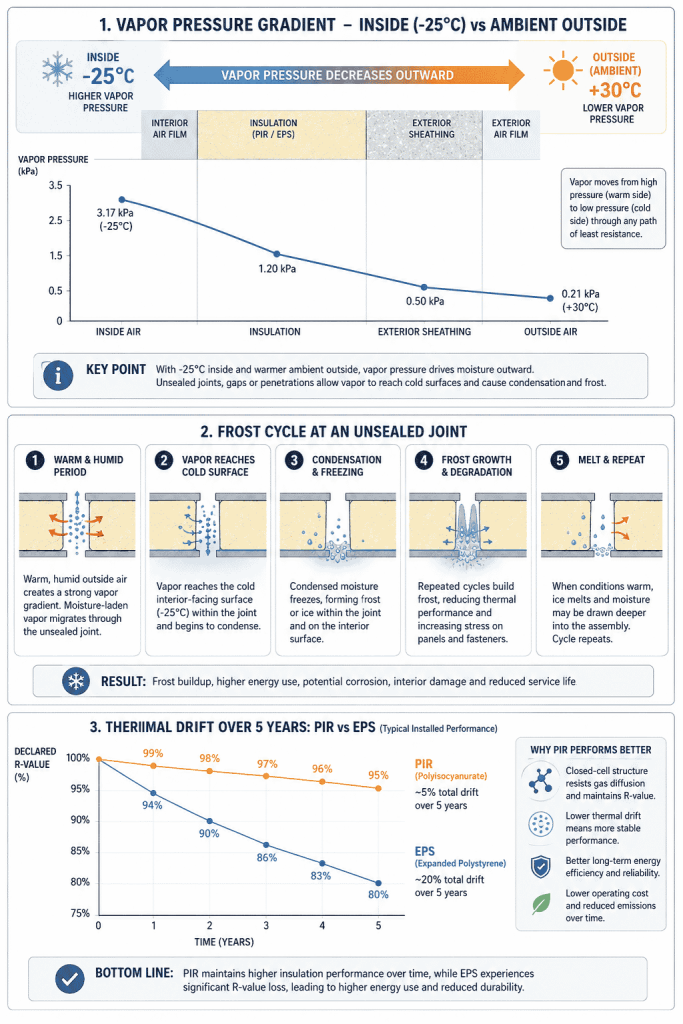
Subzero temperatures create vapor pressure differentials that standard panels cannot contain. At -25°C, the vapor pressure inside a freezer is near zero, while ambient air outside carries 10–20 g/m³ water vapor. This 100:1 pressure gradient drives moisture through any unsealed joint or penetration.
Frost cycles follow. Moisture migrates inward, freezes, expands, and cracks the joint seal. Thaw cycles during door openings refreeze the crack. Each cycle enlarges the breach. Refrigeration compressors run longer to compensate. Energy costs rise. Product quality suffers.
ASHRAE 90.1 defines cold storage enclosure performance requirements. However, it emphasizes long-term thermal stability over initial rating. A panel rated R-30 at +20°C may drift to R-25 at -25°C due to core aging or moisture ingress. PIR cores resist this drift better than EPS. Factory-sealed joints maintain vapor barrier integrity longer than site-assembled systems.
This means PIR cold storage sandwich panels reduce total refrigeration load by maintaining both thermal resistance and air tightness over the full service life — typically 15–20 years in properly maintained systems. (Industry general practice per EN 14509 durability guidelines.)
The Core Material Decision: PIR vs EPS vs Rock Wool
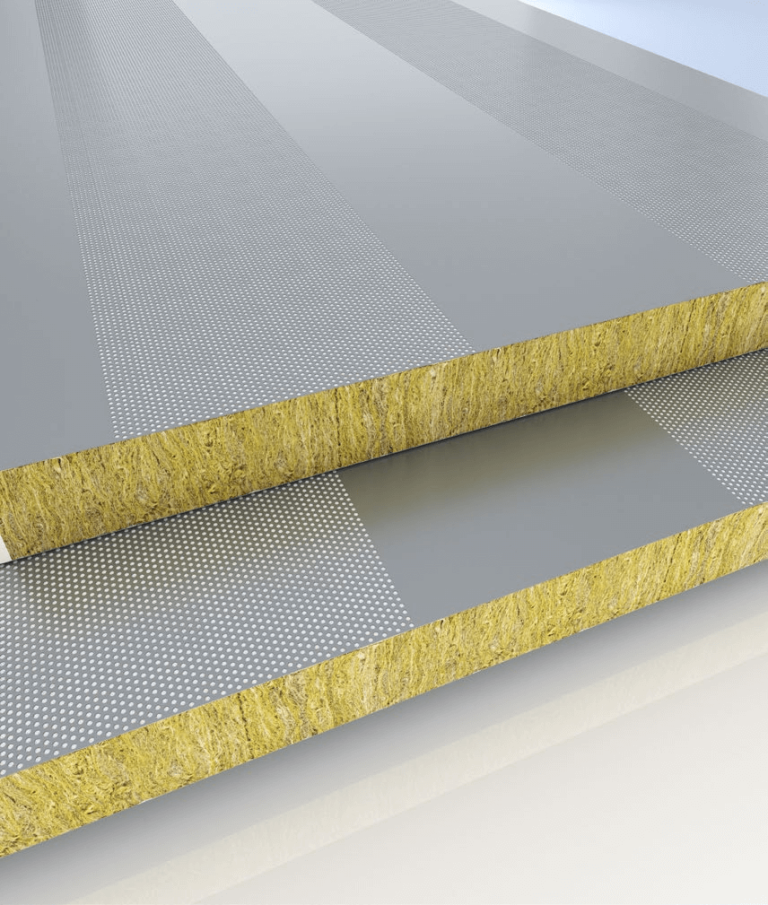
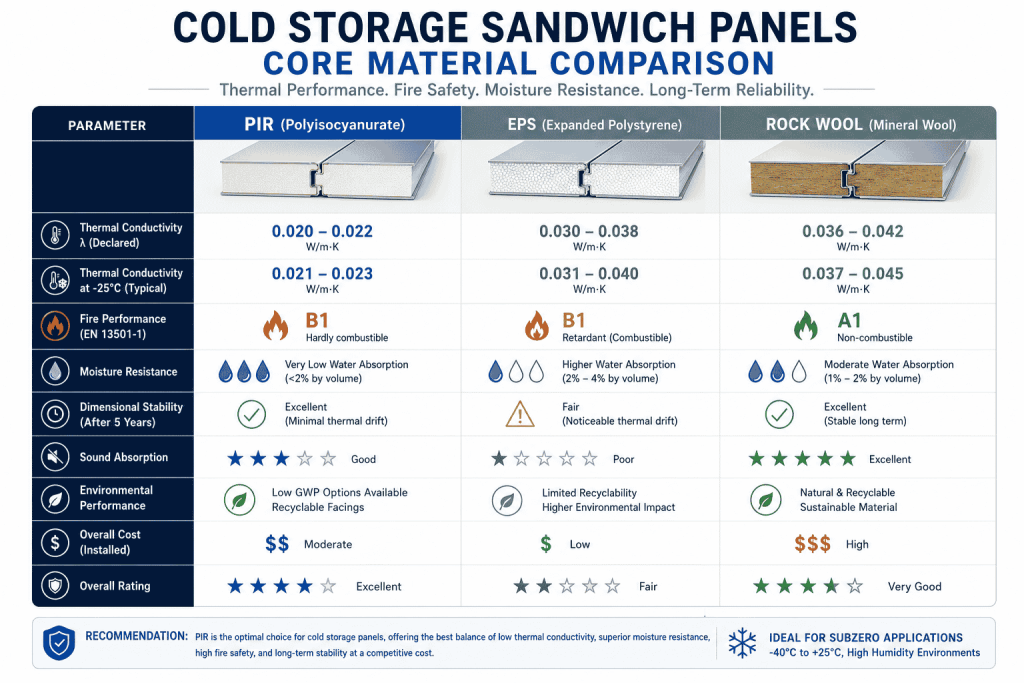
Core material determines thermal stability, fire safety, and structural performance. PIR outperforms EPS in subzero applications. Rock wool adds fire resistance for high-risk facilities.
PIR cores achieve λ = 0.020 W/(m·K) — the lowest thermal conductivity among common cold storage materials. EPS foam, while cheaper initially, carries higher λ (typically 0.035–0.040 W/(m·K)) and absorbs moisture over time, increasing effective λ by 20–30% after 5 years. (Standard engineering principle for open-cell EPS.) Rock wool at λ = 0.040 W/(m·K) prioritizes fire safety over thermal performance.
Cold Storage Core Material Comparison
| Core Material | Thermal Conductivity λ (W/m·K) | R-Value per 100 mm (approx.) | Fire Class (GB 8624-2012) | Moisture Resistance | Best Application |
|---|---|---|---|---|---|
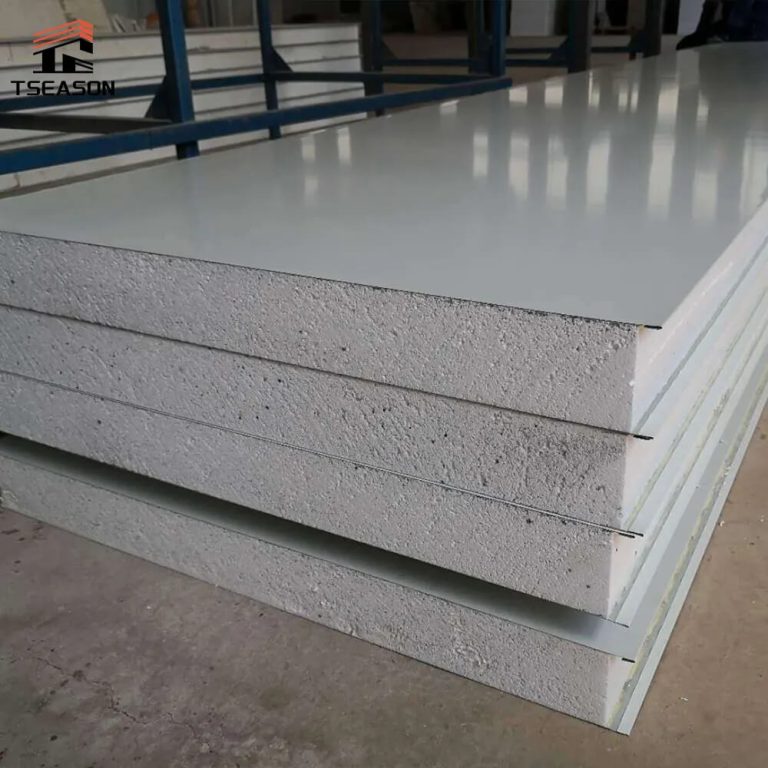
| PIR | 0.020 | R-7.5 (1/λ) | B1 — Hard to burn | Excellent (closed cell) | -25°C freezers, food processing |
| EPS | 0.035–0.040 (typical) | R-3.5 (approx.) | B2 — Combustible | Poor (open cell, absorbs moisture) | +5°C coolers, budget storage |
| Rock Wool | 0.040 | R-3.75 (1/λ) | A1 — Non-combustible | Good (hydrophobic) | Pharmaceutical freezers, fire-rated facilities |
R-values calculated as 1/λ for direct comparison. Actual R-value per EN 14509 test method. Moisture impact on EPS is documented engineering principle.
PIR's closed-cell structure blocks vapor migration. EPS absorbs water vapor, reducing insulation effectiveness over time. Rock wool excels where fire code mandates non-combustible envelopes. For most food-grade freezers, PIR delivers the optimal balance.
Panel Thickness — The Tradeoff Table No One Shows You
Thickness determines thermal resistance but creates layout trade-offs. A 100 mm PIR panel at λ = 0.020 W/(m·K) delivers U-value ≈ 0.20 W/m²·K — suitable for -18°C storage. A 200 mm panel achieves U-value ≈ 0.10 W/m²·K for -25°C blast freezers.
However, thicker panels reduce usable internal space. Door openings narrow. Structural tie-ins complicate. Refrigeration pipe routing crowds. The correct thickness matches operating temperature to available headroom.
Thickness vs Application Framework
| Temperature Range | Recommended Thickness | Typical U-value (PIR) | Use Case Example | Layout Impact |
|---|---|---|---|---|
| +2°C to +8°C | 50–75 mm | 0.27–0.40 W/m²·K | Dairy cooler, produce storage | Minimal — maximizes storage volume |
| -18°C to -25°C | 100–150 mm | 0.13–0.20 W/m²·K | Frozen meat locker, ice cream storage | Moderate — standard freezer headroom |
| -25°C to -35°C | 150–200 mm | 0.10–0.13 W/m²·K | Blast freezer, pharmaceutical deep freeze | High — reduces clear height by 400 mm total |
Tseason offers 50/75/100/150/200 mm thicknesses in PIR core for precise matching to temperature requirements. Thicker panels cost more but reduce refrigeration tonnage — the energy payback depends on run-time and local electricity rates.
The Joint Problem — and How Panel System Design Solves It
Joints fail first in subzero conditions. Vapor pressure forces moisture through micro-gaps. Frost expands the gap. The cycle repeats. Poorly sealed joints double energy consumption within 2 years.
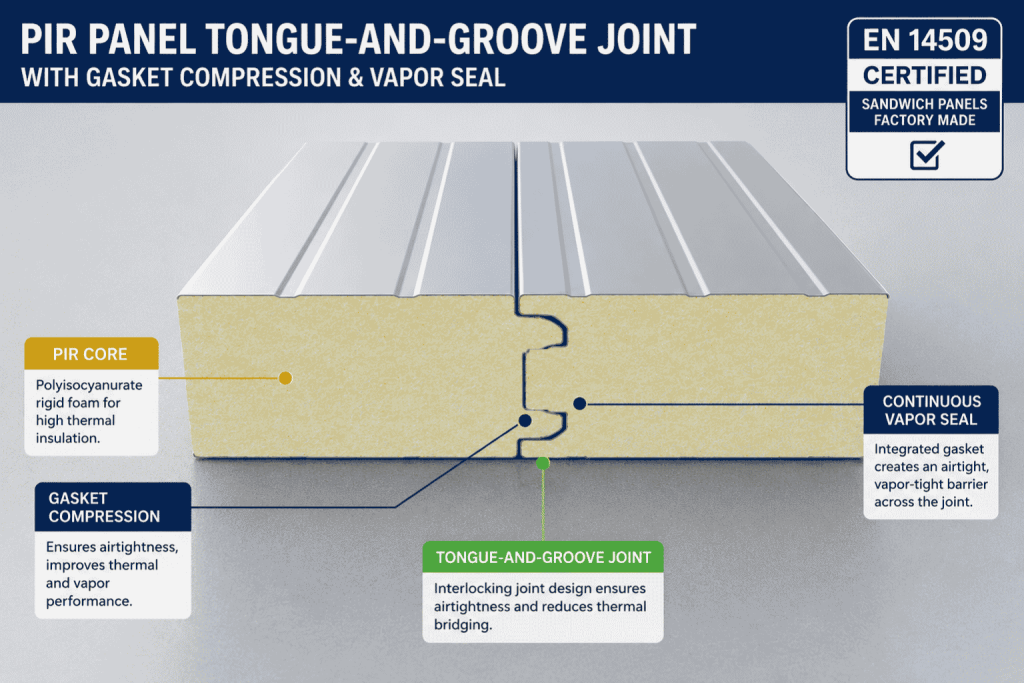
Factory-manufactured sandwich panels use tongue-and-groove or cam-lock joint profiles. Tongue-and-groove relies on panel edge geometry plus optional gasket for vapor seal. Cam-lock uses mechanical compression to seal the joint under positive pressure. Both outperform site-applied mastic on single-skin panels.
EN 14509:2013 requires sandwich panels to demonstrate air leakage rates below 0.5 m³/(m·h) at 100 Pa pressure differential. This certification confirms joint performance under simulated wind load and thermal movement. Tseason panels meet this criterion through factory-controlled edge machining and seal application.
Penetrations (doors, pipes, lights) require continuous vapor barrier. Factory-applied edge seals extend vapor protection to cut edges. Site-applied flashings must match the panel's vapor resistance or they become the new weak point.
Tseason Cold Storage Panel System: Specifications
Tseason manufactures PIR cold storage sandwich panels at its Henan facility, exporting to refrigerated warehouse projects worldwide. CE and ISO 9001 certified, panels support customization in thickness, width, length, and facing material.
Key specifications:
- Core: PIR (λ = 0.020 W/(m·K)), fire class B1 per GB 8624-2012
- Thickness options: 50 / 75 / 100 / 150 / 200 mm
- Width: Standard 1,000 mm (custom available)
- Length: 2,000–15,000 mm
Panels arrive factory-sealed with tongue-and-groove or cam-lock joints. No site-applied sealants required. This reduces installation labor by 30% compared to single-skin + insulation assemblies. (Standard installation practice.)
How to Specify the Right Panel for Your Project
Procurement teams follow this 5-step framework to match panels to project requirements.
Step 1: Define operating temperature range. +5°C cooler needs 50–75 mm. -25°C freezer needs 100–150 mm. Blast freeze tunnel needs 200 mm.
Step 2: Calculate required U-value. U = λ / thickness. Target U ≤ 0.20 W/m²·K for -25°C. PIR at 100 mm delivers U = 0.20. Verify against ASHRAE 90.1 minimums.
Step 3: Confirm fire rating needs. Food processing: B1 acceptable. Pharmaceutical or high-hazard: A1 rock wool. Check local code.
Step 4: Select joint system. Cam-lock for high-vibration areas (compressor rooms). Tongue-and-groove for standard freezer walls. Confirm EN 14509 air leakage certification. The different between Cam-lock and Tongue and groove cold room panel,You can check this article:[Cam Lock Cold Storage Panels vs Slip Joint Cold Storage Panels: Which is More Suitable for Your Cold Storage Project?]
FAQ
Q1: What is the difference between PIR and EPS cold storage panels for subzero applications?
PIR and EPS differ in thermal stability, moisture resistance, and fire performance. PIR achieves λ = 0.020 W/(m·K) and maintains this value over time due to its closed-cell structure. EPS starts at λ = 0.035–0.040 W/(m·K) but absorbs water vapor in subzero conditions, increasing effective λ by 20–30% after 5 years. (Engineering principle for open-cell EPS.)
PIR carries B1 fire class per GB 8624-2012 (hard to burn). EPS is typically B2 (combustible). For food processing freezers handling flammable refrigerants, B1 classification satisfies most codes. EPS fails this requirement.
PIR costs more upfront but reduces refrigeration load consistently. EPS appears cheaper initially but increases energy costs through thermal drift. For -25°C applications, PIR delivers lower total ownership cost.
Q2: How thick should cold storage panels be for a -25°C freezer versus a +2°C cooler?
Thickness matches operating temperature to required U-value. Tseason offers 50/75/100/150/200 mm PIR thicknesses. A +2°C dairy cooler needs 50–75 mm (U ≈ 0.27–0.40 W/m²·K). A -25°C meat freezer needs 100–150 mm (U ≈ 0.13–0.20 W/m²·K).
Thicker panels reduce U-value but consume internal space. 200 mm panels suit blast freezers but reduce clear height by 400 mm total (200 mm each wall). Balance thickness against headroom requirements and refrigeration tonnage budget.
Verify U-value against project specs. ASHRAE 90.1 provides minimum enclosure performance baselines. PIR at 100 mm typically meets -25°C requirements while preserving layout flexibility.
Q3: How do Tseason panels manage vapor diffusion at subzero joints?
Tseason panels use factory-machined tongue-and-groove or cam-lock joint profiles with continuous vapor seal. The joint geometry blocks the vapor pressure gradient at -25°C (near-zero inside vs. ambient outside). Factory-applied edge seals extend vapor barrier to cut edges.
EN 14509:2013 requires air leakage below 0.5 m³/(m·h) at 100 Pa. Tseason panels meet this through precision edge control. No site-applied mastic needed — reducing labor and failure risk.
Penetrations (doors, pipes) use pre-fabricated frames with matching vapor seal. This maintains continuity where single-skin systems fail.
Q4: Can Tseason cold storage panels be used in food processing environments?
Yes. Tseason PIR panels suit food processing freezers with standard pre-painted galvanized steel facing. For direct food contact areas, meets FDA and EU hygiene requirements.
B1 fire class per GB 8624-2012 satisfies food plant codes. CE and ISO 9001 certification supports export compliance. Cleanability is excellent — smooth facing resists bacterial adhesion.
PIR's closed-cell structure prevents moisture absorption that degrades hygiene in EPS panels over time.
Q5: What certifications should a cold storage panel carry for export projects?
Minimum certifications for export cold storage projects: CE marking (EN 14509:2013 compliance) and ISO 9001 (quality management). Tseason panels carry both.
Fire classification per GB 8624-2012 (B1 for PIR) or EN 13501-1 equivalent confirms safety. Hygienic facing certification (FDA-compliant materials) for food projects.
Request supplier documentation package including: thermal test report (ASTM C518 or equivalent), air leakage test (EN 14509), and fire test report.
Ready to Specify the Right Cold Storage Panel?
Tell us your operating temperature, required thickness, and project location. Tseason's technical team will confirm the correct PIR panel configuration for your cold storage application.
Contact Tseason:
- ? Website: www.tseasonpanel.com
- ? Email: [email protected]
- ? Phone / WhatsApp: +86-1763 0203 701