Rock wool Sandwich Panels for Solar-Ready Factory Roofs: Complete GuideRockwool Sandwich Panels for Solar-Ready Roofs
Key Takeaways - Solar-ready sandwich panels integrate PV mounting points directly into the panel design, eliminating penetrations and reducing retrofit costs by 60–80%. - Rockwool cores deliver non-combustible A2-s1,d0 fire performance — the only core material that meets the strictest fire codes for industrial roofs with PV systems. - Proper panel specification at the design stage prevents the three most expensive roofing mistakes: insufficient live-load reserve, incompatible seam profiles, and roof layouts that shadow 20–40% of PV output.
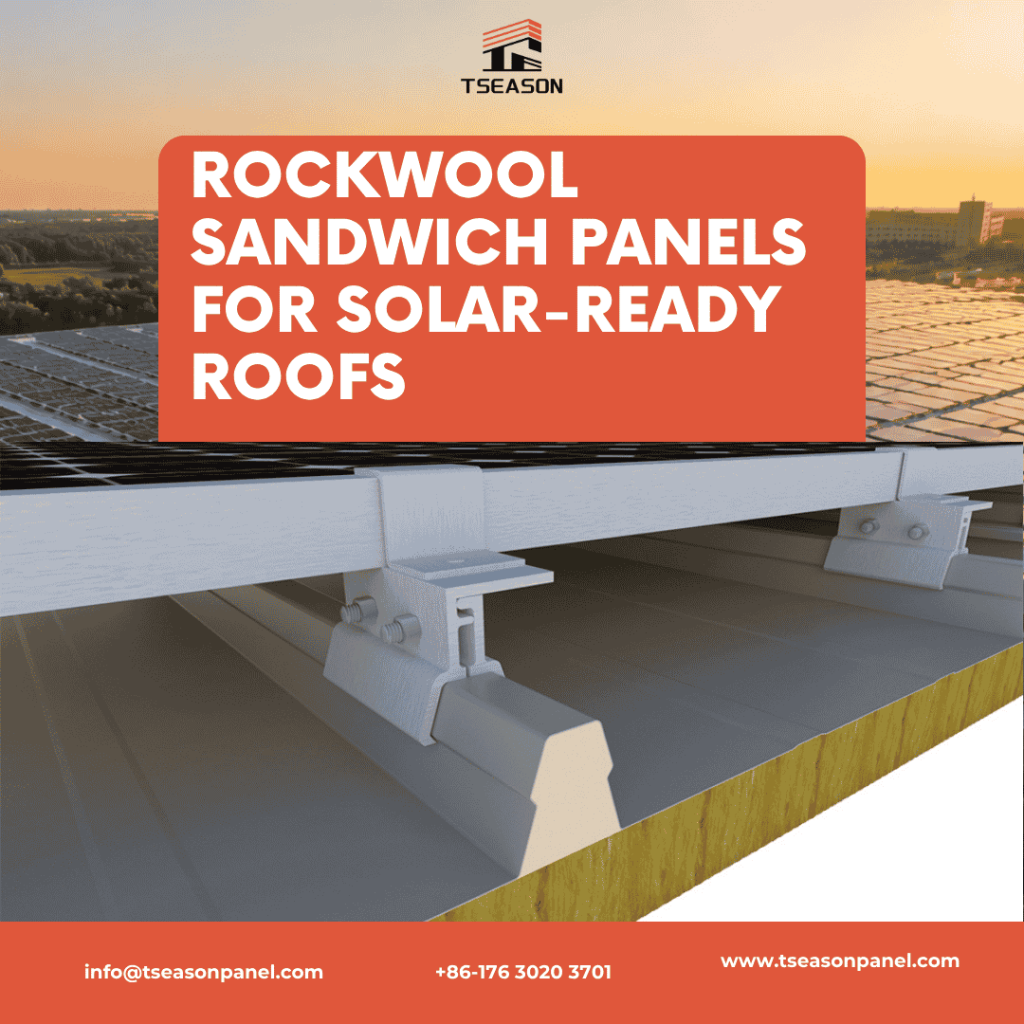
Introduction: Why Rockwool Sandwich Panels Matter for Solar Roofs
Here's a costly mistake I see repeatedly: factory owners spec their roof panels without thinking about solar. Then, 18 months later when they're ready to install PV, the retrofit quote comes back 4× higher than it should have been.
That's 25 years of unnecessary expense, locked in by a single design-phase oversight.
The root cause isn't a lack of budget. It's a lack of roof-system coordination. I've watched factory owners select industrial roof panels for their fire safety and thermal performance — only to discover, when the PV contractor finally arrives, that the roof can't safely carry the additional load. Or worse: every mounting bracket requires a penetration that voids the roof warranty.
So let's fix that.
Rockwool sandwich panels designed for solar-ready installation eliminate the trade-off between fire safety and PV feasibility. By integrating the mounting strategy into the panel specification — before the first steel column is erected — you reduce total installed cost, preserve the roof warranty, and secure a larger, unshaded PV array.
Here's what we'll cover — and honestly, #5 is the section most people skip (then regret it later):
- What "solar-ready" actually means in panel-specification terms (hint: it's not just "buy thicker panels").
- The technical specifications that matter most for rockwool panels on solar roofs.
- How integrated installation works — and why it avoids the leaks that plague retrofits.
- A step-by-step load-calculation method you can apply to your own project.
- How three real-world factories solved these problems with measurable results.
Evaluating panels for your project?
We've got load-span tables, BIM models, and technical datasheets waiting for you: Photovoltaic Roof Integrated Panel product page.
What Are Solar-Ready Rockwool Sandwich Panels?
Definition and Working Principle
Think of a solar-ready panel as a roof that's been designed with solar in mind from day one. Not as an afterthought — but as part of the original blueprint.
A solar-ready sandwich panel is a factory-engineered roofing system where the PV mounting interface is built into the panel itself.
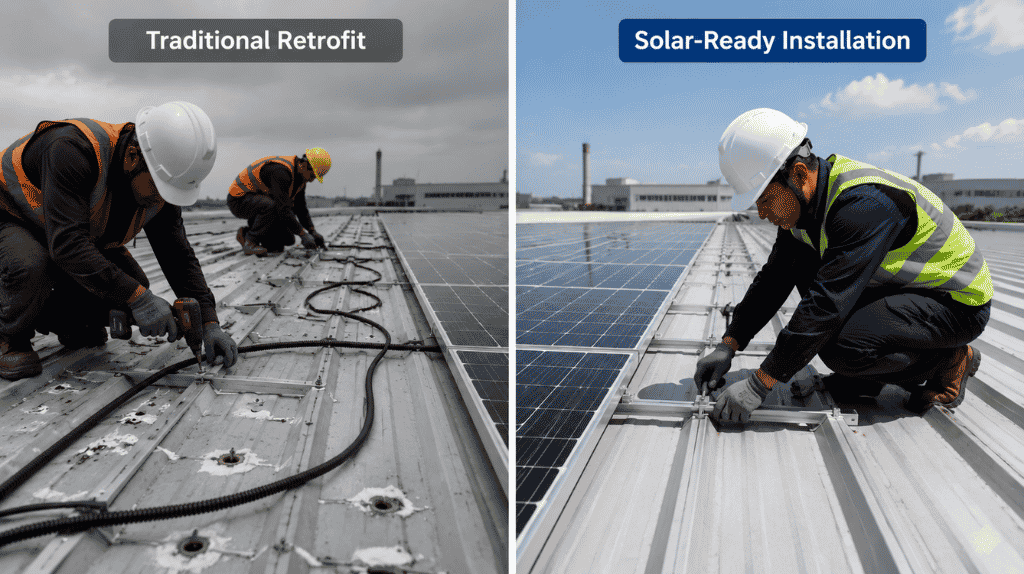
Here's what usually happens with retrofits: the PV racking contractor shows up after the roof is complete. They drill through the roof cladding to bolt down brackets. They snake cables across the roof surface. And then? They just hope the original roof warranty survives the penetration pattern.
The result is predictable. Leaks within 18–36 months. Structural reinforcement costs. And PV array layouts dictated by (rather than optimized for) the existing roof geometry.
Here's the smarter approach.
The panel is specified and installed with the PV system in mind:
- Integrated mounting profiles — the panel seam or surface incorporates reinforced zones or concealed inserts that accept PV clamps without penetrating the weather envelope.
- Pre-calculated load paths — the panel, purlin, and frame design already account for the dead load of the PV array, the wind suction, and the maintenance live load.
- Cable management built in — the panel system includes concealed channels or specified attachment points for DC cabling, eliminating cable ties and roof-walking damage.
The result: the PV array is installed without a single penetration through the weather surface, and the roof warranty remains fully intact.
For a deeper look at panel options, see our overview of solar roof sandwich panels.
Core Advantages
| Advantage | What It Means | Why It Matters |
| Zero-penetration mounting | PV clamps engage the panel seam or concealed insert | No roof penetrations = no leak pathway |
| Warranty preserved | Roof and PV systems installed under a single coordinated specification | Avoids the "whose warranty is it?" dispute |
| Non-combustible core | Rockwool A2-s1,d0 core as standard | Meets strictest fire codes for industrial roofs |
| Faster PV installation | No measuring, drilling, or sealing on-site | Reduces PV installation time by 30–50% |
| Thermal + PV synergy | Panel insulation reduces building cooling load; PV shade reduces panel surface temperature | Combined energy saving 15–30% |
| 8 cm air channel | 5 cm high-rib profile + 3 cm custom clamp forms 8 cm ventilation gap | Prevents PV back-sheet overheating, protects conversion efficiency |
| Rockwool core (standard) | Non-combustible A2-s1,d0 core — not PU/PIR | Fire-critical roofs require non-combustible core |
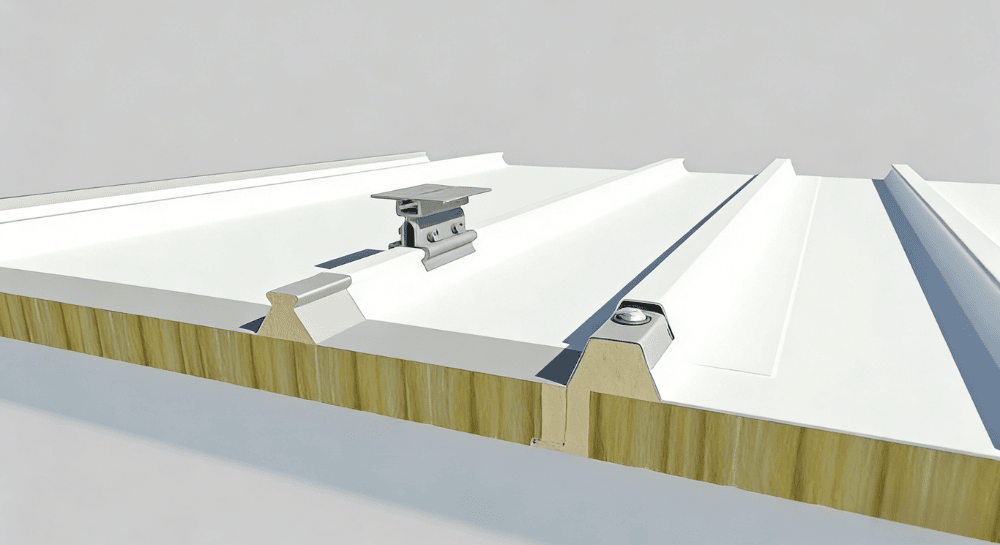
Six Technical Advantages of Tseason Solar-Ready Panels
① 5 cm high-rib profile + 3 cm custom clamp → 8 cm air channel
The panel's rib profile stands 50 mm above the flat surface. The PV clamp adds another ~30 mm of standoff. The result is an 80 mm air channel between the PV module and the roof surface. This ventilation gap is the single most effective way to prevent PV back-sheet temperature from exceeding 50°C — the threshold at which conversion efficiency drops rapidly. For every 1°C above 50°C, crystalline silicon modules lose ~0.45% of output.
② Exclusive rib-and-clamp design — direct PV mounting on roof panel
Tseason's rib profile is engineered with a concealed engagement groove that accepts proprietary PV clamps without any modification. The clamp snaps onto the rib and is torqued to spec — no drilling, no sealant, no heat welding. This is not a generic seam-clamp adapted to the panel; it is a co-engineered interface covered by design patent ZL201310162001.1.
③ Sliding bracket fix — no fastener penetrates the roof
The panel is held by a sliding bracket that engages the seam from above. The bracket is secured to the purlin below via a sliding clip that allows thermal expansion — but no fastener penetrates the weather surface. The entire PV racking system is mechanically locked to the panel seam from above. Compare this to a penetrated roof: every bracket requires at least 4 fasteners through the panel skin. A 100 kW array = 400–600 roof penetrations. Each one is a future leak.
④ Cold-bridge break at panel joints
At every panel-to-panel lap, a butyl sealant strip is factory-applied to the female side of the seam. When the next panel is rolled into place, the sealant is compressed across the entire seam length. This continuous seal breaks the thermal bridge at the joint — meaning the roof's U-value is not compromised at the lap. For a 75 mm PIR panel, the measured thermal bridge effect at the seam is <3% of the clear-panel U-value.
⑤ Design patent ZL201310162001.1
The rib profile and clamp engagement system is protected by Chinese design patent ZL201310162001.1. This patent covers the rib geometry, the clamp engagement mechanism, and the standing-seam profile that enables 360° mechanical interlock. When you specify Tseason solar-ready panels, you are buying a system that cannot be lawfully copied by generic panel manufacturers.
Technical Specifications of Rockwool Sandwich Panels for Solar
Core Material: Why Rock wool Is the Standard Choice
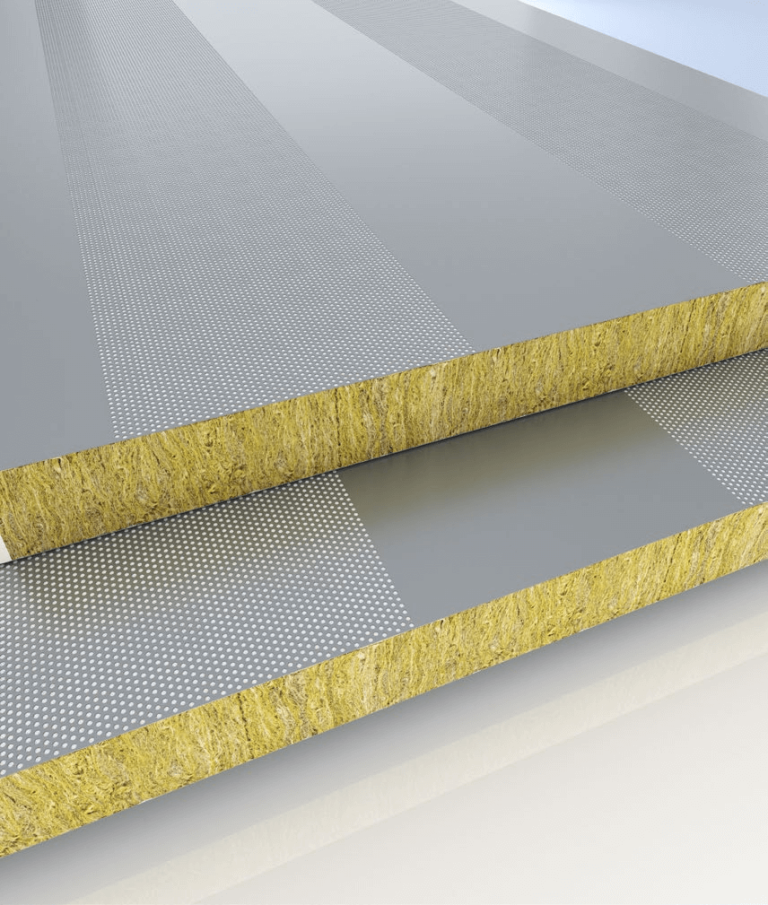
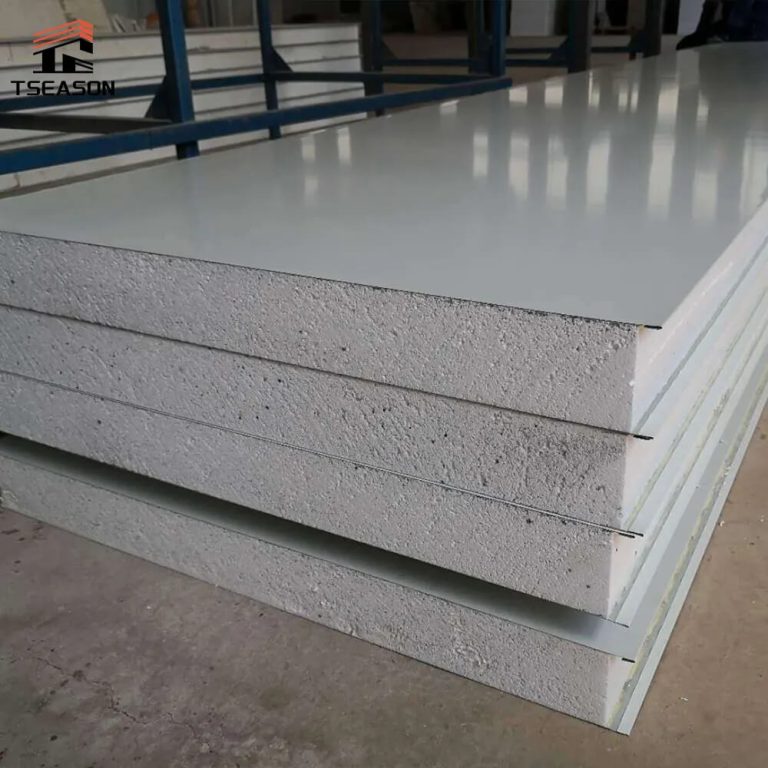
Tseason solar-ready panels use PU edge-sealed rock wool as standard. Features excellent waterproof and fire resistance performance.
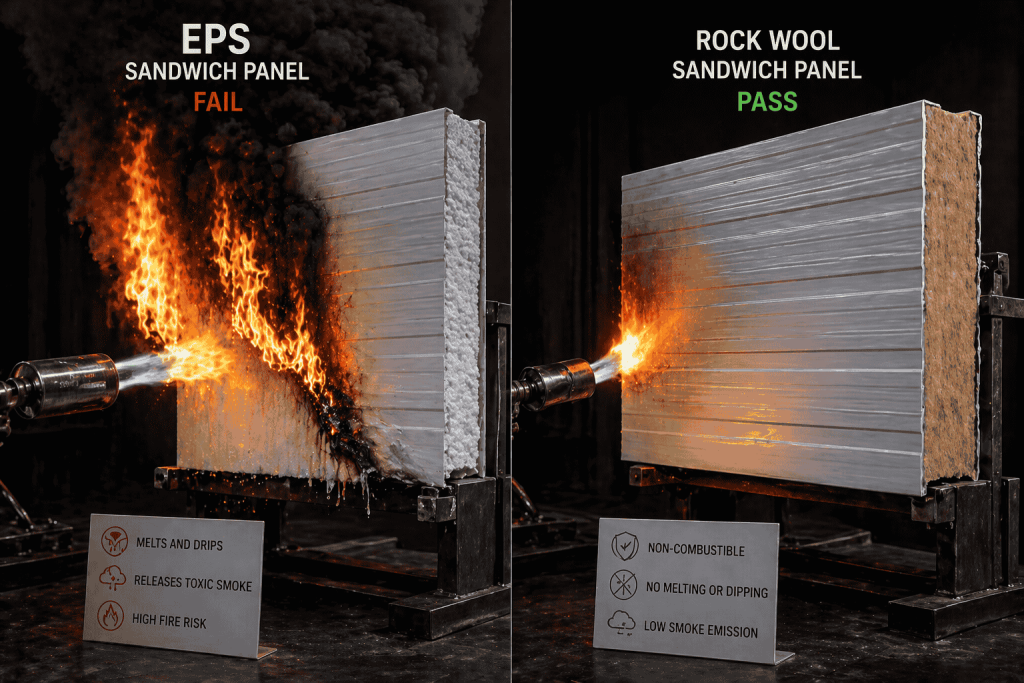
Rockwool (stone wool) is a non-combustible fibrous material made from molten volcanic rock spun into fibers. It achieves A2-s1,d0 classification under EN 13501-1 — the highest fire-performance class available for sandwich panels.
| Property | Rockwool Core (Standard) | PIR Core (Available on request) |
| Thermal conductivity (λ) | 0.042 W/m·K | 0.023 W/m·K |
| Density | 100–120 kg/m³ | 38–45 kg/m³ |
| Fire classification (EN 13501-1) | A2-s1,d0 (non-combustible) | B-s1,d0 (improved) |
| Compressive strength | 60–100 kPa | 160–210 kPa |
| Weight vs. rockwool | Baseline | -75–115% (lighter) |
| Typical roof application | Fire-critical industrial, public buildings | Fire-sensitive occupancy |
Note: Tseason can supply PU/PIR cores on request for projects where fire codes permit combustible cores and thermal efficiency is the priority. But our default recommendation — and our primary product focus — is rockwool.
Panel Dimensions and Customization
Tseason rockwool sandwich panels for solar ready roof are produced to the following standard and customizable specifications:
| Parameter | Standard Value | Custom Range |
| Effective cover width | 910 mm | 800–1,000 mm |
| Panel length | Made to order | 2,000–15,000 mm |
| Total thickness | 75 mm (standard) | 50–200 mm |
| Steel skin thickness (outer) | 0.5 mm | 0.4–0.8 mm |
| Steel skin thickness (inner) | 0.4 mm | 0.4–0.6 mm |
| Coating (outer) | PVDF 25 μm | PE / SMP / PVDF |
| Coating (inner) | Polyester 15 μm | Epoxy / Polyester |
| U-value (100 mm Rockwool) | 0.42 W/m²·K | Varies with thickness |
The 910 mm effective cover width is an important design parameter for PV layout. Most commercial PV modules (e.g., 550 W monocrystalline) have a width of ~1,130 mm. A 2-panel-across roof layout (1,820 mm) aligns with exactly two panel widths (1,820 mm) with a small lap allowance. This alignment reduces module overhang, simplifies clamp placement, and minimizes roof-walking during installation.
Solar Panel Installation Solutions for Sandwich Panel Roofs
Integrated Installation (Zero-Penetration)
The defining feature of a solar-ready sandwich panel system is the integrated PV mounting interface.
Tseason's photovoltaic roof integrated panel incorporates a 5 cm high-rib profile. When combined with the custom 3 cm standoff clamp, the two create an 8 cm air channel between the PV module and the roof surface. This ventilation gap is critical: it prevents the PV back-sheet temperature from exceeding 50°C — the threshold at which crystalline silicon efficiency drops rapidly.
How it works, step by step:
1.Panel installation — sandwich panels are installed to purlins using the standard concealed-fix method. No special preparation is needed on the roof surface.
2.Sliding bracket placement — PV seam-clamps are snapped onto the panel seam using a sliding bracket that engages the concealed rib profile. No fastener penetrates the weather surface.
3.Rail attachment — aluminum PV rails are bolted to the clamps. The rail sits above the roof surface on the 3 cm standoff, creating the 8 cm air channel.
4.Module mounting — PV modules are clamped to the rails using standard mid-clamps and end-clamps.
5.Cable routing — DC cables are routed along the rail and secured with clip-on cable ties. No cables cross the roof surface independently.
The result: The entire PV array is installed from above, with no roof penetrations, no sealant, and no warranty disputes. The 8 cm air channel reduces PV back-sheet temperature by 10–18°C, protecting conversion efficiency even on 40°C+ summer days.
If the roof has not been installed: Specify solar ready panels directly; if the roof is already installed: Conduct a roof compatibility assessment before construction.
How to Choose the Right Sandwich Panel for Your Solar-Ready Roof
Decision Checklist
Okay, let's make this practical. Here's your pre-flight checklist before you sign off on any panel spec.
✅ 1. What is the design wind speed and terrain category?
The wind load determines the required panel thickness, steel-skin thickness, and purlin spacing. Do not guess. Obtain a site-specific wind-load calculation from a qualified structural engineer.
✅ 2. What is the target PV capacity (kW)?
The PV capacity determines the additional dead load and the roof area required. A typical rule of thumb: 1 kW of PV requires ~8–10 m² of unshaded roof area.
✅ 3. What are the fire-safety requirements?
If the factory processes combustible materials, stores hazardous goods, or houses occupied spaces, the roof may be required to achieve A2-s1,d0 classification — which means rockwool core. For general industrial occupancy, PIR (B-s1,d0) is typically acceptable and far more weight-efficient.
✅ 4. What is the building's thermal performance target?
The panel thickness required for the roof's thermal performance may be different from the thickness required for structural load capacity. Select the greater of the two thicknesses.
✅ 5. What is the roof layout (clear area, equipment, skylights)?
PV modules require a clear, unshaded roof area. Roof equipment (HVAC units, vents, skylights) creates shade that reduces PV output. The roof layout should be planned with the PV array in mind — not the other way around.
Common mistake: Placing roof ventilators in the middle of the roof plane. Every ventilator creates a ~3×3 m shade zone. For a large factory roof, this can reduce PV output by 5–15%.
Common Mistakes to Avoid
Mistake 1: Specifying the panel without accounting for PV dead load
The panel is installed first; the PV array is installed 6–18 months later. If the panel wasn't specified for the PV dead load, the owner faces three bad options: (a) reinforce the roof structure (expensive), (b) reduce the PV array size (lost revenue), or (c) install the PV anyway and accept the safety risk.
Fix: Specify the panel for the final roof load (panel + PV + maintenance), not just the panel dead load.
Mistake 2: Choosing a panel with an incompatible seam profile
Not all sandwich panels have a seam profile that accepts PV seam-clamps. If the panel seam is an incompatible profile, the PV retrofit will require penetrations — and the associated leak risk.
Fix: Verify PV-clamp compatibility before specifying the panel. Request a compatibility letter from the panel supplier and the PV racking supplier.
Mistake 3: Underestimating the cable-management requirement
DC cables from the PV array must be routed to the inverter. If the roof specification doesn't include a cable-management strategy, the installer will use cable ties and roof-walking — which damages the panel coating and creates roof-access safety risks.
Fix: Specify concealed cable-management channels or require that the PV racking system includes integrated cable clips.
Mistake 4: Ignoring the roof-warranty interaction
Many roof-panel warranties explicitly exclude damage caused by "penetrations not authorized by the panel manufacturer." If the PV array requires penetrations, and the panel manufacturer hasn't authorized the penetration method, the roof warranty is void.
Fix: Use a solar-ready panel system with integrated mounting (zero penetrations), or obtain written warranty approval for the PV penetration method before installation.
Project Case Studies
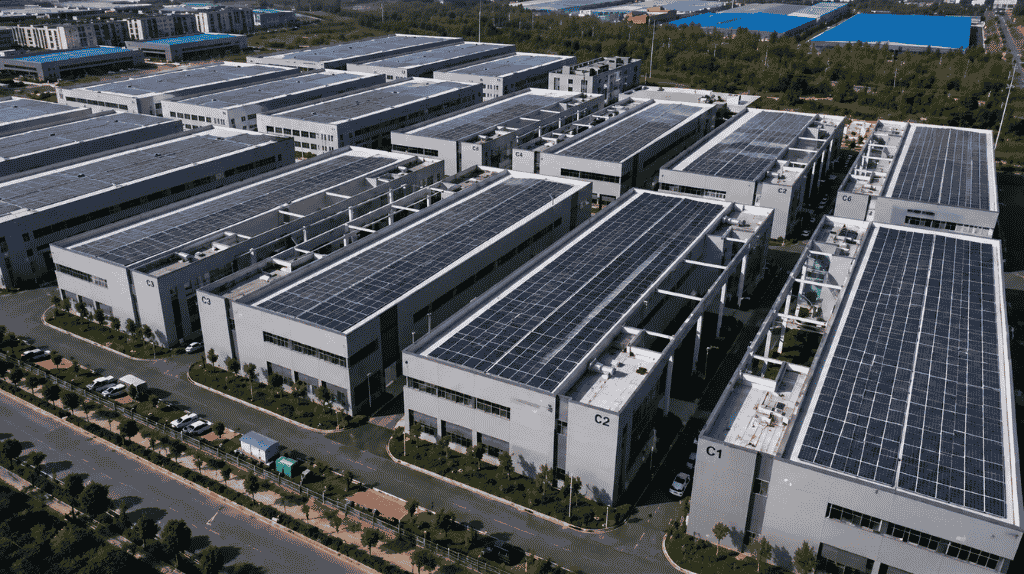
National High-Tech Zone Aerospace Industrial Park,Xinxiang,China
Project scale: 150,000 square meters.
Panel specification:
Roof System:Tseason BIPV solar-integrated roof panels,Total usage: 100,000 ㎡
Wall System:Tseason PU-edge-sealed rockwool large-texture sandwich panels,Total usage: 50,000 ㎡
The solution: All door and window openings of the factory walls adopt integral one-piece corner processing. This optimized construction method eliminates traditional splicing gaps, effectively improving the overall airtightness, waterproof performance and structural stability of the building envelope. Meanwhile, it achieves a high-end curtain-wall-grade architectural appearance for industrial workshops at a lower construction cost, balancing structural safety, economic efficiency and visual aesthetics.
Why Choose Tseason Rockwool Sandwich Panels?
Exclusive Patent Technology
Tseason's solar-ready sandwich panel system is protected by Chinese utility model patent ZL201310162001.1. This patent covers the rib geometry, the clamp engagement mechanism, and the 360° locking seam profile. When you specify Tseason solar-ready panels, you are buying a system that cannot be lawfully copied by generic panel manufacturers.
The patent covers:
- Rib profile geometry — the 5 cm high-rib design that forms the 8 cm air channel.
- Clamp engagement mechanism — the sliding bracket that engages the seam without penetration.
- 360° locking seam — the mechanical interlock that distributes PV clamp loads across the seam.
Technical Support Advantages
Specifying a solar-ready roof involves coordination between the roof-panel supplier, the structural engineer, the PV system designer, and the installation contractors. Tseason provides integrated technical support throughout the design and construction process.
What this means in practice:
- Load calculation service: Tseason's engineering team reviews the site-specific wind-load calculation and confirms panel suitability. If the standard panel is not adequate, Tseason engineers propose an optimized specification (thicker skin, closer purlin spacing, or different core density).
- BIM model delivery: Tseason supplies BIM models (Revit, ArchiCAD) of the panel system, including the solar-ready seam profile. The PV racking designer can model the clamp engagement in 3D before ordering materials.
- On-site technical supervision: For projects above 20,000 m², Tseason provides on-site technical supervision during roof installation to verify that the panel seam is correctly rolled and that the PV clamp interface is not compromised.
- Warranty coordination: Tseason issues a combined roof-and-PV warranty letter (for projects using Tseason-approved PV clamp systems), confirming that the PV installation doesn't void the roof warranty.
Product Certification and Quality
Tseason rockwool sandwich panels are manufactured in accordance with EN 14509 (self-supporting double skin metal-faced insulating panels) and are certified by independent third-party organizations. Recent Building Integrated Photovoltaics (BIPV) research confirms that integrated roof-PV systems deliver superior long-term performance compared to retrofit installations.
| Certification | Scope | Status |
| CE Marking | Product conformity (EN 14509) | ✅ |
| ISO 9001:2015 | Quality management system | ✅ |
| SGS Fire Test Report | Fire performance (Rockwool: A2-s1,d0) | ✅ |
| TÜV SÜD | Thermal performance verification | ✅ |
| FM Approvals | (Available on request) | On request |
All certified rockwool sandwich panels are traceable to production batch and raw material lot.
Production capacity: Tseason's manufacturing facility in Xinxiang, Henan produces 3.5 million m²/year of rockwool sandwich panels, with automated continuous-line production (not batch production).
Export experience: Tseason panels have been supplied to 42 countries, including PV-integrated roofing projects in China, Southeast Asia, the Middle East, and South America.
Conclusion: Choosing the Right Solar-Ready Roof Panel
A factory roof is a 25–40 year asset. The decision to make it solar-ready — or not — is made during the design phase, before the first panel is ordered. After the roof is installed, the cost of adding solar-ready capability increases by 3–5×.
Rockwool sandwich panels designed for solar-ready installation eliminate the compromise between fire safety and PV feasibility. The integrated mounting system preserves the roof warranty, reduces PV installation time, and delivers measurable cooling-energy savings through the PV-shade effect.
When specifying solar-ready panel specifications, make sure your supplier can provide load calculations, BIM models, and on-site technical support.
Three actions to take now:
- If you are planning a new factory: Include the PV system capacity and roof layout in the architectural brief. Ask the roof-panel supplier to confirm that the specified panel is solar-ready and PV-clamp-compatible.
- If you are retrofitting an existing roof: Commission a roof compatibility assessment. Determine whether the existing panel seam profile accepts clamp-on PV brackets — and if not, obtain a written cost estimate for penetration-based mounting (including leak-risk mitigation).
- If you are specifying panels: Request the load-span table, the fire-test report, and (for solar-ready projects) the PV-clamp compatibility letter from the panel supplier. Verify that the supplier can provide on-site technical support and a combined warranty letter.
Ready to specify solar-ready rockwool panels for your factory roof? Contact Tseason's technical team for load calculations, BIM models, and project-specific panel specifications.
? WhatsApp: +86 176 3020 3701
? Email: [email protected]
? Website: www.tseasonpanel.com