PUF vs PIR vs Rock Wool: How to Compare Sandwich Panel Cores by Fire Code, U-Value, and Landed Cost
Comparing 100 mm PUF, 100 mm PIR, and 100 mm rock wool panels by bare ex-factory price per square meter sets up a costly surprise on site. Match a 100 mm PIR wall’s thermal transmittance (U around 0.22 W/m²·K) in rock wool, and panel thickness jumps to 180-200 mm. Panel dead weight more than doubles on your secondary steel purlins, and the square meters packed into each 40-foot high-cube (40HQ) container drop by roughly half. Conversely, substituting standard PUF where insurers or fire authorities require a non-combustible core stalls occupancy sign-off.
Whether your tender schedule writes PUF (Polyurethane Foam, common across South Asian, Middle Eastern, and African specifications) or PU / PUR (standard in European EN 14509 and Chinese GB schedules), use one four-step elimination order: lock the mandatory fire class first, check vapor drive across your operating temperature delta second, calculate equal-U landed container volume third, and assign cores zone by zone rather than buying one core for the entire building.
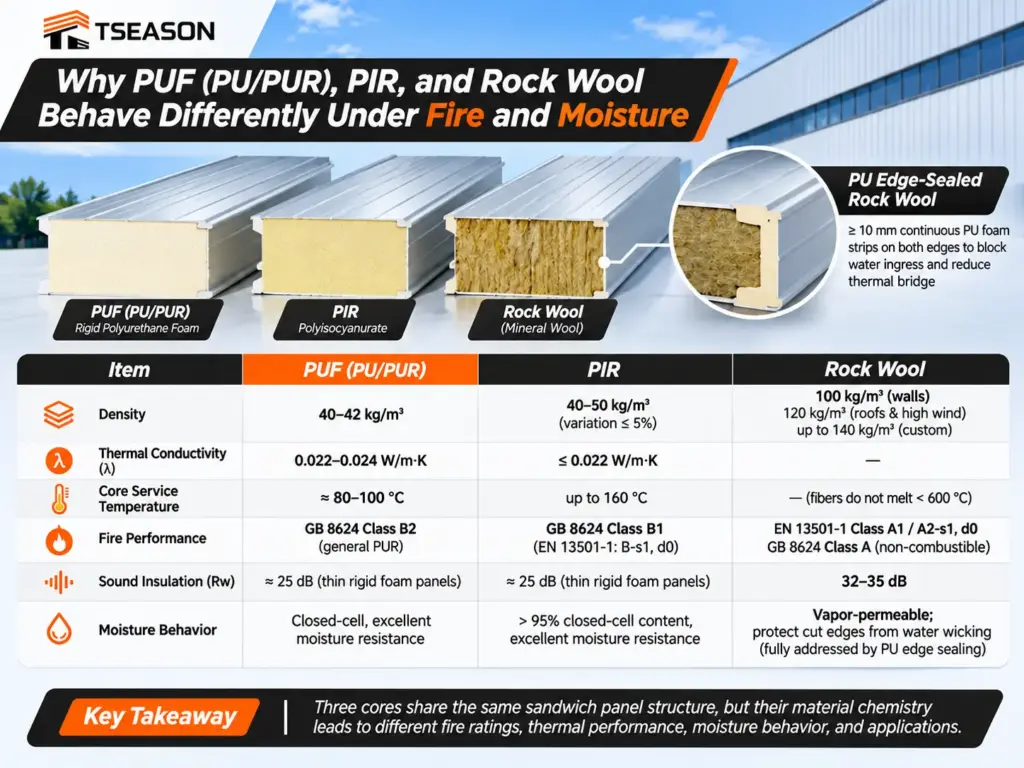
Why PUF (PU/PUR), PIR, and rock wool behave differently under fire and moisture
All three sandwich panels bond two pre-painted or stainless metal facings to an insulating core on a continuous laminating line, yet the cores belong to two separate material families with three distinct failure thresholds.
- PUF (
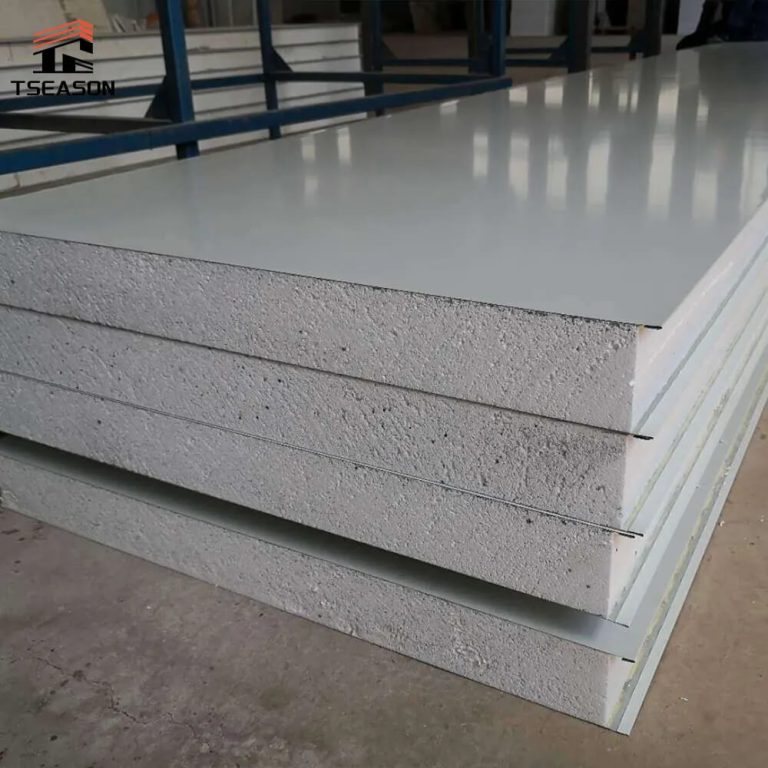
PU/PUR, rigid polyurethane foam) reacts polyols and isocyanates into a closed-cell thermoset foam (40-42 kg/m³typical density, thermal conductivity0.022-0.024 W/m·K). Closed cells block moisture migration well in chillers and ambient claddings, and continuous service stability holds up to roughly80-100 °C. Under direct flame, however, standard linear urethane bonds soften and decompose rapidly, placing general PUR formulations inGB 8624 Class B2unless upgraded. - PIR (polyisocyanurate) modifies that foam chemistry with a higher isocyanate index that forms cross-linked cyclic isocyanurate rings. On our Italian OMS high-pressure foaming and PUMA automated continuous lines at Tseason, PIR achieves over
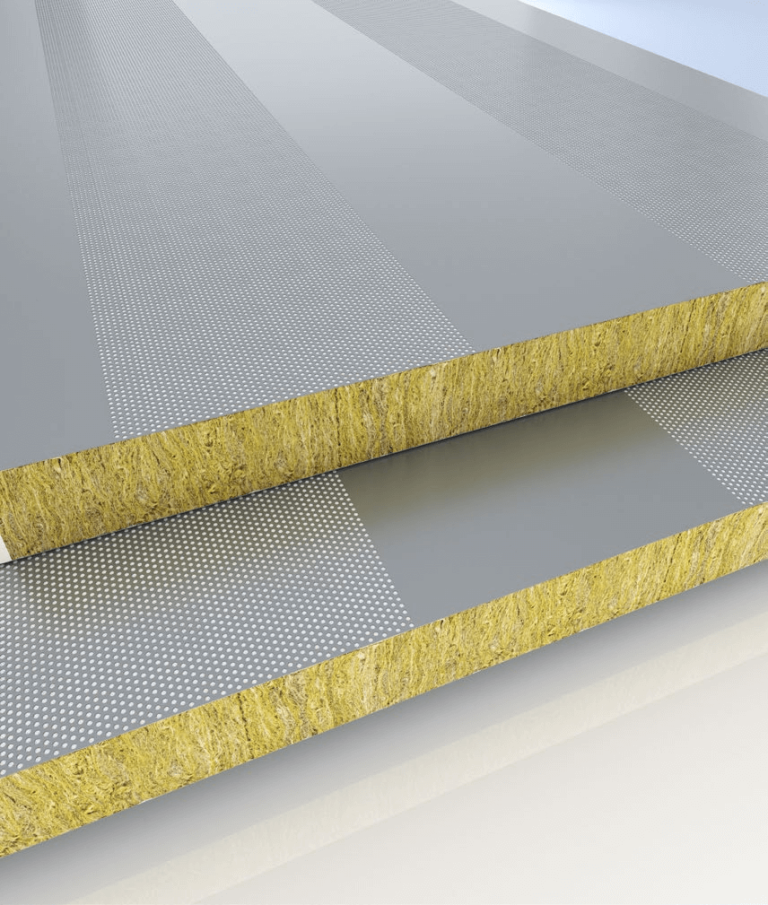
95%closed-cell content (40-50 kg/m³depending on panel series, density variation within5%) and thermal conductivity at or below0.022 W/(m·K). When exposed to flame, PIR rapidly forms a carbonaceous char skin that shields underlying foam, limits smoke, and reachesGB 8624 Class B1(EN 13501-1B-s1, d0reaction class on tested configurations) with core thermal stability up to160 °C. Because PIR upgrades fire and thermal stability for a modest material step-up, our main foam-core production line standardizes on PIR while supporting custom PUR requests. - Rock wool (stone wool / mineral wool) is spun from molten basalt rock into vertically oriented inorganic fibers bonded between steel facings (
100 kg/m³standard wall density,120 kg/m³recommended for roofs and high wind-load zones, up to140 kg/m³custom). Basalt fibers do not melt below600 °C(EN 13501-1 Class A1 / A2-s1, d0andGB 8624 Class Anon-combustible) and absorb airborne machinery noise (Rw 32-35 dBvs roughlyRw 25 dBon thin rigid foam panels). Because fibrous cores remain vapor-permeable, raw cut edges must be protected against liquid water wicking. - PU edge-sealed rock wool closes the moisture and thermal-bridge gap on mineral wool envelopes. We encapsulate the basalt core with
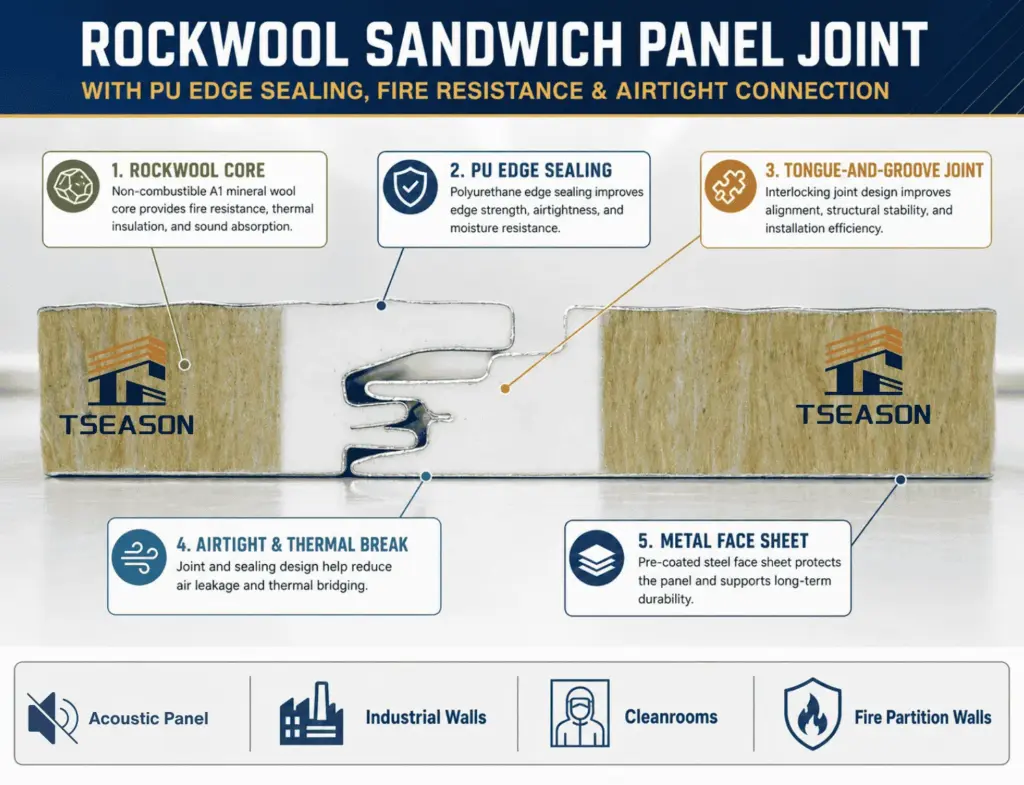
>= 10 mmcontinuous polyurethane foam strips along both longitudinal tongue-and-groove edges (>= 98%hydrophobic rock wool core inside, concealed screw joints outside), preventing edge water ingress while preserving a mineral-wool fire core across the panel field.
Three specification mistakes to rule out before comparing panel prices
Before entering unit rates into a bid tab, eliminate three engineering mismatches that trigger site rejections or premature envelope failure:
- Rule out treating core reaction-to-fire labels as wall fire-resistance minutes. Building regulations draw a strict boundary between how a material feeds a fire (reaction to fire, such as
Class B1orClass A1) and how long a complete wall or roof assembly contains fire and heat transmission (fire resistance, rated in minutes). As explained in the UK Government’s Approved Document B fire safety guidance, reaction classifications apply to specific tested end-use conditions and do not substitute for full-assembly fire-resistance testing across joints, spans, and fasteners. When your fire authority specifies a 60-minute or 120-minute boundary wall, request a complete assembly specification matching core density, panel thickness, and joint detail rather than ordering by core acronym alone. - Stop specifying unsealed open-edge rock wool panels for subzero freezers or high-pressure washdown rooms. A
-25 °Cfreezer surrounded by+32 °Chumid ambient air experiences relentless inward vapor drive. As building-science guidance from the U.S. Department of Energy Building America Solution Center notes, air leakage through unsealed joints carries far more moisture into an enclosure than diffusion through intact facings. Moisture that enters fibrous mineral wool freezes, expands, and destroys insulating capacity. Route subzero envelopes to150-250 mmclosed-cell PIR cam-lock panels; if local fire code mandates mineral wool in a humid food hall, specify PU edge-sealed rock wool (>= 10 mmedge seal) with continuous butyl tape and neutral-cure silicone at every joint. - Do not substitute flat wall panels or sub-
100 kg/m³rock wool on long-span walkable roofs. Flat facers pond water and buckle under maintenance foot traffic, while low-density mineral wool loses flatness across purlin spans. Specify trapezoidal ribbed roof profiles (minimum5%roof slope,10%preferred) with120 kg/m³rock wool or PIR cores, and check your purlin spacing against our sandwich panel load-span engineering data before releasing steelwork drawings.
Engineering comparison across PUF, PIR, rock wool, and PU-sealed rock wool
Use the matrix below to filter candidate cores against your building code, thermal target, acoustic limit, and shipping weight. Values reflect Tseason continuous-line specifications; custom widths, facings (PPGI, PPGL, or SUS304 stainless steel), and thicknesses are confirmed on project shop drawings.
| Selection parameter | PUF (PU / PUR foam) | PIR (Polyisocyanurate foam) | Standard rock wool | PU edge-sealed rock wool |
|---|---|---|---|---|
| Core structure | Closed-cell rigid urethane foam | Cross-linked cyclic isocyanurate foam (>95% closed cell) | Vertically oriented basalt fiber (>=98% hydrophobic) | Basalt fiber core + >=10 mm PU foam side seals |
Thermal conductivity (λ) | 0.022-0.024 W/(m·K) | <= 0.022 W/(m·K) | 0.038-0.043 W/(m·K) | Core <= 0.043 W/(m·K) with reduced joint thermal bridging |
| Standard core density | 40-42 kg/m³ | 40-50 kg/m³ (series dependent) | 100 kg/m³ (wall) / 120 kg/m³ (roof & high-load) | 100-120 kg/m³ (80-140 kg/m³ customizable) |
| Continuous service temp limit | Up to 80-100 °C | Up to 160 °C (core thermal limit; subzero down to -60 °C) | Above 600 °C without melting drips | Core above 600 °C; PU edge seal governed by foam limit |
Airborne sound reduction (Rw) | Approx. 25 dB (50 mm baseline) | Approx. 25 dB (50 mm baseline) | 32-35 dB (fibrous sound absorption) | 32-35 dB with tight 0.3-0.5 mm joint gap precision |
Reference weight (100 mm, 0.5/0.5 mm steel) | Approx. 12 kg/m² | Approx. 12-13 kg/m² | Approx. 20 kg/m² (at 120 kg/m³ core) | Approx. 20-21 kg/m² (at 120 kg/m³ core) |
| Tseason standard thicknesses | 50 / 75 / 100 / 150 / 200 mm | 50 / 75 / 100 / 120 / 150 / 180 / 200 / 220 / 250 mm | 50 / 75 / 100 / 120 / 150 / 200 mm | 50 / 75 / 100 / 120 / 150 / 200 mm |
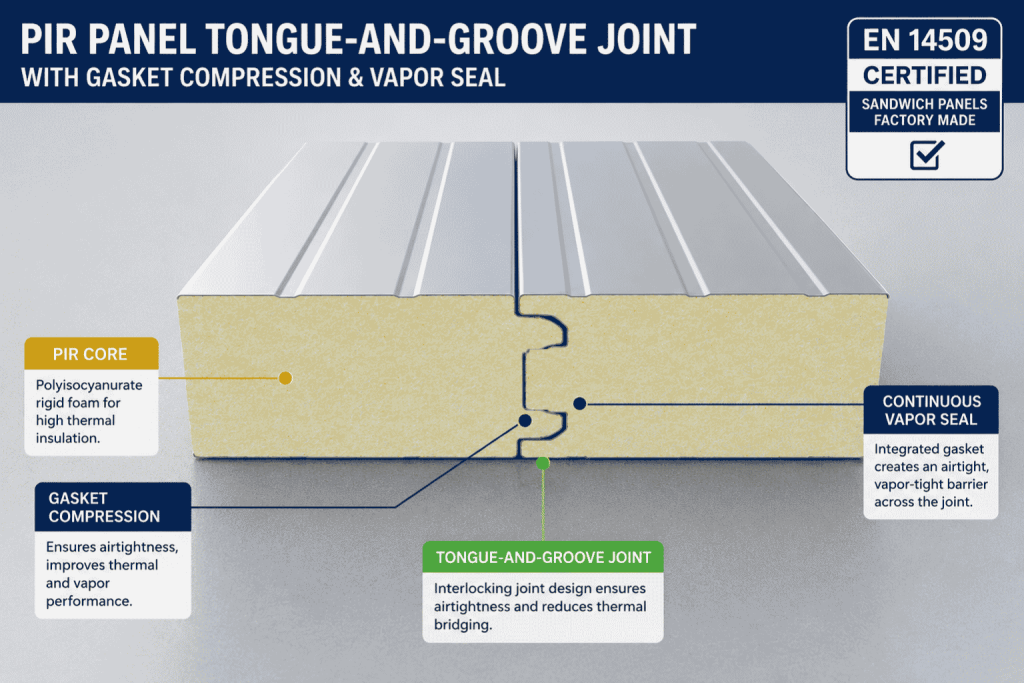
| Effective cover width & joints | 1,000 mm; tongue-and-groove or cam-lock | 1,000 mm (custom optional); tongue-and-groove, overlap, or cam-lock | 1,000 mm (roof/wall) or 1,150 mm (wall); tongue-and-groove | 1,000-1,150 mm; double-rebated hidden-screw seam lock |
For projects standardized on closed-cell foam insulation, review full facing and profile options on our polyurethane and PIR sandwich panel page. Where non-combustible mineral cores or acoustic walls govern the permit, compare profiles on our rock wool sandwich panel page.
How equal U-value requirements flip panel thickness, dead weight, and 40HQ freight cost
Ocean freight and structural steel budgets punish buyers who compare cores at equal thickness instead of equal thermal transmittance (U-value). Because PIR conducts roughly half as much heat per millimeter as rock wool (0.022 vs 0.040-0.043 W/m·K), holding the same building cooling load requires nearly twice the thickness in mineral wool.
Suppose, for illustration, you are importing 2,000 m² of exterior cladding for an air-conditioned logistics or pharmaceutical packaging hall overseas, with panel lengths cut under 11.8 m to fit standard 40HQ sea containers and an envelope target of U <= 0.22 W/(m²·K):
- Option A (
100 mmPIR core atλ = 0.022 W/m·K): A100 mmpanel meets the thermal target atU ≈ 0.21-0.22 W/(m²·K). With0.5 mmsteel facings on both sides, panel weight sits near12 kg/m², putting24 metric tonsof cladding onto the building frame. Because a single40HQcontainer loads roughly500 to 580 m²of100 mmpanels, the entire2,000 m²wall order ships in 4 containers. - Option B (Rock wool sized to match
U <= 0.22 W/m²·Katλ = 0.040-0.043 W/m·K): Reaching the same thermal resistance pushes rock wool thickness into the180-200 mmbracket. At120 kg/m³density, panel mass climbs past28-31 kg/m²(56 to 62 metric tonstotal), requiring crane-assisted erection and heavier girts. Worse for import buyers,200 mmpanels cut single-container capacity down to roughly250 to 290 m²per40HQ, expanding the shipment to 7 or 8 containers. - Suppose ocean freight + port drayage runs an illustrative
$3,500 per 40HQ: those 3 to 4 extra containers add$10,500 to $14,000($5.25 to $7.00 per m²) in shipping cost alone, completely erasing any perceived ex-factory discount on mineral wool.
For EPC estimators, the cost rule comes down to what governs the wall. Specify 100-150 mm rock wool where non-combustible Class A fire separation or Rw 32-35 dB noise control is the governing code driver and moderate thermal resistance (U ≈ 0.38 W/m²·K at 100 mm) is acceptable. Where tight cooling loads dominate and Class B1 (B-s1, d0) foam cores are permitted, PIR delivers lower landed cost per square meter of thermal resistance.
Zone-by-zone core schedule for mixed-use industrial and cold-chain facilities
Industrial parks, food plants, and distribution centers rarely share one risk profile from end to end. Splitting your bill of quantities by room condition lets you put non-combustible mass only where fire or acoustics demand it while keeping cold-chain and high-bay zones thermally compact.
| Building zone / room type | Governing site risk | Recommended Tseason core & thickness | Joint, facing & envelope pairing |
|---|---|---|---|
Blast freezers & cold stores (-30 °C to -60 °C / -20 °C) | Severe inward vapor drive, compressor power draw, subzero shrinkage | 150-250 mm PIR (150 mm typical at -20 °C; 200-250 mm below -30 °C) | Eccentric cam-lock + factory gasket + butyl seal; PPGL or food-safe SUS304 inner skin (see cold storage panels) |
Chilled food prep & washdown halls (0 °C to +10 °C) | Daily washdown humidity, hygiene audits (HACCP), moderate fire code | 75-120 mm PIR; or 100 mm PU edge-sealed rock wool if Class A core is mandated | SUS304 stainless or PET laminated food-grade skin, coved corners, neutral-cure silicone |
| Ambient logistics warehouses & assembly bays | HVAC payback, fast erection, wind load across girts | 75-100 mm PIR (50 mm unconditioned shells) | 1,000 mm cover width, concealed-screw micro-rib facade; PE inland or PVDF coastal |
| Compressor rooms, generator bays & stamping lines | Continuous machinery noise (>85 dB) and heat radiation | 100-120 mm rock wool at 120 kg/m³ density (Rw 32-35 dB) | Vertically oriented basalt core; optional perforated acoustic inner liner |
| Lot-line firewalls & battery / chemical storage partitions | Non-combustible barrier mandate, zero flaming droplets | 100-150 mm rock wool (120 kg/m³, EN 13501-1 Class A1 / GB Class A) | Tongue-and-groove or PU edge-sealed joint cleared with the local fire authority |
| Large-span industrial & solar-ready roofs | Foot traffic, ponding water, solar clamping load | 75-100 mm trapezoidal PIR or 120 kg/m³ rock wool roof panel; or insulated deck + TPO membrane | 35-45 mm high trapezoidal rib (>=5%-10% slope), or single-ply Tseason TPO membrane + vapor barrier consolidated in the same container |
Six line items to lock down when auditing sandwich panel quotes
When two quotes for “100 mm PIR” or “100 mm rock wool” sit $3 to $5/m² apart, the gap almost always hides in six specification lines rather than factory margin:
- Check whether square meters are priced on net effective cover width (
1,000 mmor1,150 mm) rather than unformed steel coil width (1,200 mm). Quoting gross coil width inflates your invoiced area by15% to 20%before a single panel leaves port. - Check bare metal substrate and coating build separately (
0.5-0.8 mmouter /0.4-0.5 mminner steel thickness; galvanized>= 120 g/m²orAZ150Galvalume with25 micron PVDFin coastal/high-UV zones vs20 micron PEinland). - Lock minimum core density and bond strength in writing (
40-50 kg/m³and>95%closed cells on PIR;100 kg/m³wall /120 kg/m³roof and>= 0.06 MPabond strength on rock wool). Sub-100 kg/m³roof mineral wool sags and delaminates under wind uplift. - Confirm edge-seal geometry (
>= 10 mmdual-side polyurethane strips) whenever buying rock wool for exterior facades or humid climates. - Itemize the complete joint and flashing kit (ridge caps, eaves flashings, base U-channels, cam-locks, butyl tape, self-drilling fasteners, neutral silicone, plus
2-3%spare consumables). Acidic silicone must never touch coated steel. - Consolidate roof membranes and vapor barriers at the source. Because Tseason manufactures TPO and PVC waterproofing membranes alongside sandwich panels in Xinxiang, loading panels, vapor barriers, membranes, and flashings on one bill of lading eliminates third-party consolidation delays and port handling damage.
Frequently asked questions on PUF, PIR, and rock wool cores
Why do many international specs replace standard PUF with PIR even when cold-room U-values look similar?
Fresh PUF (PUR) and PIR sit close in initial thermal conductivity (0.022-0.024 vs <= 0.022 W/m·K), so power bills look similar in year one. Buyers upgrade to PIR for insurer acceptance and dimensional stability: PIR chars instead of melting into flaming droplets (GB 8624 Class B1 vs standard B2) and holds structural stability across wider temperature swings (-60 °C deep freeze up to 160 °C hot roof skin exposure).
Can we install exterior wall sandwich panels on the roof to simplify container ordering?
No. Wall panels use flat or micro-ribbed facings built for horizontal wind transfer, not snow load, maintenance foot traffic, or rainwater drainage. Roof panels require 35-45 mm trapezoidal ribs, thicker outer steel (0.5-0.8 mm), and overlapped weather-sealed joints on slopes of at least 5% (or a dedicated TPO membrane assembly on low-slope decks).
Which metal skin and fastener package prevents cut-edge rust on coastal projects?
Core choice does not protect steel skins from salt fog. Within coastal or chemical zones, pair your PIR or rock wool core with an aluminum-zinc (AZ150 Galvalume) substrate, PVDF topcoat, 304 stainless steel fasteners, and capped or neutral-silicone-sealed cut edges. Standard galvanized panels with carbon-steel screws corrode around fixings within a few seasons near the shoreline.
Can we mix PIR cold-room panels, rock wool firewall panels, and TPO roofing rolls in one container shipment?
Yes. Different core types, panel thicknesses (50 mm to 250 mm), custom cut lengths (up to 11.8 m for 40HQ containers), flashings, and Tseason TPO roofing membranes can be loaded together at our plant, provided color batches are planned upfront. Keep panel lengths at or below 11.8 m to avoid flat-rack surcharges.
Send your zone schedule or building sketch for an apples-to-apples Tseason quote
You do not need a finalized bill of quantities to compare PUF, PIR, and rock wool on real landed project cost. Share two items through our Tseason project contact page and our engineering export team will return an itemized envelope proposal:
- A basic floor/roof layout sketch or two-line room schedule noting interior operating temperatures (
-25 °Cfreezer,+5 °Cchill hall, or ambient bay), purlin spacing, and local fire classification requirements. - Approximate wall/roof square meters and your destination port so we can calculate net
1,000 mmcoverage quantities,40HQcontainer loading counts, matching flashings, and optional single-container consolidation with Tseason TPO membranes and vapor barriers.