TPO Roof Repair Guide: Common Problems, Repair Methods, and Cost Factors
TPO roof membranes are widely used in commercial and industrial buildings due to their weather resistance, energy efficiency, and relatively low maintenance requirements. However, even a TPO roof that has been installed according to specifications and well-maintained may develop damage or leaks after years of foot traffic, extreme weather, or simply due to aging. If it is not found and repaired in time, these local damages may further affect the insulation layer and the roof substrate, increasing the cost of subsequent maintenance.
This article will introduce the common damage signs of TPO roof membrane, repair methods, factors affecting maintenance costs, and how to determine whether the roof should continue to be repaired or replaced.
Why TPO Roofs Need Repairs Over Time
Although TPO roofs have good weather resistance and durability, long-term exposure to the outdoor environment will still be affected by factors such as climatic conditions, foot traffic and construction quality. With the increase of use time, the roof system may be locally damaged, which needs to be checked and repaired in time.
Long-term environmental exposure: Ultraviolet radiation and temperature fluctuations will cause the membrane material and seams to continuous environmental stress. As the roof ages, surface wear or weld separation may occur in certain areas.
Mechanical Damage and Daily Use: Equipment installation, air conditioning maintenance, or foot traffic can all cause punctures and scratches to the membrane material.
Installation Quality: If seams are not properly welded or flashing details are handled incorrectly, it may gradually weld separation, loosening, or leakage during use.
Signs That a TPO Membrane Needs Repair
There are many signs that a roof is about to leak. Detecting these signs early and taking prompt action can help reduce future costs:
- Water continues to pool after 48 hours
- Visible punctures, tears, or surface damage
- Cracks in seams or loose edges of the membrane
- Roof leaks and water stains indoors
- Bulging, wrinkling, or localized lifting of the membrane
DIY Patch or Professional Weld?
DIY repairs are more suitable for limited emergency protection. For punctures or tears with a small area and easy access to the location, temporary patch materials can be used for emergency repairs. However, their adhesive strength is not as good as that of proper welding, and such repairs usually invalidates the manufacturer's warranty.
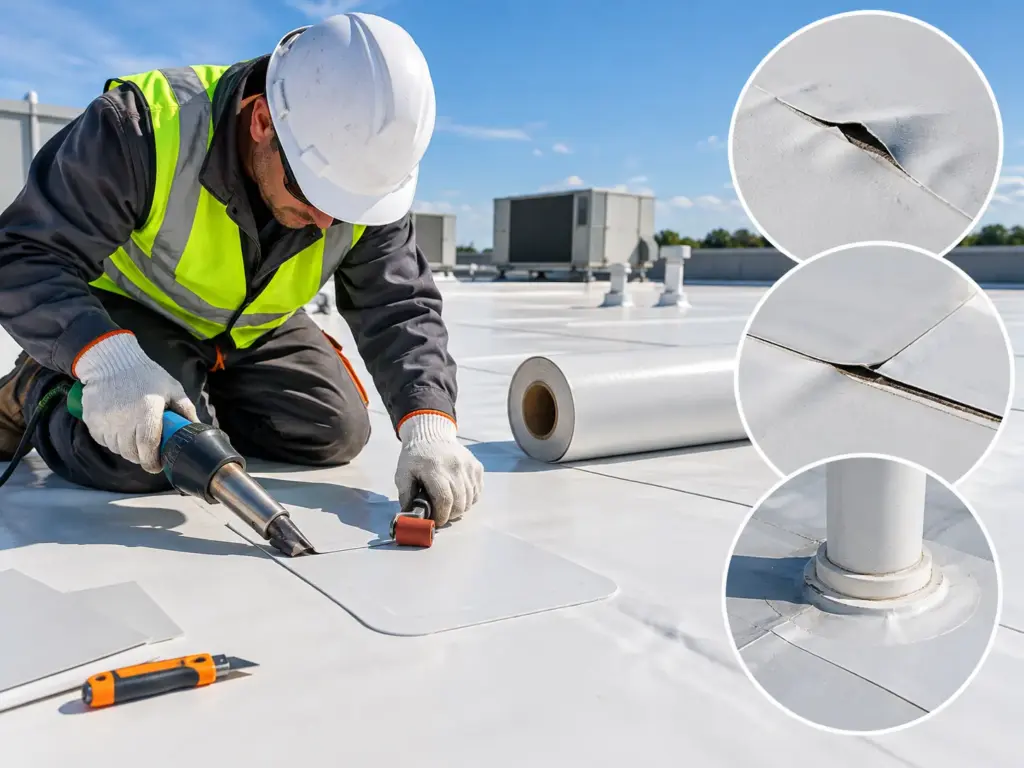
For repairs involving the integrity of the waterproofing membrane, structural joints, or long-term performance, priority should be given to professional hot air welding. Technicians use a welding machine to fuse a new TPO patch onto the existing membrane. After the weld is cooled, it is completely integrated into a thermoplastic material.
How to Repair Common TPO Roofing Problems
Repairing Punctures and Tears in TPO Membranes
Small holes, scratches or tears on the TPO membrane can usually be repaired by compatible TPO patches, but if the damage has caused moisture to penetrate the insulation layer, and the surrounding membrane material has obvious aging and brittleness, the damage scope needs to be further evaluated.
When carrying out local repair, dust and pollutants around the damaged area should be removed first. Then cut the TPO patch with appropriate size and rounded corners, ensuring sufficient welding overlap width around the damaged area. Use hot air welding equipment to bond the patch to the existing membrane material. After welding is completed and cooled, check whether the edge of the patch is not properly welded or lifted.
Repairing Failed TPO Seams
Seam failure is a key repair issue that requires attention in TPO roofing systems. The reason may be that the quality of TPO welding during installation is insufficient, long-term stress, surface contamination or changes in the condition of the membrane material.
For open welding areas with a small range and good condition of the membrane material, clean and prepare the surface according to the manufacturer's repair specifications, and repaired after confirming that the reliable welding conditions are available. If the original overlap width is insufficient, the membrane material is severely deteriorated, or there is damage near the seam, it may be necessary to add compatible TPO patch.
Fixing Leaks Around Flashings and Roof Penetrations
For local weld defects, you can re-weld or add compatible TPO patches according to the actual conditions. If the prefabricated pipe collars, flashing membrane or detail components have been damaged, the corresponding parts need to be removed and replaced.
For leakage around drain outlets, check the drain assemblies, clamping rings, and membrane connections for looseness or deformation. After the repair is completed, it should be checked and confirmed that the waterproof continuity and drainage function of the joints have been restored. These parts are complex in structure and more suitable for professional construction personnel to handle.
Extending the Service Life of a Roof After Repairs
TPO roof maintenance is essential to ensuring your roof lasts as long as possible.
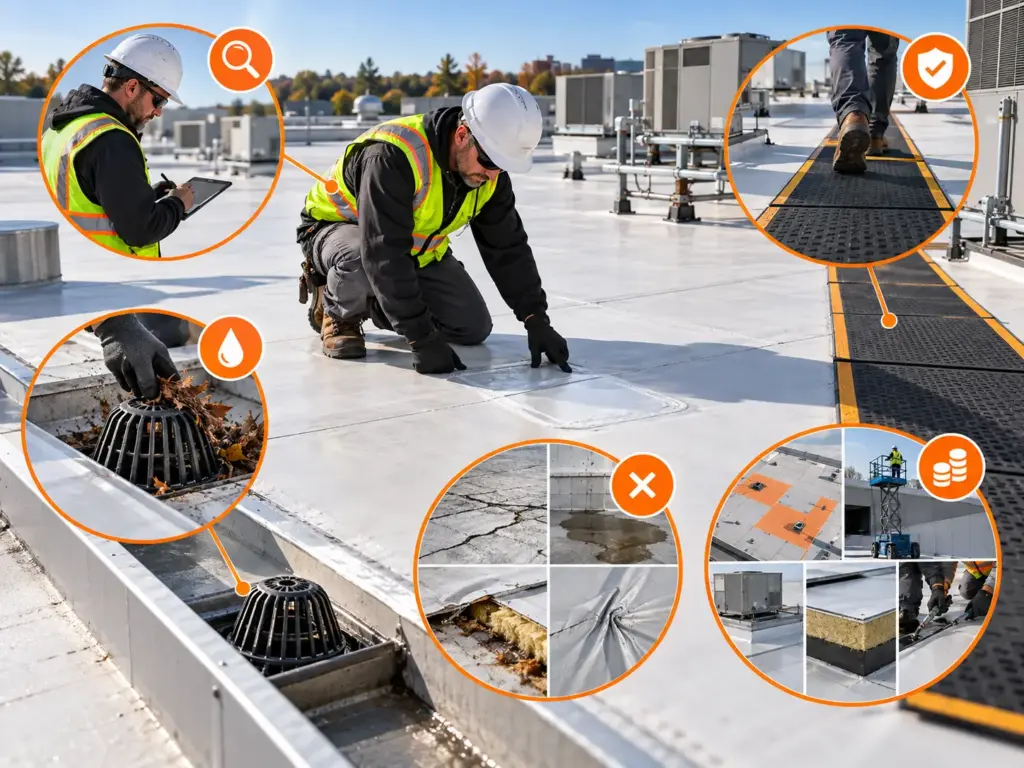
Regularly inspect and maintain the roof. It is recommended to conduct routine roof inspections at least twice a year, and increase targeted inspections after storms, hail or other extreme weather. Focus on whether there are signs of curling, cracking or leakage on the edge of the patches, the repaired seam and the surrounding membrane.
Keep the drainage system clear. Regularly clean up roof drains, gutters and surrounding areas to avoid leaves and silt from obstructing drainage. Long-term water increases will increase the risk of leakage of seams and joints. If there is still obvious water after repair, the roof slope, drainage design and condition of the substrate should be further checked.
Minimize unnecessary mechanical damage. For commercial roofs equipped with air conditioning, ventilation systems or other facilities that require regular maintenance, plan reasonable pedestrian access routes, and special walkway mats compatible with roof systems should be set up in high-traffic areas.
When Repairs aren’t Enough to Solve the Problem
Partial repair can effectively deal with many TPO roofing damage, but not all problems are suitable for solving by repair or re-welding. When the roof has the following conditions, it may be necessary to consider TPO roof replacement or install a roof covering system instead of partial repair again.
- Recurring leaks that cannot be completely resolved.
- Extensive aging or damage to the membrane material.
- Prolonged moisture penetration into the roofing system, resulting in severe damage to the insulation layer or substrate and a decline in thermal insulation performance.
- Loose fasteners or severe shrinkage causing deck deformation.
Cost Factors for TPO Roof Repairs
The cost of TPO roof repair depends on many factors. Understanding the influencing factors of TPO repair price will help you make a reasonable budget and avoid paying too much. Influencing factors include the extent of damage, construction convenience, repair location and whether the insulation layer needs to be replaced. Labor intensity will also affect costs. It is faster and cheaper to re-weld a cracked seam than to cut multiple reinforcement patches. Ask the contractor to provide a detailed cost breakdown so that you can understand how each project affects the final cost.
Why Choose Tseason TPO Roofing Membrane?
As a supplier of TPO waterproofing membranes, Tseason is committed to providing reliable waterproofing solutions for commercial and industrial roofing projects. Based on the specific roof structures, construction methods, and environmental conditions of different buildings, Tseason can assist customers in selecting the appropriate membranes according to actual product specifications and project requirements. In addition, Tseason can also offer flexible customization options to meet your specific needs, including length, width, and color.
If you are looking for the right TPO roof membrane, please feel free to contact the Tseason team to learn about product specifications, request samples, and discuss your specific project needs.
FAQs
- Can an aged TPO membrane still be reliably welded to a new patch?
Yes, provided the existing membrane remains suitable for welding. Age alone does not determine repairability; surface contamination, weathering, and the condition of the remaining weldable layer also matter. Prepare the membrane according to the original manufacturer’s instructions, then perform a test weld and evaluate the bond after cooling. If a reliable weld cannot be achieved, reassess the preparation method or replacement scope rather than repeatedly increasing the welding temperature.
- Why can’t the original installation welding settings simply be reused for repairs?
The welder’s temperature setting does not represent the actual temperature reached at the membrane interface. Ambient conditions, wind, membrane temperature, equipment output, and welding speed all affect heat transfer. Weathered membrane also behaves differently from new material. Establish suitable settings through on-site test welds and reassess them when conditions change significantly. Excessive heat can damage the membrane even when the seam appears closed.
- Can TPO membranes from different manufacturers be used as repair patches?
Do not assume that products are interchangeable simply because both are labeled TPO. Formulations, surface characteristics, and installation requirements may differ, and using another manufacturer’s material may affect the existing warranty. Prioritize repair materials approved for the original roofing system. Where an alternative is proposed, obtain technical confirmation and verify weldability through field testing. A successful test weld does not automatically establish warranty acceptance.
- Can any cleaning product be used to prepare a TPO repair area?
No. Products intended for routine roof cleaning may not be suitable for preparing weathered membrane for welding. An unsuitable cleaner can leave residue that interferes with the weld. Follow the membrane manufacturer’s cleaning procedure and use the specified products. Allow rinse water to dry and cleaning solvents to evaporate fully before welding, and protect the prepared surface from further contamination.
- How can you determine whether a leak has affected the insulation beneath the membrane?
Surface observations and interior water stains cannot reliably establish the extent of wet insulation. Depending on the roof assembly, a professional investigation may combine infrared thermography, suitable moisture detection equipment, and localized core sampling or inspection openings. Suspected wet areas require verification. The repair scope should reflect the confirmed extent of moisture intrusion rather than only the visible membrane damage.
- How should a TPO repair weld be inspected beyond its appearance?
A smooth patch with flat edges is only a starting point. After the weld has cooled, trained personnel should check its edges with an appropriate seam probe, paying particular attention to missed welds, incomplete bonding, corners, and changes in material thickness. Test-weld peel checks verify welding settings and preparation, while seam probing checks the installed weld. Neither replaces the other.