TPO Roofing Installation: Guide to Getting Single-Ply Roofs Right
No matter how superior TPO waterproofing materials may be, they still require proper installation. If TPO is installed incorrectly—for example, due to improper membrane thickness, a reinforcement layer that is incompatible with the building structure, or incompatible fasteners—it can lead to roof failure and result in financial losses.
This guide covers the construction steps of TPO waterproof membrane, the comparison of different installation methods, common problems during construction, etc. After reading this guide, you’ll have a better understanding of the TPO installation process and key points.
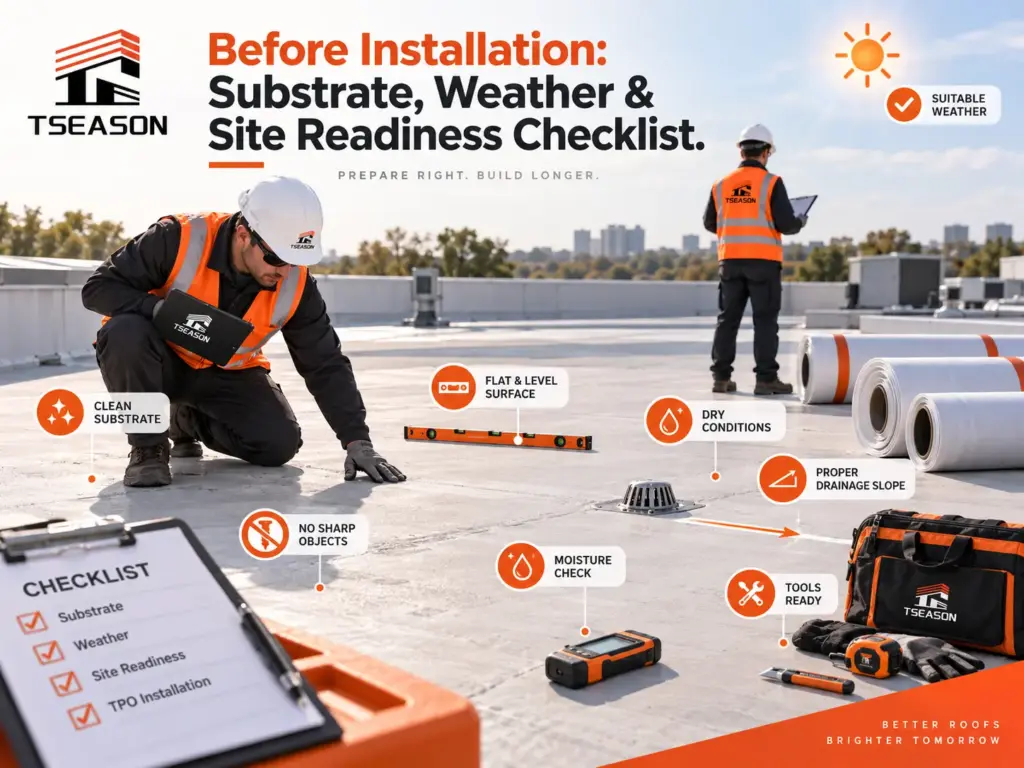
Before Installation: Substrate, Weather & Site Readiness Checklist
Preparation before installation is very important. Before installation, the condition of the substrate should be carefully checked. Whether it is concrete, metal or wooden, it is necessary to ensure that the surface is clean, flat, and free of sharp objects and oil stains. At the same time, it is necessary to test the moisture content of concrete and the existing insulation layer. If the old roof is renovated, the condition of the old roof needs to be evaluated. The roof must be maintained at an appropriate drainage slope to prevent water from pooling. The weather conditions during construction cannot be ignored either. Weather conditions during construction must also be taken into account. Welding and adhesive application must not be performed in rain or snow. Construction must be suspended when wind speeds or other conditions exceed the limits specified in the project plan or by the membrane manufacturer. Before installation, prepare the necessary tools to ensure the efficient and smooth progress of the follow-up operation.
TPO Roofing Installation Methods: Mechanically Fastened vs. Fully Adhered vs. Induction Welding
In the TPO roofing system, choosing the appropriate installation method is the core step to determine the quality of the project. It is necessary to comprehensively evaluate the type of roof substrate, wind resistance requirements, project budget and other factors. At present, the mainstream TPO roof installation methods are mainly divided into three types: mechanical fastened, full adhesive and induction welding.
Mechanically fastened method is to loosely lay the membrane during construction, and use washers and fasteners to securing it at the seam position, and then completely cover the fastener and hide it inside the weld by hot air welding. This method offers fast construction speed and is often a cost-effective option for large-area open roofs, but it must be fastened in strict accordance with the requirements of wind resistance design during installation.
Fully adhered method mainly bonds the membrane on the insulation board, covering board or qualified concrete substrate layer through contact adhesive. It has a stronger resistance to wind and peeling, which is suitable for roofs with complex shapes and more penetration parts, or lightweight/composite roofs. However, the installation speed of the fully adhered method is lower than that of mechanical fastened, and the overall cost will be relatively higher.
Induction welding is often used for the renovation of metal roofs. It is based on a dedicated fastening-plate system: specially coated plates are mechanically fastened to the load-bearing substrate, and induction heating is then used to weld the membrane to these plates. No open flame is used during the process.
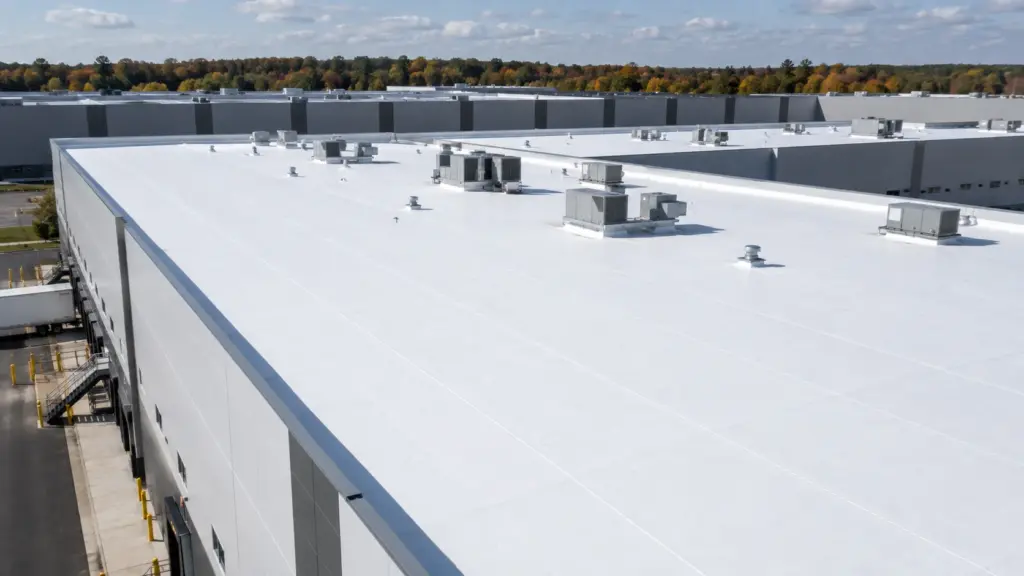
TPO Roofing Installation: Step-by-Step Process
Inspect and prepare the roof deck
Before the construction, it is necessary to clean the deck, remove all debris, check whether the wooden deck is softened or rotten, and repair the damaged parts to ensure that the roof is dry and the structure is stable. The damp or damaged substrate will trap moisture under the waterproof layer, causing the insulation layer to deteriorate from below. At the same time, it is necessary to examine the use of the building and the foot traffic on the roof, which helps to determine the appropriate installation method for the building.
Install the insulation layer, cover board or decking
Most TPO systems include a structural deck, insulation layers and cover board, the type and thickness of which are defined by the roof design. The insulation improves energy performance, while the cover board provides a strong, uniform surface for the membrane. Each layer must be installed as specified: the deck, insulation and cover board should be fastened or adhered according to the design, and boards should be laid with staggered joints to improve the strength and stability of the system. Any vapor barrier or retarder required by design must also be installed and sealed before the membrane is applied. Cracks, loose boards, gaps and improper fastening will compromise the final performance of the roof.
Lay the TPO membrane
After the preparation work is completed, unroll the TPO membrane material and allow it to rest after unrolling. If it is directly unrolled on the hot roof without resting, it will cause uneven material shrinkage, wrinkles and other problems, and water leakage may occur in the future. Mechanical fastening uses screws and washers, driven through the waterproofing membrane and insulation layer into the roof deck at specified intervals. When using a fully bonded installation method, follow the requirements of the selected adhesive system, including application temperature, wet or dry bonding conditions, open time, application method, and pressure roller pressure. Note that the application methods for contact adhesives, liner adhesives, and self-adhesive systems differ; adhesive application may be single-sided or double-sided.
Welding seams
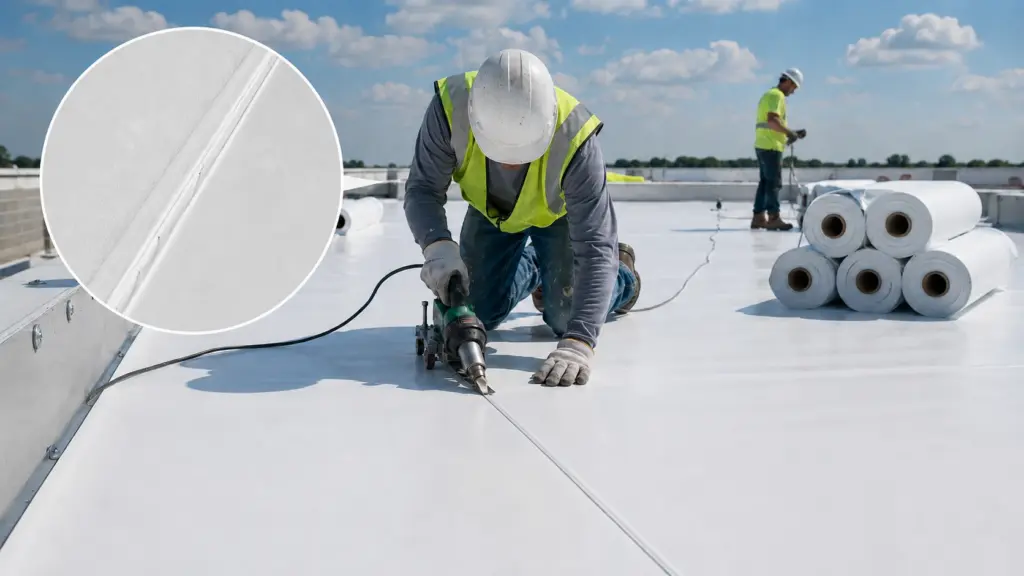
TPO seams are joined by hot-air welding, which fuses the membrane layers into a high-strength seam and gives the system excellent wind resistance. The automatic welding machine keeps the temperature and welding speed consistent along long runs, while manual welders handle corners and details. Before welding, perform a trial weld; after it has cooled, peel apart to verify the welding parameters. After full-scale welding, each seam is probed along its entire length once it has cooled. Repair any defects promptly to prevent them from developing into leaks.
Carefully address roof penetrations
Pipes, drains, HVAC equipment bases, walls and skylights are all potential water-leakage points, so each penetration must be detailed with the appropriate flashing, such as flashing membranes, prefabricated boots and metal details. Every penetration should follow an approved detail drawing, and the installer and the inspector are responsible for verifying that the flashing is installed and sealed correctly. Careful detailing protects these vulnerable areas and helps extend the service life of the roof system.
Conduct a thorough final inspection
After the installation is completed, it is necessary to carefully inspect the seams, edges, gutters, waterproof layers, fasteners and surface conditions, and repair the openings, fishmouth defects, wrinkles and damaged areas in time. Small problems may cause high losses in the future.
Common TPO Roofing Installation Mistakes
Details are very important during installation. Even if high-quality roofing membranes are selected, it is easy to leave safety hazards if the welding, fastening, or substrate preparation are neglected. Mastering common installation misunderstandings and how to avoid them is the key to ensuring that the roof meets the expected life.
Neglecting Substrate Preparation and Moisture Content Testing: Laying directly on a damp, contaminated or damaged substrate layer will close the internal moisture, causing bulging, aging of the insulation board and even delamination. The correct way is to test the moisture content of the substrate layer before covering, and remove dust and oil to ensure that the roof is flat and dry.
Failure to Conduct Pre-Installation Test Welds and Parameter Calibration: Relying on experience and skipping test welding is easy to lead to excessive or insufficient welding due to environmental changes. Before starting work, the parameters must be adjusted according to the environment and test welding must be carried out.
Insufficient Lap Width and Narrow Welds: Attempts to save time or material by narrowing the weld width will leave the seams unable to withstand long-term thermal cycling stresses. The lap width must be sufficient to provide the required effective weld width.
Sloppy Handling Of Edge Flashings And Detail Joints: Joints such as penetration details, terminations, and parapet walls are high-risk areas for leaks. The flashing process must be taken seriously; prefabricated flashing components should be used, and experienced, specialized workers should be assigned to the task.
Lack Of Probe Inspection And Protection: It is difficult to detect minor weld defects with the naked eye alone, and allowing people to walk on the welds or stacking materials on them before they have fully cooled can cause deformation. It is necessary to use probes for testing before completion, and do a good job of regional restricted protection in the early stage of welding.

Get Factory-Direct TPO Roofing Membranes from Tseason
Tseason is committed to providing stable and reliable TPO roofing membrane solutions for commercial and industrial construction projects. Leveraging our in-house production capabilities, we are able to ensure consistent product quality while offering flexible specification options and a steady supply, meeting the diverse needs of various projects in terms of membrane thickness, reinforcement methods, and width. In addition to product supply, Tseason offers product selection guidance and technical support tailored to your specific roof structure, construction methods, and project requirements, helping you efficiently identify the most suitable TPO solution.
If you are selecting TPO waterproofing membranes for a specific project, please contact Tseason to obtain product specifications, customized solutions, and project support.
FAQs
- How does ambient temperature affect TPO hot-air welding on-site, and how should workers respond?
Ambient temperature directly affects the thermal transfer needed for proper fusion, and conditions on a roof can change over the course of a day. Rather than applying fixed "raise the heat" or "lower the heat" rules whenever the weather changes, workers should treat such changes as a signal to re-verify the welding parameters. A trial weld is made and, after cooling, peeled apart to confirm that the temperature and drive speed produce a sound weld. Whenever the environment or the equipment changes noticeably, the trial weld should be repeated and the settings re-confirmed before production welding continues.
- Which areas of a TPO roof require the most attention during detailing?
Roof penetrations and termination details generally require particularly careful workmanship because they interrupt the continuous membrane layer. Pipes, HVAC equipment bases, skylights, walls, parapets, and edge terminations should receive dedicated detailing rather than being treated as extensions of the field membrane. Properly designed and installed flashing and prefabricated components can help reduce leakage risks at these transitions.
- How are TPO seams tested for quality assurance right after hot-air welding?
After the weld has cooled completely, inspectors use a blunt-tip split-pin extractor or a weld probe to inspect the entire length of each lap joint. Repairs following the discovery of voids depend on the nature of the defect and the condition of the membrane material. Clean, intact voids can be re-welded using a handheld heat gun and a silicone pressure roller, while contaminated, aged, or deteriorated areas may require patching. Regardless of the method used, the repair must follow the repair details approved by the membrane manufacturer, and the repaired area must be re-inspected before construction continues.
- What causes "fishmouths" along TPO seam laps, and how are they corrected?
"Fishmouths" are gap-like wrinkles that occur when the top and bottom sheets are not aligned or tensioned evenly during the welding process. They create a direct path for water intrusion. To repair a fishmouth, the raised wrinkle must be cut open, laid flat, clean-welded, and then fully covered with a target patch of reinforced TPO.
- What is the recommended maintenance routine to preserve a newly installed TPO roof?
A semi-annual inspection is recommended, typically in spring and autumn. Maintenance teams should clear debris from drains and scuppers, inspect perimeter flashings, check sealant integrity at termination bars, and look for physical puncture damage caused by HVAC technicians or storms. Periodic low-pressure washing can also keep the white surface reflective, maintaining high energy efficiency.