TPO Roofing Lifespan: How Long Does TPO Roofing Last?
In recent years, TPO waterproof membrane has been popular for its durability and economy. With the increasing importance of energy efficiency and sustainability, TPO roofing has become a very attractive choice for many owners. If you are considering choosing TPO roofing material for your house, it is essential to understand its lifespan and what factors will shorten its life.
TPO waterproof membrane is an ideal choice for commercial roofs, but even the best materials need some maintenance to maintain their stability. This guide will help you disassemble how long your TPO roof can be used, how to maintain its lifespan, and when you need to start paying attention to its maintenance. After understanding these factors, you can make wise decisions to protect your investment and maintain the integrity of the roof of the building.
Quick Answer: How Long Does TPO Roof Last?
The typical service life of TPO roof is 20–30 years. The service life is an interval rather than a fixed number. Installation quality, climate environment and daily maintenance will affect its final service life.
Standard manufacturer's warranty: 20 years
Recommended routine maintenance: Complete the first inspection within 6 months after installation, and then regularly check twice a year.
Most common reasons for shortening life: Poor seam welding and standing water on the roof
Factors That Affect TPO Roof Lifespan
Membrane Thickness
The thickness of TPO membranes will directly affect its anti-aging performance and durability. 45 mil is an economical roof suitable for light use; 60mil is a standard commercial-grade specification, which is extremely cost-effective. If 80-90mil TPO membranes are selected, its puncture resistance and hail resistance will be significantly improved, and the lifespan may be extended accordingly. In a word, for buildings with large flow of people, hail-prone areas or buildings with more roofing equipment, it is recommended to prioritize thicker membrane specifications to ensure long-lasting protection.
Installation Quality and Welding Quality
Poor welding quality will cause the TPO roof to leak in advance, thus affecting the lifespan of TPO. TPO membranes rely on hot air to weld joints. The temperature, pressure and lap width of welding all determine the integrity of the seam. Improperly welding seams may soon fail and crack, and the strength of properly welding can effectively extend the service life of TPO. It is very important to choose a professional construction team during installation.
UV Exposure and Climate Zones
Although the white TPO membranes has excellent UV reflection, decades of strong UV exposure will still cause small cracks on the surface. In areas with high UV rays and high temperatures, it is recommended to choose membranes of more than 60 mil and equip them with a UV-resistant surface layer to slow down the aging of materials. In cold areas, although TPO can maintain good flexibility at low temperatures, frequent freeze-thaw cycles will exert great physical stress on the seams. Therefore, when constructing in a cold climate, the sealing of the details is very important.
Water Accumulation and Drainage Design
TPO waterproof membranes themselves have good water resistance, but long-term water accumulation on the roof will not only accelerate the growth of algae and moss, but also damage the seams of the membranes. Therefore, a well-designed drainage design is indispensable. Reasonable roof design should include the correct drainage slope. At the same time, the drain should be cleaned regularly, the drainage should be kept smooth, and water should be avoided, so as to extend the overall life of the roof.
Maintenance and Inspection Frequency
Regular maintenance habits are conducive to prolonging the life of the roof. Regular inspection and maintenance can find problems with the roof in time, such as small cracks or water cracks. On the contrary, if it is not handled in time, it may develop into a serious leakage point within a few months. Regular professional inspection can exchange extremely low maintenance costs for decades of safe and stable operation of the roof.
Exposure to Chemicals and Contaminants
Although TPO roofing membranes have excellent chemical stability, grease, organic solvents and acidic industrial emissions will have a corrosive effect on TPO materials. Therefore, roofs are very prone to high-risk corrosion near kitchen smoke outlets or chemical plant areas. For these special areas, it is recommended to install washable walkway panels during installation to provide physical separation. If a chemical or grease spill accidentally occurs on the roof, it should be cleaned up in time to avoid the continuous penetration of chemicals and damage to the membrane.
Unsure which membrane grade and fastening system is best suited for your local climate and roof loads? Feel free to contact Tseason for professional specification recommendations and a customized quote!
How to Extend the Lifespan of a TPO Roof
You don't need to make complicated strategies, you just need to persevere and get the right support. If you want your TPO roof to be used normally after the end of the warranty period to avoid unexpected failure, we recommend that you take the following measures.
Strictly Follow the Maintenance Schedule
Make a plan and strictly implement it. Carry out comprehensive inspections in spring and autumn every year. Once problems are found, they will be repaired immediately. At the same time, it is necessary to remove fallen leaves and debris in time to ensure smooth drainage and avoid water stagnation on the roof. In addition, after each extreme hail or stormy weather, an additional quick inspection should be added to detect and eliminate potential problems in time. You can also establish a roof maintenance log to record the details of each inspection and repair. The perfect history not only helps to track repeated problems, but also provides proof when applying for the manufacturer's warranty claim in the future.
Work with Licensed Roofing Professionals
The quality of installation is very important. Only by obtaining an experienced professional team can we ensure the correct welding of the welds, find problems invisible to the naked eye, and use appropriate materials for each patch or seal. Good quality installation can not only lay a good foundation for the life of TPO, but also reduce the probability of daily problems.
Plan Ahead from the Start
If you are considering installing a TPO roof, it is recommended to plan in advance. The key to prolonging life begins with the initial selection. It is recommended to choose a minimum of 60 mil standard for industrial roofs; for roofs with heavy foot traffic, frequent maintenance or hail areas, it is recommended to choose 80-90 mil reinforced membranes. In order to prevent physical damage caused by daily trampling, walkway panels should be laid on the routes frequented by people, and the slope of the roof should be designed to improve drainage.
Warning Signs Your Roof is Nearing the End
If many seam openings are found in routine inspection, the surface of the membrane is cracked and bent, there is obvious blistering and delamination between the membrane and the insulation layer, or repeated leakage in the same position within a year, it means that the roof is close to the limit.
Repair vs. Replace
Local Repairs or Seam Rewelding: There are only isolated cracks and local leaks, but the membrane remaining intact overall. Only local water failure or seam failure, the roof has been used for less than 20 years and the insulation layer is dry.
Complete Removal and Replacement: There is a large area of cracking or embrittlement, and the roof has been used for more than 20 years. Long-term water accumulation causes the insulation layer to be excessively damp or damaged. Large-area seam failure, structural aging, etc.
TPO vs PVC vs EPDM: Lifespan Comparison
| Membrane | Typical Lifespan | Key Weak Point | Best Fit |
| TPO | 20–30 yrs | Surface chalking in extreme UV | Cost-efficient commercial & industrial |
| EPDM | 20–30 yrs | Adhesive/tape seams weaker than welds; black surface traps heat | Large industrial roofs, ballasted systems |
| PVC | 25–35 yrs | Plasticizer migration in some formulations | Chemical-exposure environments |
Why Tseason for Your TPO Roofing Project
Choosing Tseason as your TPO roofing supplier means that you have chosen a comprehensive and reliable guarantee from product quality to project cost. We provide TPO membranes covering a full range of thicknesses, and self-adhesive types are available. With many years of export manufacturing experience, we have reliable quality control and supply reliability. We not only support manufacturers' direct supply to avoid intermediate dealers' price increases and significantly reduce comprehensive costs, but also open up OEM branding cooperation for dealers and roofing contractors, and provide flexible customized services.
Contact us today to request a direct factory quote or order samples! We’ll conduct a comprehensive roof assessment and provide the roofing solution that best suits your needs.
FAQs
- Does a thicker TPO membrane last longer than a thinner membrane?
Generally, thicker TPO membranes provide greater resistance to punctures, hail, and mechanical damage, which can help extend the roof's service life in demanding applications. A 45-mil membrane may be suitable for light-duty roofing, while 60-mil is commonly used for commercial applications. For roofs with heavy foot traffic, frequent maintenance, rooftop equipment, or significant hail exposure, 80–90 mil reinforced TPO membranes offer greater physical protection.
- How does poor seam welding shorten the lifespan of a TPO roof?
TPO roofing systems rely on hot-air welding to create watertight seams, making welding quality one of the most important factors affecting long-term performance. Welding temperature, pressure, and overlap width must be properly controlled. Poorly welded seams can crack, peel, or allow water penetration prematurely, even when the membrane itself remains in good condition. Professional installation and appropriate quality control are therefore essential for maximizing TPO roof lifespan.
- How does TPO compare directly against EPDM and PVC in commercial applications?
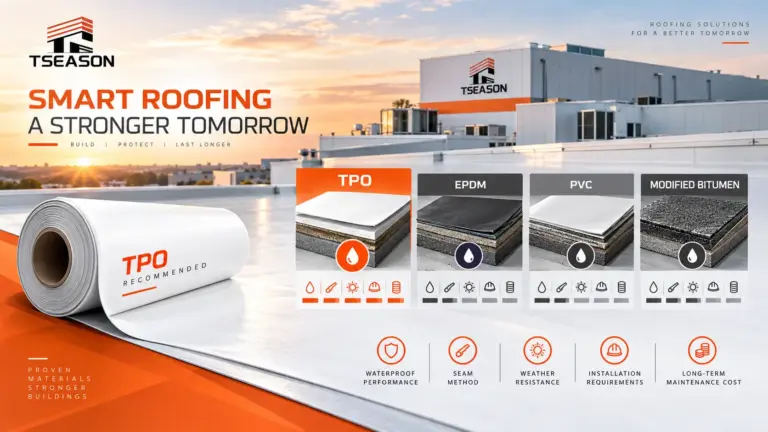
TPO combines the heat-welded seam strength of PVC with the atmospheric durability of EPDM. Unlike EPDM, TPO features heat-welded seams and a high-reflectivity surface that cuts cooling costs. Unlike PVC, TPO contains no plasticizers, meaning it will not suffer from plasticizer migration that leads to embrittlement.
- How often should a TPO roof be inspected and maintained?
The article recommends completing the first inspection within six months after installation, followed by two inspections per year. A practical maintenance program should include comprehensive inspections in spring and fall, removal of leaves and debris, and prompt repair of minor tears, flashing gaps, or seam defects. Additional inspections are advisable after severe hail, high winds, or heavy rain because these events can cause damage that is not immediately visible.
- What are the clearest signs that a TPO roof is approaching the end of its service life?
Several recurring conditions can indicate that a TPO roofing system is nearing the end of its useful life. These include multiple seams peeling apart, a membrane surface that has become cracked or brittle, blistering or delamination between the membrane and insulation, and repeated leaks occurring in the same areas within a relatively short period. When several of these conditions appear together, continued spot repairs may become less cost-effective than planning for roof replacement.