TPO Roofing Cost Guide: How Much Does TPO Cost per Square Foot in 2026?
For businesses or property owners considering the purchase of roofing materials, choosing the right roofing material will not only significantly affect the durability and aesthetics of the building, but will also affect your financial planning and long-term maintenance costs. Before purchasing, understanding the relevant costs and precautions of TPO roofing can help you make decisions more confidently.
This guide will disassemble the true composition of TPO roofing cost, discuss the factors affecting the cost of TPO roofing, and evaluate whether TPO is worth the money for you. After reading this article, you will be able to distinguish whether a quotation is really competitive and formulate a reliable TPO roofing plan for the whole life cycle of the building.
TPO Roofing Price at a Glance: Quick-Answer Summary
TPO materials typically cost is usually about $1.5 to $3.5 per square foot, depending on the thickness and manufacturer. With labor, the price of TPO may be between $5 and $15 per square foot. It depends on the complexity and geographical location of the project.
This price is only for planning reference and informal quotation; contact Tseason to obtain a quote directly from the manufacturer.
What is TPO Roofing
TPO waterproof membrane is a polymer blend that combines the elasticity of rubber, UV resistance and the advantages of hot-air welding. In practical application, after large-scale TPO membrane are transported to the construction site, they are stitched into a continuous seamless overall waterproof layer by hot air welding. In terms of installation method, TPO roofing are highly flexible, and different construction processes can be selected according to construction needs. With excellent waterproof performance and durability, TPO roofing are widely used in all kinds of low-slope commercial and industrial buildings, including large warehouses, supermarkets, clean rooms and pharmaceutical plants, and have become an ideal choice for modern industrial and commercial roofing construction.
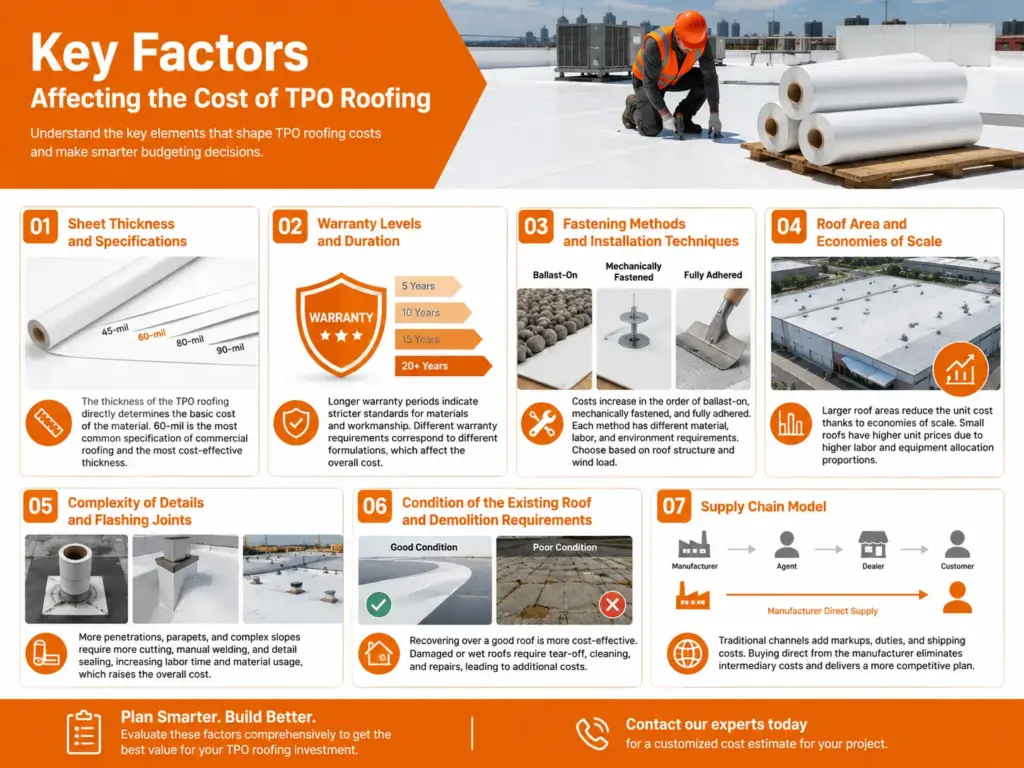
Key Factors Affecting the Cost of TPO Roofing
Sheet Thickness and Specifications
The thickness of the TPO roofing directly determines the basic cost of the material. Usually, the higher the thickness, the higher the corresponding price. 60-mil is the most common specification of commercial roofing at present, and it is the most cost-effective thickness specification.
Warranty Levels and Duration
Warranty levels are typically categorized into different tiers; a longer warranty period indicates stricter standards for materials and workmanship. Different warranty requirements correspond to different formulations, which in turn affect the overall cost.
Fastening Methods and Installation Techniques
Installation methods for TPO systems are primarily categorized as ballast-on, mechanically fastened, and fully adhered, with costs increasing in that order. The ballast-on method is the most economical; the mechanically fastened method uses screws and washers, and the cost of fixed parts is relatively high but the construction is fast; and the fully adhered method requires a large number of special adhesives, which has high requirements for the construction environment and longer labor hours, and the total cost is the highest. The choice of fastening method depends on the roof structure and wind load requirements.
Roof Area and Economies of Scale
The total roof area has a great impact on the unit cost. The larger the area, the more obvious the scale effect of the project, and large-scale orders of rolls can also enjoy a lower purchase unit price. On the contrary, for small-area residential flat roofs or small commercial roofs, the comprehensive unit price per square foot tends to be higher due to the high proportion of basic labor and equipment allocation costs.
Complexity of Details and Flashing Joints
The shape of the roof and the number of pipe penetrations will affect the construction efficiency. The simple rectangular roof is the most labor-saving and material-saving. If the roof contains a large number of parapets, pipe penetrations or complex slopes, the construction personnel need to carry out a large number of cutting, manual welding and special water node sealing, which will consume a lot of labor and additional materials, and the cost will be higher.
Condition of the Existing Roof and Demolition Requirements
For renovation projects, how the existing roof is handled is critical. If the original roof structure is good, the cost of directly covering and laying TPO materials is the lowest; however, if the old roof is seriously damp or damaged, it will need to be dismantled, cleaned and repaired, which will lead to additional costs.
Supply Chain Model
The procurement channel is crucial. Through traditional agents and dealers, price-added purchases, including import duties and intermediate shipping costs, will lead to an overall premium. Purchasing from the manufacturer can eliminate the price difference of the intermediary and obtain a competitive cost plan.
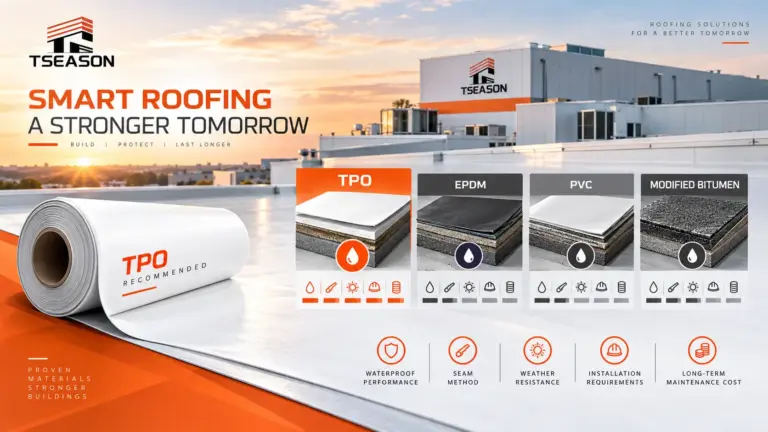
TPO vs EPDM vs PVC: Price Comparison
| Criteria | TPO | PVC | EPDM |
| Typical installed cost | Medium | Higher | Lower |
| Expected lifespan | 20-30 yrs | 20-30 yrs | 20-30 yrs |
| Seam method | Heat-weld | Heat-weld | Adhesive / tape |
| Solar Reflectivity | High | High | Low |
| Chemical resistance | Medium | High | Medium |
| Maintenance | Low | Low | Medium |
Is TPO Roof Worth the Investment?
When evaluating the roof waterproofing scheme, in addition to paying attention to the initial installation cost, the whole life cycle performance, energy consumption impact and follow-up maintenance requirements of the roof system are also key factors that determine its comprehensive cost-effectiveness.
- Energy Efficiency and Cooling Performance
White TPO membranes have a high solar reflectance, which can reduce the heat absorbed by the roof in summer and reduce the refrigeration load of buildings. For industrial and commercial buildings located in hot areas, it can effectively reduce the energy consumption of air conditioning.
- Design Life and Warranty
According to different membrane thicknesses and construction standards, the design service life of TPO roof is usually between 20 and 30 years. Mainstream manufacturers in the market generally provide 10-year, 20-year or 30-year quality assurance, providing a predictable period of coverage.
- Maintenance and Care Requirements
The strength of the TPO roofing membrane weld is high, and the integrity of the seam is better, which reduces the potential water leakage risk. Only regular inspection and cleaning are usually needed in the application, and the workload is relatively low.
- Environmental Sustainability and Recyclability
TPO generates relatively low emissions of VOC during production and installation. In addition, TPO roofing membrane do not contain chlorine elements and can be recycled in the future, which is in line with the current sustainable development trend of building materials.
Overall, if you have a commercial or flat roof and want to ensure the long-term durability of the building structure while balancing low maintenance costs and high energy efficiency, then TPO is a highly cost-effective choice.
Get a Factory-Direct TPO Roofing Quote from Tseason
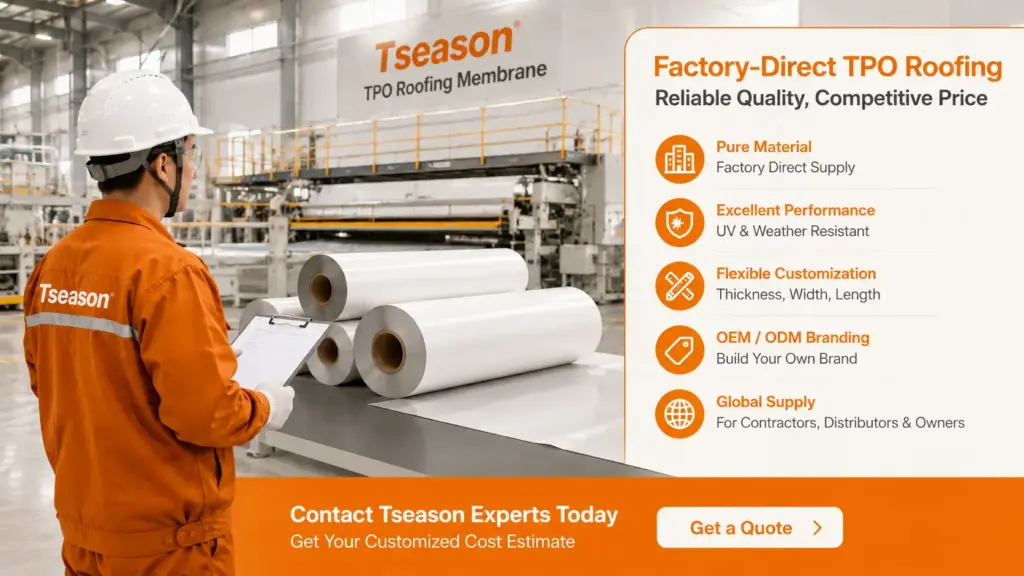
Tseason's TPO waterproof membranes provide pure material factory direct procurement and export supply for global construction contractors, distributors and owners. With a mature manufacturing system and strict quality control, Tseason's TPO membranes have excellent UV resistance and weather resistance. Tseason provides factory-direct supply prices, which is a highly cost-effective choice while ensuring quality and preferential prices. We support flexible customization services, including thickness, width and length. At the same time, we provide OEM/ODM branding services to help you create your own brand.
The roof of each building is different, and the actual cost needs to be determined according to the specific situation. If you are considering choosing a TPO roof for your building, contact Tseason's experts today to consult and get a customized cost estimate for your property.
FAQs
- What is the approximate total budget for a TPO roofing system in 2026?
The material cost of TPO roofing membranes typically ranges from $1.50 to $3.50 per square foot. When labor and installation costs are included, the total installation cost is approximately $5 to $15 per square foot. Actual prices are influenced by project complexity, geographic location, and economies of scale based on the total roof area. Contact Tseason for an accurate quote for your project.
- What is the expected service life and warranty period for TPO roofing systems?
Depending on the membrane thickness, formulation, and proper installation, the design service life of a TPO roof typically ranges from 20 to 30 years. Tseason offers warranty periods of 10, 20, or 30 years, depending on your needs, providing predictable, long-term protection.
- What factors have the greatest impact on the installed cost of a TPO roofing system?
The installed cost of a TPO roofing system is influenced by several factors rather than membrane price alone. Membrane thickness, warranty requirements, installation method, total roof area, roof geometry, flashing and penetration details, existing roof conditions, labor rates, and project location can all affect the final price. Larger and relatively simple roofs generally achieve a lower cost per square foot, while projects with numerous penetrations, parapets, complex slopes, or extensive detailing typically require more labor and materials.
- How does TPO membrane thickness affect the overall roofing cost?
Membrane thickness has a direct impact on the material cost of a TPO roofing system. Thicker membranes generally provide greater material volume and can meet more demanding durability or warranty requirements, but they also increase the initial purchase price. A 60-mil membrane is commonly used in commercial roofing and is often considered a cost-effective balance between material cost and system performance. The appropriate thickness should ultimately be selected according to project requirements rather than simply choosing the lowest-priced option.
- Why can two TPO roofing projects with the same roof area have very different costs?
Roof area alone does not determine the final cost. Two roofs with the same square footage can require substantially different amounts of labor and accessories if their designs differ. A large rectangular roof with relatively few penetrations is generally more efficient to install, whereas a roof with numerous pipes, parapets, equipment curbs, changes in elevation, or complex flashing details requires additional cutting, welding, sealing, and detailing. These factors can significantly increase the installed cost per square foot.