TPO Membrane Thickness: How to Choose Between 45, 60, and 80 Mil
TPO membrane roof has become a popular roofing material because of its durability, energy saving and economy. However, when choosing TPO membrane roof, different thickness specifications often make it difficult for buyers to make an informed decision. The thickness of TPO will directly affect puncture resistance, warranty coverage, long-term durability and installation cost.
This article will explain the thickness unit of TPO membrane roof, compare common specifications, and analyze the relationship between thickness and durability, cost and warranty requirements to help you determine a reasonable thickness scheme for specific projects.
What Does TPO Membrane Thickness Mean
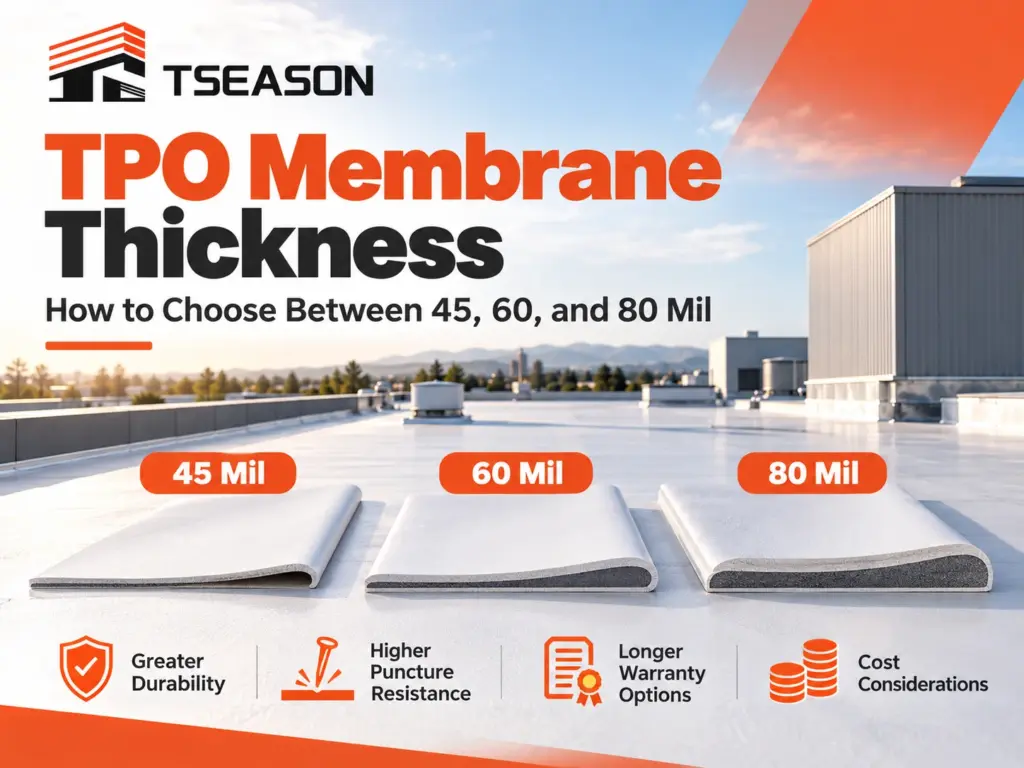
TPO roof membranes are available in a variety of thicknesses, usually ranging from 45 mil to 80 mil (1.1 mm to 2.0 mm). The thickness will significantly affect the durability, energy efficiency, puncture resistance, ultraviolet resistance and weather resistance of the roof. Thicker membranes can provide stronger protection and longer service life, but the cost is also higher.
Understanding Mil and Millimeter Measurements
A mil is a unit of length in the imperial system; 1 mil equals 0.001 inch, or 0.0254 millimeters. The conversions for common TPO sheet specifications are as follows:
| Thickness Specifications | Inches | Millimeters |
| 45mil | 0.045 | 1.14 mm |
| 60mil | 0.060 | 1.52 mm |
| 80mil | 0.080 | 2.03 mm |
When comparing products labeled with different units, you can perform the necessary conversions. Purchasing decisions should be based on the specific product’s nominal values.
Overall Thickness vs. Thickness Over Scrim
For internally reinforced TPO membranes, it is necessary to distinguish Between "Overall Thickness" and "Thickness Over Scrim". TPO film is not completely composed of solid polymers. They contain a reinforcing layer in the middle, which gives the film dimensional stability, tear resistance and puncture resistance. The polymer layer is laminated on both sides of the reinforcing layer. Therefore, "60 mil" refers to Overall Thickness, but the layer that actually weathers, resists UV, and takes abuse is the polymer above the scrim: the thickness over scrim (TOS).
The material above the reinforcement layer is directly exposed to sunlight, high temperature and environmental conditions, and its thickness is an important indicator for evaluating the long-term weather resistance performance of roofing membranes. Two membranes with the same overall thickness may have different thickness-over-scrim due to the different position of the reinforcement layer and the distribution of upper and lower materials. And the membrane with a thicker surface layer also has a longer service life than the membrane with a thinner surface layer. When comparing the quotations of different TPO roofing manufacturers, be sure to ask about their thickness-over-scrim spec.
45 vs. 60 vs. 80 Mil TPO: What Are the Differences?
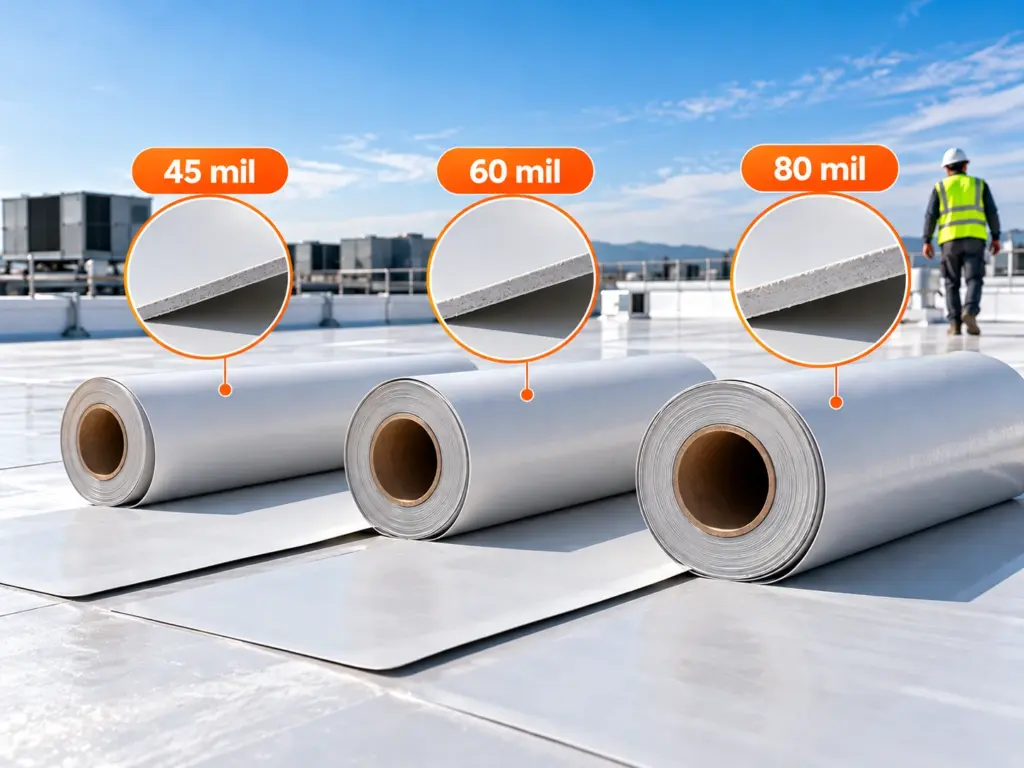
| Specification | 45mil | 60mil | 80mil |
| Actual Thickness | 0.045 in (1.14 mm) | 0.060 in (1.52 mm) | 0.080 in (2.03 mm) |
| Puncture resistance | Baseline, adequate for low-traffic roofs | Strong, handles occasional service traffic | Highest, best for hail, tools, heavy traffic |
| Weatherability | Shortest weathering reserve | Solid long-term UV margin | Longest weathering reserve |
| Typical warranty tier | Shorter-term warranty | Mid to long-term warranty | Longest available warranty tier |
| Foot-traffic tolerance | Light, walkway pads recommended | Moderate, good for periodic maintenance | High, routine service and equipment traffic |
| Best-fit use case | Simple roofs, budget re-cover, short hold | Bay Area default for most buildings | Equipment-heavy, hail-prone, long hold |
45mil TPO: The Budget Specification
The main advantage of 45 mil TPO is the low procurement cost. However, its scope of application is relatively narrow. For projects with less roofing equipment and limited daily maintenance, buildings with short-term warranty and short-term residence, it can be used as an option.
The main limitation of the 45 mil thick TPO roofing membranes is the low puncture resistance. If the roof needs to be repaired frequently, or there are still other types of roof operations after construction, you should pay more attention to the risk of puncture and impact when choosing.
60mil TPO: The Industry Standard
60mil TPO membrane is the most commonly used membrane thickness in commercial roofing. Its performance strikes the right balance: it is thick enough to provide substantial puncture resistance and withstand standard commercial foot traffic, yet thin enough to keep costs down. And it meets the basic requirements for the 20- and 25-year NDL warranties offered by most manufacturers.
80mil TPO: The Premium Specification
80 mil TPO is suitable for projects with a higher level of protection as the focus of procurement. It has stronger anti-puncture and anti-impact ability. For buildings that are planned to be held for a long time, roofs with high foot traffic or frequent equipment maintenance, 80 mil thick TPO membrane can be considered, which can reduce wear and avoid the risk of damage. However, its cost is relatively high, and it needs to be chosen according to specific construction conditions and needs. 80 mil also has the conditions to apply for a long-term warranty.
Cost Difference Analysis
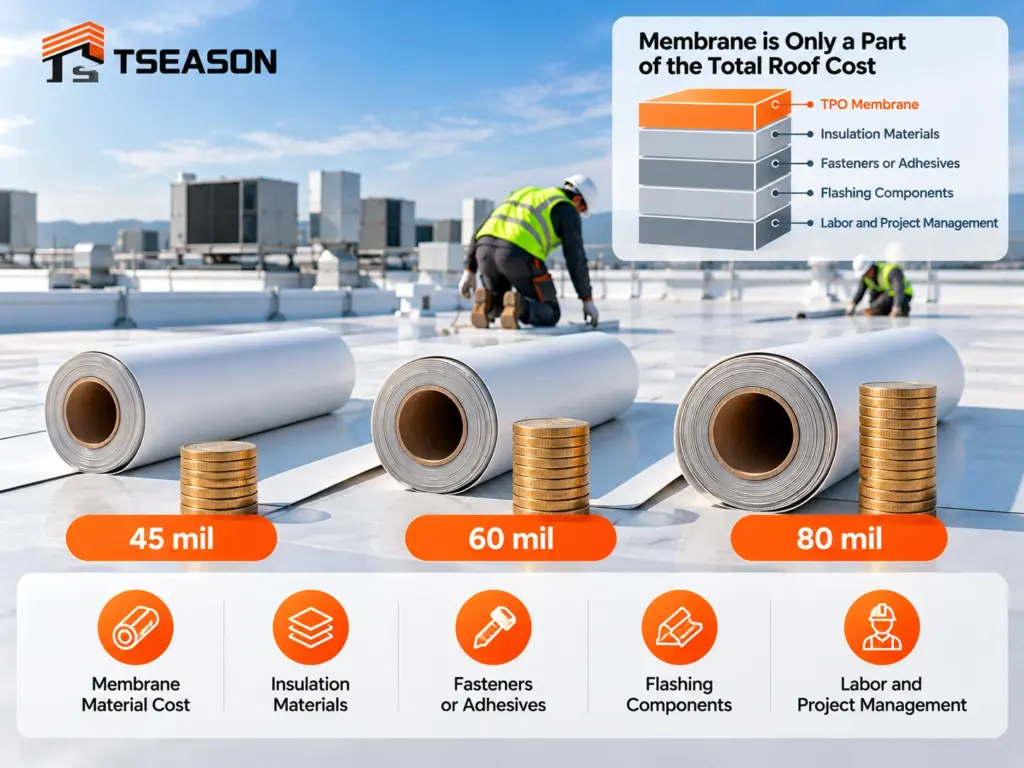
The difference in installation cost between waterproofing membranes of different thicknesses is usually smaller than expected. This is because the membrane itself only accounts for a part of the total cost of the roof. Under the condition that the roof construction and fastening methods are the same, the cost of insulation materials, fasteners or adhesives, flashing components, labor and project management usually does not change significantly due to the increase in the thickness of the film, and the price difference mainly comes from the membrane itself.
To determine whether the upgrade is cost-effective, you can spread the additional investment over the expected extended service life. For example, upgrading from 45 mil to 60 mil will increase the initial purchase cost, but if the service life of the roof can be extended, the actual cost difference every year may not be large. Considering that the early replacement of the roof involves costs such as demolition, reconstruction and disruption building use, the choice of thicker membrane is often more economical in the long term.
The same comparison method can be used to upgrade from 60 mil to 80 mil, but for standard buildings, the benefits from additional investment may gradually decrease. For buildings with frequent maintenance, more roofing equipment experience heavy foot traffic, thicker roofing membranes can provide greater wear-resistant and puncture-resistant, reducing damage and subsequent maintenance needs. However, for buildings with low foot traffic, 60 mil can usually meet the demand, and further thickness increase may not bring a commensurate economic return.
How to Choose the Right TPO Membrane Thickness
When selecting the thickness of a TPO membrane, consider how long the building is planned to be in use, the number of rooftop equipment, and the amount of foot traffic on the roof.
Frequent equipment maintenance or personnel access calls for a thicker TPO membrane. If the roof is fitted with HVAC, refrigeration, and exhaust units, that means more maintenance and more wear and tear, consider carefully when making your decision. The intended holding period of the building also affects the choice. For long-term ownership, a thicker TPO membrane is recommended, as it offers greater weather resistance and a longer warranty.
Ask each bidder about the thickness specification of the reinforcement layer, not just the overall membrane thickness. Be sure to make a fair comparison of the layer that actually bears the brunt of wind and rain. At the same time, confirm the warranty level that corresponds to your chosen thickness. Thickness and the warranty period are related. Please make sure that the warranty coverage meets your needs.
Why Choose Tseason TPO Roofing Membranes?
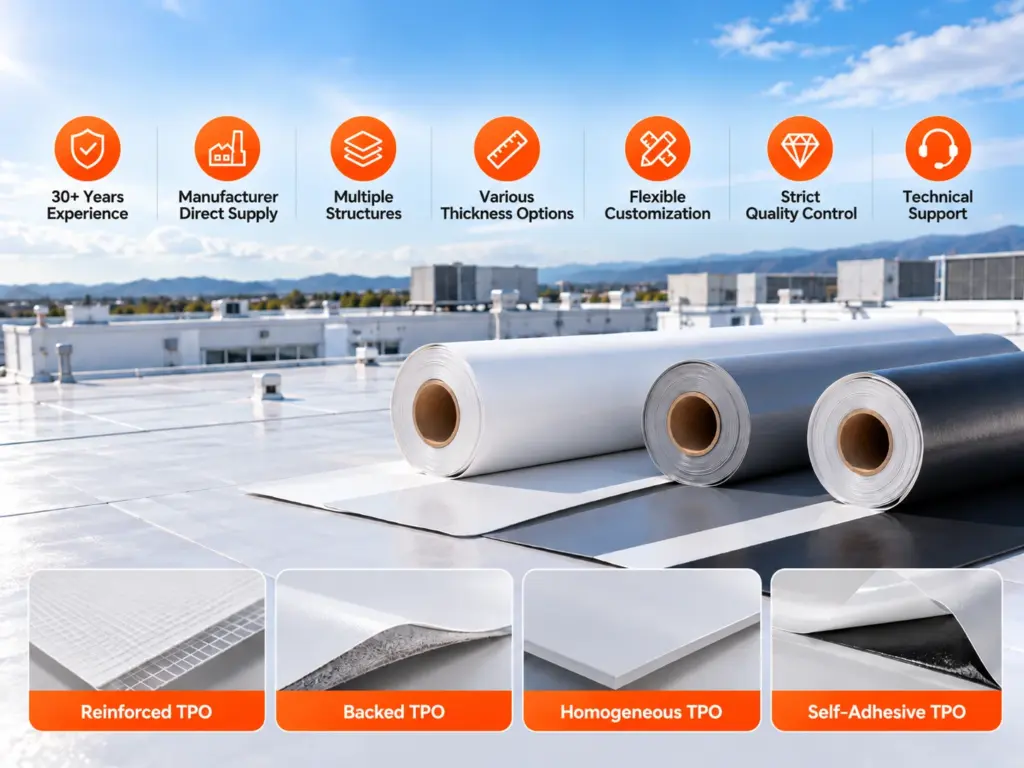
Selecting the appropriate TPO roofing thickness is critical to ensuring service life, energy efficiency, and cost-effectiveness. Tseason is a manufacturer with over 30 years of experience specializing in commercial and industrial roofing solutions. Tseason offers reinforced, backed, homogeneous, and self-adhesive TPO roofing membranes, allowing you to select the appropriate material structure based on your roof construction and installation requirements. When it comes to thickness, Tseason offers a variety of specifications and can provide flexible customization based on your needs. We maintain strict quality control and are committed to providing you with TPO membranes that deliver both performance and value.
Contact the Tseason team to receive exclusive TPO membrane samples, detailed technical specifications, and competitive quotes. Let us help you build a robust and durable roof waterproofing system.
FAQs
- Can a thicker TPO membrane replace part of the roof insulation?
No. Increasing membrane thickness does not justify reducing insulation thickness. TPO primarily provides waterproofing, while roof thermal resistance comes mainly from the insulation and its installation. Membrane and insulation thicknesses should be specified separately. The solar reflectance of white TPO also serves a different function from the thermal resistance provided by insulation.
- Why do T-joints in thicker TPO membranes require additional attention?
Overlapping membrane layers create a step at seam intersections. Inadequate welding or rolling can leave small water channels beside this step. Some manufacturers require dedicated T-joint covers for specified membrane thicknesses. Follow the selected manufacturer’s details for cover requirements, dimensions, placement, and welding procedures.
- Can an 80 mil TPO membrane eliminate the need for a cover board?
A thicker membrane does not automatically replace a cover board. Cover boards provide a stable substrate, help protect the underlying insulation, and may fulfill other assembly requirements. If the project specification or approved roof assembly requires a cover board, it must remain part of the system even when an 80 mil membrane is selected.
- What should be checked beyond TPO thickness for a rooftop solar installation?
Confirm that the membrane is suitable for potential localized heat near solar equipment. Also verify the compatibility of supports, protection pads, and attachment details with the roofing system. Some TPO products use formulations intended for high-heat and solar applications, so suitability should be assessed through product documentation and complete system design.
- Can a new patch be welded directly onto an aged TPO membrane?
Not without proper preparation. Dirt and surface weathering must be removed using manufacturer-approved methods and cleaning materials. Field test welds should confirm that the new and existing membranes can form a reliable bond. If the existing sheet is significantly embrittled, cracked, or persistently contaminated, localized patching may be insufficient.